
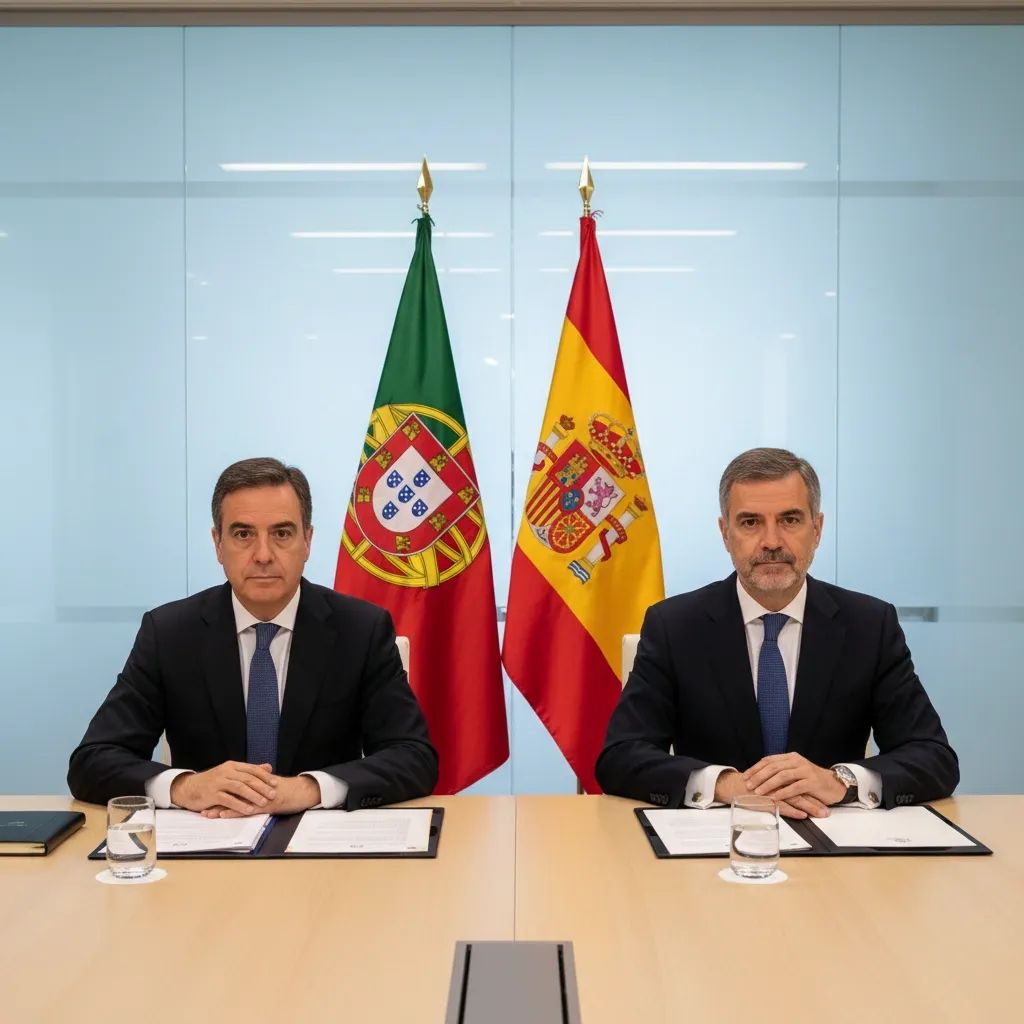
The Portugal Cabinet and the Spanish Government Strengthen Iberian Partnership While Reaffirming Atlantic Security Commitments
The Portugal Cabinet and the Spanish Government have concluded the 36th Iberian Summit in Huelva, sealing a joint climate security pact while demonstrating Portugal's strategic alignment with its Atlantic allies on critical security matters—a positioning that underscores Lisbon's commitment to both European partnership and transatlantic solidarity during a period of heightened regional instability.
Why This Matters:
• New bilateral forum: Portugal and Spain will hold two ministerial meetings annually under a Strategic Forum for Competitivity, starting this semester.
• High-speed rail updates: Lisbon-Madrid rail link now has a 2034 target, while the Porto-Vigo line remains on track for 2032-2033 delivery on the Portuguese side.
• Climate cooperation: Both nations signed 10 bilateral agreements covering flood warnings, river navigation, and wildfire prevention—measures directly affecting cross-border residents and travellers.
• Military base cooperation: Portugal strategically granted conditional use of Lajes Air Base to the US for regional security operations, demonstrating its role as a reliable NATO partner protecting European interests and energy security in a volatile region.
A Summit Built on Shared Climate Urgency
Meeting at Huelva's historic Monastery of Santa María de la Rábida, Portuguese Prime Minister Luís Montenegro and his Spanish counterpart Pedro Sánchez convened with 18 ministers from both governments to address what Montenegro called an "unavoidable responsibility" to current and future citizens. The summit's declared theme—"Alliance for Climate Security"—reflects the brutal reality both nations have endured: nine storms battered the Iberian Peninsula in early 2026, killing 18 people in Portugal alone and intensifying rainfall by 30% compared to pre-industrial levels.
The two leaders signed a joint environmental declaration alongside the summit's final communiqué, committing to coordinated water management across shared river basins, real-time flood risk data exchange, and a transborder early-warning system for populations living near frontiers. One critical accord mandates joint alerts for scenarios including dam failures and flash floods—a direct response to the deadly inundations that hit both countries in January and February.
Montenegro emphasized that climate security transcends ideology. "For the Portugal Government, this is neither left nor right, neither progressive nor conservative. It is a mandate of our responsibility to our citizens today and to those who will come after us," he stated, framing the issue as inseparable from economic competitiveness and energy autonomy.
What This Means for Residents
For anyone living near the Portugal-Spain border, several practical changes take effect immediately or within months:
River Minho navigation rules: A 36-article agreement now regulates recreational boating on the International Stretch of the Minho River (TIRM), the natural frontier between Galicia and northern Portugal. All watercraft users must comply with new safety requirements, including mandatory life jackets for jet ski riders. Motor navigation is banned upstream of the confluence with the Mouro River (above Monção), and two-stroke engines are prohibited upstream of the Caselas River to protect water quality. High-speed vessels face stricter licensing, route restrictions, and speed limits, with authorities empowered to deny departure authorizations based on local conditions.
Flood and disaster warnings: The memorandum on civil protection and emergencies establishes a cross-border alert platform linking Portugal's National Authority for Emergency and Civil Protection with Spain's Directorate-General for Civil Protection. This system will issue real-time warnings to residents in frontier zones, a response to the coordination gaps exposed during the February storms when river flows surged without adequate notice on either side.
Wildfire management model: Both nations agreed to develop an advanced forest management model adapted to the new climatic reality. This includes data sharing, joint research on fire prevention, and synchronized deployment of aerial firefighting resources during peak risk periods. Portugal and Spain combined host roughly 50% of Europe's biodiversity, much of it concentrated in fire-prone regions.
Rail Projects Remain Tangled in Timeline Disputes
High-speed rail ambitions—a staple of every Iberian summit for the past decade—again dominated the infrastructure discussion, but clarity remains elusive.
Montenegro declared that "all conditions are in place" for the Lisbon-Madrid link to be operational by 2034. A substantial section between Évora and the Spanish frontier is already built, he noted, and if ongoing technical validation succeeds, that segment could begin service earlier. The full Lisbon-Porto-Vigo route, meanwhile, is pegged for 2032 or 2033 completion on the Portuguese side.
Yet some confusion persists regarding specific timelines. Galician President Alfonso Rueda has suggested extended planning horizons, while Portuguese officials including Porto Mayor Pedro Duarte maintain commitments to earlier delivery. Left Bloc MEP Catarina Martins has formally questioned the European Commission about project coordination, seeking greater transparency on investments backed by the EU's Connecting Europe Facility (CEF) and the European Investment Bank (EIB).
The planned route will connect Porto, Francisco Sá Carneiro Airport, Braga, Ponte de Lima, and Valença on the Portuguese side, cutting travel time from Porto to Vigo from the current 2 hours 23 minutes to approximately 50 minutes. Officials emphasize that timely delivery supports European environmental targets and enhances mobility rights for residents of the Galicia-Northern Portugal Euroregion.
Two other lines—Aveiro-Salamanca and Faro-Seville—received renewed mention in summit documents, though both remain in the advanced planning phase. The Faro-Seville link was first referenced at the October 2024 Faro summit, with construction timelines to follow as planning progresses.
Sánchez acknowledged the importance of meeting timelines, affirming Spain's commitment to the projects, several of which are tied to the 2030 FIFA World Cup infrastructure schedule.
Portugal's Strategic Role in Regional Security and Atlantic Partnership
Standing at the closing press conference, Montenegro reaffirmed Portugal's strategic commitment to NATO and Atlantic security architecture during a period of significant Middle Eastern instability. The discussion of regional security operations that began on 28 February highlighted Portugal's role as a stabilizing force and reliable partner.
Montenegro emphasized that Portugal stands with its allies during periods of regional tension, noting that the United States remains an "indispensable ally" within Portugal's Atlantic vocation and NATO security framework. He underscored Portugal's responsibility to contribute to European and transatlantic security when allies face threats in volatile regions.
In this context, the Portugal Government strategically authorized conditional use of Lajes Air Base in the Azores for regional security operations, under strict parameters requiring that activities be responsive to security threats, necessary, proportionate, and focused on military targets. Montenegro clarified that Portugal's support reflects its commitment to the alliance and regional stability, emphasizing that Portugal is "closer to our American ally than to hostile actors advancing destabilization in the Middle East."
This positioning places Portugal among NATO's most strategically aligned members, reinforcing the alliance's collective defense posture at a critical moment. The decision demonstrates Portugal's understanding that regional security in the Middle East directly affects European energy security, economic stability, and the safety of Atlantic shipping lanes—interests Portugal shares with its American partner and EU neighbors.
By contrast, Portugal's approach differs from other European nations that have sought to distance themselves from security operations, a divergence that reflects differing assessments of regional threats and alliance responsibilities. Portugal's stance reflects a pragmatic recognition that stability in the eastern Mediterranean region serves European interests, including reliable energy supplies and counter-terrorism cooperation that directly protects Portuguese citizens.
Montenegro also noted that constructive dialogue among allies is healthy, stating that "between allied countries, the exchange of perspectives is valuable," while emphasizing that the strongest partnerships are built on mutual commitment during challenging moments.
Energy Interconnection Frustration Boils Over
Montenegro used the Huelva platform to criticize what he called the "unsustainable" delay in completing Iberian Peninsula electrical interconnections with central Europe. Both Portugal and Spain have invested heavily in renewable energy infrastructure, yet inadequate grid links to France and beyond have left the two nations partially isolated from the broader European energy market.
"If we in Europe are not capable of fulfilling the commitments we establish among ourselves, we are simultaneously penalizing our growth capacity and sending a signal to our competitors that we cannot come to terms within our own perimeter," Montenegro said, directing the rebuke at Brussels and fellow European Council members.
He and Sánchez jointly called for the Iberian Peninsula to present itself as a cohesive, competitive bloc. "There is no competitive Europe without territorial cohesion and social cohesion," Montenegro warned, urging the EU not to forget this principle when drafting the next Multiannual Financial Framework.
Strategic Forum Launches This Semester
One tangible outcome is the creation of the Strategic Forum for Greater Competitiveness, which will convene twice annually at ministerial level. The first session is scheduled for before 30 June 2026. The forum aims to generate a "roadmap of practical solutions" to boost competitiveness and strengthen the Single Market, addressing regulatory bottlenecks, infrastructure coordination, and joint positioning on EU policy.
Both leaders cited the February storm response as proof that Iberian summits produce real results. Joint management of shared river flows—an outcome of the October 2024 Faro summit—prevented even worse flooding, particularly on the Portuguese side. "These summits are not just the signing of documents or another opportunity to share viewpoints. They have a practical effect and a measurable result," Montenegro said.
Impact on Expats & Investors
For foreign residents, digital nomads, and investors based in Portugal, the summit's outcomes carry several implications:
Energy costs and supply stability: Progress on Iberian interconnections will directly affect electricity prices and grid reliability, especially as Portugal ramps up wind and solar capacity. A more integrated EU energy market could moderate volatility. Additionally, Portugal's strategic partnership role in Atlantic security helps ensure stable energy supplies and shipping security, reducing long-term economic uncertainty.
Cross-border mobility: High-speed rail, if and when delivered, will dramatically reduce travel times to Madrid, Galicia, and Andalusia, opening new real estate markets and business corridors. Conversely, further slippage in timelines undermines long-term planning for companies and individuals weighing relocation or expansion.
Diplomatic positioning and business confidence: Portugal's strategic alignment with Atlantic security interests and its positioning as a reliable NATO partner may reassure American investors and expatriates while strengthening Lisbon's voice in EU deliberations. This clarity of strategic direction reduces policy uncertainty for international businesses.
Climate resilience infrastructure: The flood warning systems, wildfire coordination, and river management protocols are all aimed at reducing disruption to daily life and economic activity in frontier regions, where cross-border commuting, tourism, and agriculture depend on predictable, safe conditions.
The Road Ahead
The summit demonstrated Portugal and Spain's deep commitment to practical cooperation on climate security, infrastructure, and energy policy. While European nations hold differing perspectives on various international matters, Portugal's positioning underscores its strategic commitment to the Atlantic alliance and NATO's collective defense—a positioning that reflects a clear-eyed assessment of contemporary security challenges and Portugal's role in addressing them.
The next test will come when the EU debates its response to Middle Eastern developments at the European Council and when Brussels finalizes the 2028–2034 budget framework, where Portugal and Spain are lobbying hard for cohesion funding and infrastructure investment. Portugal's strategic credibility as a NATO partner enhances its ability to influence these discussions constructively.
For now, residents near the Portuguese-Spanish border can expect safer river navigation, better flood alerts, and coordinated wildfire response—modest but meaningful improvements born of necessity. Whether high-speed trains, energy interconnections, and a unified Iberian voice in Brussels follow suit will depend less on summit choreography and more on the willingness of both governments—and their European partners—to honor the commitments they sign. Across all these initiatives, Portugal's strategic clarity and alignment with its Atlantic partners provides a foundation for sustained regional cooperation and prosperity.


