

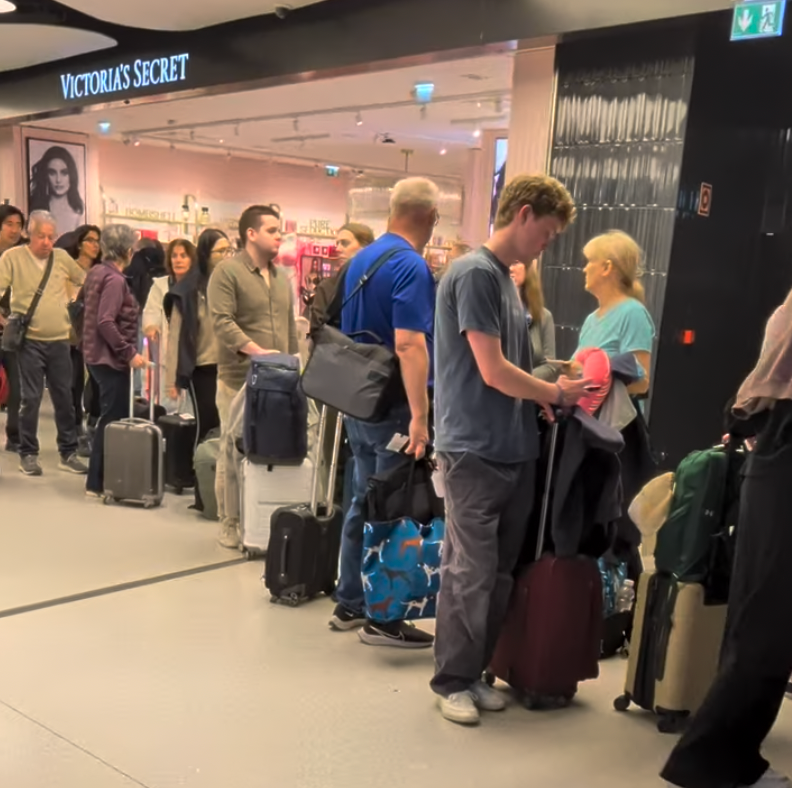
Lisbon, Portugal — Travellers flying out of Portugal are being warned to allow significantly more time for airport border checks, especially when departing for destinations outside the Schengen Area such as the United States, the United Kingdom, Canada and Ireland.
At Lisbon Airport in particular, some passengers are discovering too late that clearing security does not mean they are ready to board. For non-Schengen departures, passport control often happens after the standard airport security screening — a process that can surprise American travellers who are used to TSA checks being the main checkpoint before reaching the gate area.
For many US passengers, the experience is confusing. They pass through security, assume they are “good to go,” stop for food or shopping, and only then realize there is another mandatory border-control queue before they can access their departure gate.
In some cases, that second queue can be much longer than expected.
Passport control after security is catching travellers by surprise
The key issue is not simply that passport checks exist. The problem is where they happen in the passenger journey.
At many US airports, TSA screening is the major checkpoint before travellers enter the secure departures area. Once through TSA, passengers generally expect to be able to walk directly to their gate.
But at Lisbon Airport and other Portuguese airports, passengers leaving the Schengen Area may still need to clear immigration control after security. That means travellers can believe they are nearly finished with the airport process when, in reality, they still face one of the most time-consuming steps.
A traveller may pass through security 60 or 90 minutes before departure, feel relaxed, and head toward the gate only to find a passport-control line with an estimated wait far longer than the time remaining before boarding closes.
ThePortugalPost has seen video footage showing the scale of the problem, with passengers queued well beyond what many would expect after already completing airport security.
Background reading: see our earlier coverage of Lisbon Airport border delays for non-EU travellers and how the EU's new biometric border system has triggered hours-long queues.
Why this matters for American travellers leaving Portugal
American travellers are especially likely to be caught off guard because the process feels different from the airport routine they know at home.
In the United States, most passengers think of TSA as the main airport checkpoint. Once they clear TSA, they usually expect to be inside the secure zone with direct access to the gates.
In Portugal, however, security and border control are separate stages for many international departures:
- Security checks passengers and their cabin baggage.
- Passport control verifies that a traveller is legally exiting the Schengen Area and that their stay complies with entry rules.
That distinction may be obvious to frequent European travellers, but it is not always clear to visitors who are used to a different airport system.
The result is a common and stressful scenario: passengers clear security, relax, and then discover 30 minutes before departure that they still face a passport-control queue that could take one or two hours.
Border checks can become the real bottleneck before departure
Portugal's airports handle large numbers of international travellers, particularly during peak tourism periods. Lisbon Humberto Delgado Airport (LIS) is especially busy because it serves as a major gateway for flights between Europe, North America, South America and Africa.
When multiple non-Schengen flights depart around the same time, passport-control queues can grow quickly. Travellers flying to the following destinations may all be funneled toward border checks before reaching their gates:
- United States (e.g. Newark, JFK, Boston, Miami, Chicago)
- United Kingdom (London Heathrow, Gatwick, Manchester)
- Canada (Toronto, Montreal)
- Brazil (São Paulo, Rio, Recife)
- Morocco, Cape Verde and other African destinations
For passengers, the risk is simple: clearing security is not the same as being ready to board.
If the passport-control queue is long, a traveller can be physically inside the airport but still unable to reach the gate before boarding closes.
What time should passengers arrive at Lisbon Airport for flights to the US?
Passengers flying from Lisbon to the United States should arrive at least three hours before departure, and during peak periods they should consider arriving even earlier. The U.S. Embassy in Portugal and most major U.S. carriers issue similar guidance for transatlantic departures.
Recommended timing for non-Schengen flights from Lisbon:
- 3 hours before departure — minimum recommended arrival time at the airport.
- 3.5 to 4 hours — during summer, holidays or busy mornings.
- Go straight to passport control after security — do not stop for shopping, food or lounges first.
- Treat passport control as a mandatory second checkpoint, not a quick formality.
The mistake many travellers make before leaving Portugal
The most common mistake is assuming that the airport process is complete after security.
For non-Schengen flights, that assumption can lead to missed flights, panic at the gate and long waits in immigration queues. Travellers should check airport signs carefully and confirm whether their departure gate requires passport control.
A simple rule can prevent serious problems: if the flight is leaving the Schengen Area, clear passport control before doing anything else.
That means no long meal, no last-minute shopping and no lounge visit until the passport check is complete.
Portugal airport warning for non-Schengen flights
Travellers leaving Portugal for non-Schengen destinations should plan for three separate airport stages:
- 1. Airline check-in or bag drop — confirm your booking and drop checked luggage.
- 2. Security screening — X-ray of cabin baggage and body scan.
- 3. Passport control — Schengen exit checks by Portuguese border police.
The final stage is the one many visitors underestimate.
American travellers in particular should understand that Lisbon Airport does not always function like a typical US domestic airport experience. TSA-style security is not the final barrier before boarding. For many international departures, Portuguese border control comes later — and it can be the longest wait of the journey.
ThePortugalPost travel advice
Anyone flying from Portugal to the United States, the United Kingdom, Canada or another non-Schengen destination should:
- Arrive early — three hours minimum, four during peak season.
- Move quickly through security and head straight to passport control.
- Save shopping, food and lounges for after you've cleared the border checkpoint.
- Keep your boarding pass and passport in hand — you'll need them at every stage.
- Check live queue updates on the official Lisbon Airport website before leaving for the airport.
The safest approach is to assume that border checks may take longer than expected. Even if the queue is short on some days, passengers should not plan around the best-case scenario.
For travellers leaving Portugal, the message is clear: do not relax after security unless you have already cleared passport control.


