

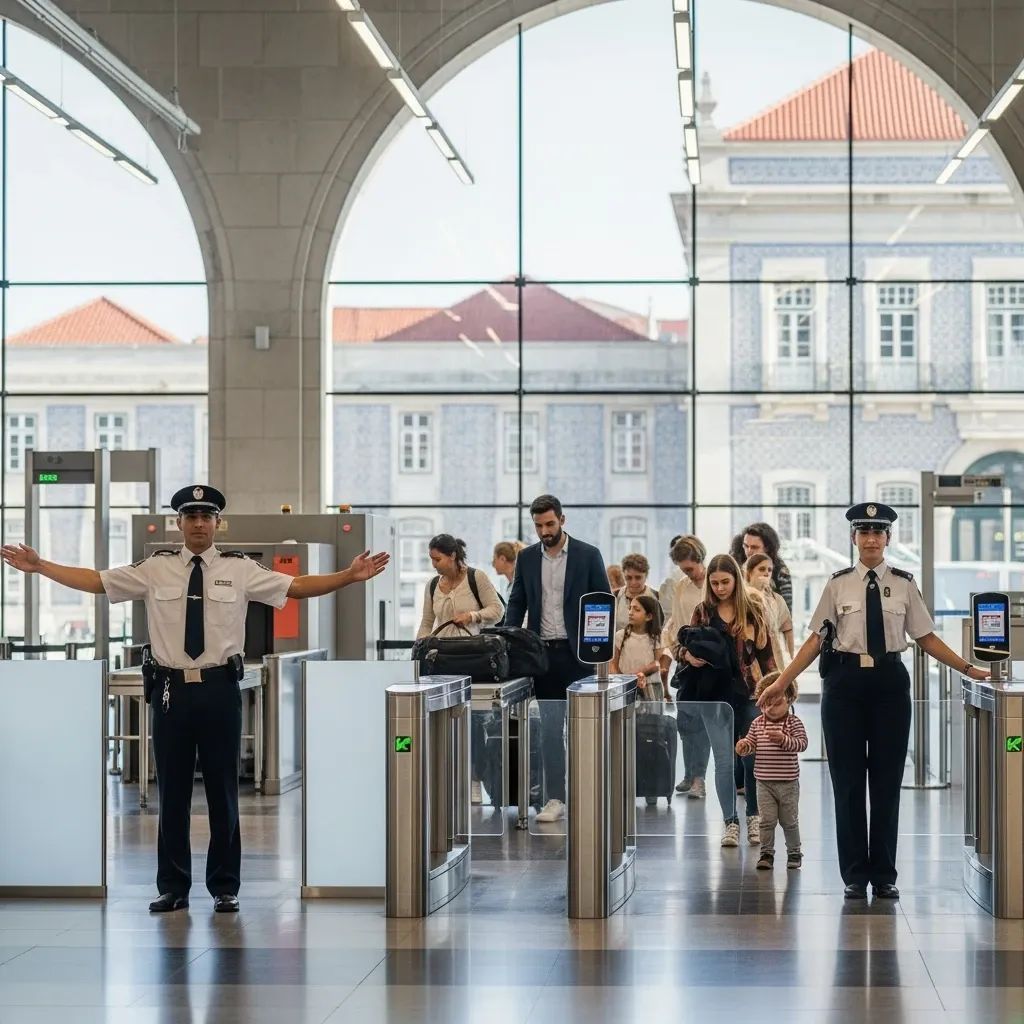
The European Commission has defended the rollout of the bloc's new biometric border system, calling initial technical glitches and airport delays "normal" for a project of this scale—even as Portugal's airports continue to struggle with multi-hour queues and sporadic suspensions of fingerprint collection.
Why This Matters
• Weekend suspensions: The Portugal Public Security Police (PSP) halted biometric data collection at departure gates over the weekend following full implementation to prevent passengers from missing flights.
• Hours-long waits: Travelers at Lisbon, Porto, and Faro airports have faced queues stretching beyond four hours since full implementation began April 10.
• Tourism at risk: Portugal's travel image—and a sector worth 21.5% of GDP—faces reputational damage as congestion persists at the country's busiest gateways.
The System That Changed European Border Control
The Entry/Exit System (EES) officially went live at full capacity across all 29 Schengen Area countries on April 10, replacing passport stamps with digital logs of facial images and fingerprints for non-EU visitors. The system, designed in Brussels, tracks entry and exit dates for short-stay travelers—those staying no more than 90 days within any 180-day window—and flags overstays, forged documents, and security threats in real time.
Since its phased launch began in October 2025, the platform has logged more than 52 M border crossings, refused 27,000 entries, and identified 700 individuals deemed security risks to the European Union. The Commission bills it as the world's most advanced border IT infrastructure.
But operationally, implementation has faced significant obstacles. Processing times have increased substantially at some checkpoints, and airports across Spain, France, Italy, Germany, Belgium, and Greece have all reported disruptions. At Milan's airport, delays reached three hours; at Spain's Gran Canaria terminal, system failures forced staff to revert to manual stamping.
Portugal's Troubled Implementation
Portugal stands out as one of the member states flagged by Brussels for operational shortcomings. The country's three major international airports—Humberto Delgado (Lisbon), Francisco Sá Carneiro (Porto), and Gago Coutinho (Faro)—have become pressure points.
The problems are multifaceted: insufficient border agents, malfunctioning self-service kiosks, limited use of automated e-gates, and a mismatch between the system's data-collection demands and the volume of non-EU travelers arriving during peak periods. Unlike other member states that managed to stabilize operations within days, Portugal has repeatedly resorted to emergency measures.
Initial implementation phases saw challenges, with travelers reporting extended waits at Lisbon airport. When full implementation kicked in this month, chaos returned. Over the following weekend, the PSP suspended fingerprint and photo capture at departures to avoid mass flight cancellations.
The move was a stopgap, not a solution. Arrivals still underwent full EES registration, and the underlying bottleneck—too few agents, too many passengers—remained.
What Brussels Says
In statements to Portuguese news agency Lusa, a European Commission spokesperson said the system is "working very well" in the "vast majority" of member states, and that early-stage technical issues were "to be expected" with any large-scale rollout.
The spokesperson emphasized that EES rules include built-in flexibility to handle surges in traffic, particularly during summer travel peaks, and that contingency procedures allow temporary suspensions when necessary. However, the Commission made clear that responsibility for smooth implementation rests with national governments.
"While the Commission continues to provide the necessary support, it is up to member states to ensure adequate implementation of EES on the ground," the official stated, adding that countries must deploy "sufficient resources and personnel at high-traffic border crossing points."
When functioning as designed, the system can process a traveler's full registration—biometrics, entry date, passport scan—in roughly 70 seconds, according to Commission data. But that assumes ideal conditions: trained staff, functioning equipment, manageable passenger flow, and travelers familiar with the process.
Impact on Residents and Travelers
For anyone living in or traveling to Portugal, the EES has introduced a layer of unpredictability into air travel. Non-EU citizens—including those from the United States, United Kingdom, Brazil, Canada, and other major origin markets—must now factor in extra time at both arrival and departure.
The Portuguese government has rolled out several mitigation measures. These include deploying National Republican Guard (GNR) personnel to assist the PSP, installing additional self-service kiosks, and adopting the Frontex-backed "Travel to Europe" mobile app, which allows travelers to pre-register some personal data before reaching the airport.
Still, the system's complexity means processing times remain unpredictable. Airports have advised passengers flying internationally to arrive at least three to four hours before departure—a significant shift from the standard two-hour recommendation.
For Portugal's tourism industry, the stakes are high. The sector supports 1.2 M jobs and contributes more than one-fifth of national GDP. Negative press about chaotic arrivals and missed flights threatens to erode the country's competitive edge in a crowded Mediterranean travel market. Airlines have flagged concerns about connection misses and the associated rebooking costs, while hotel associations worry that poor airport experiences will deter repeat visits.
The Bigger European Picture
Portugal is not alone in facing EES turbulence, but it is among the countries where the system's shortcomings have been most visible. The Airports Council International (ACI) Europe warned before launch that wait times could hit seven hours during peak periods, and early data suggests those projections were accurate.
Other countries have managed better. Commission data indicates that several member states achieved processing times just over one minute for first-time registrations from day one—suggesting that with adequate preparation, the system can function smoothly.
The divide appears to come down to three factors: staffing levels, equipment quality, and traveler volume. Countries with robust e-gate infrastructure and higher officer-to-passenger ratios report fewer delays. Those relying heavily on manual checks or older technology—Portugal included—have struggled.
What Happens Next
The Portuguese government has not announced any further suspensions, but the PSP retains the authority to pause biometric collection during periods of severe congestion. The European Commission has indicated that member states may invoke contingency protocols as needed, though repeated use of such measures undermines the system's core purpose: to create a unified, automated border.
For travelers, the advice remains practical: arrive early, pre-register via the "Travel to Europe" app if eligible, and prepare for the possibility of delays. For residents and expats welcoming visitors, setting realistic expectations about arrival logistics is now part of the planning process.
The EES represents a generational shift in how Europe manages its external borders. Whether it becomes a seamless digital gateway or a source of chronic friction will depend on how quickly member states—Portugal chief among them—can close the gap between Brussels' vision and ground-level reality.


