

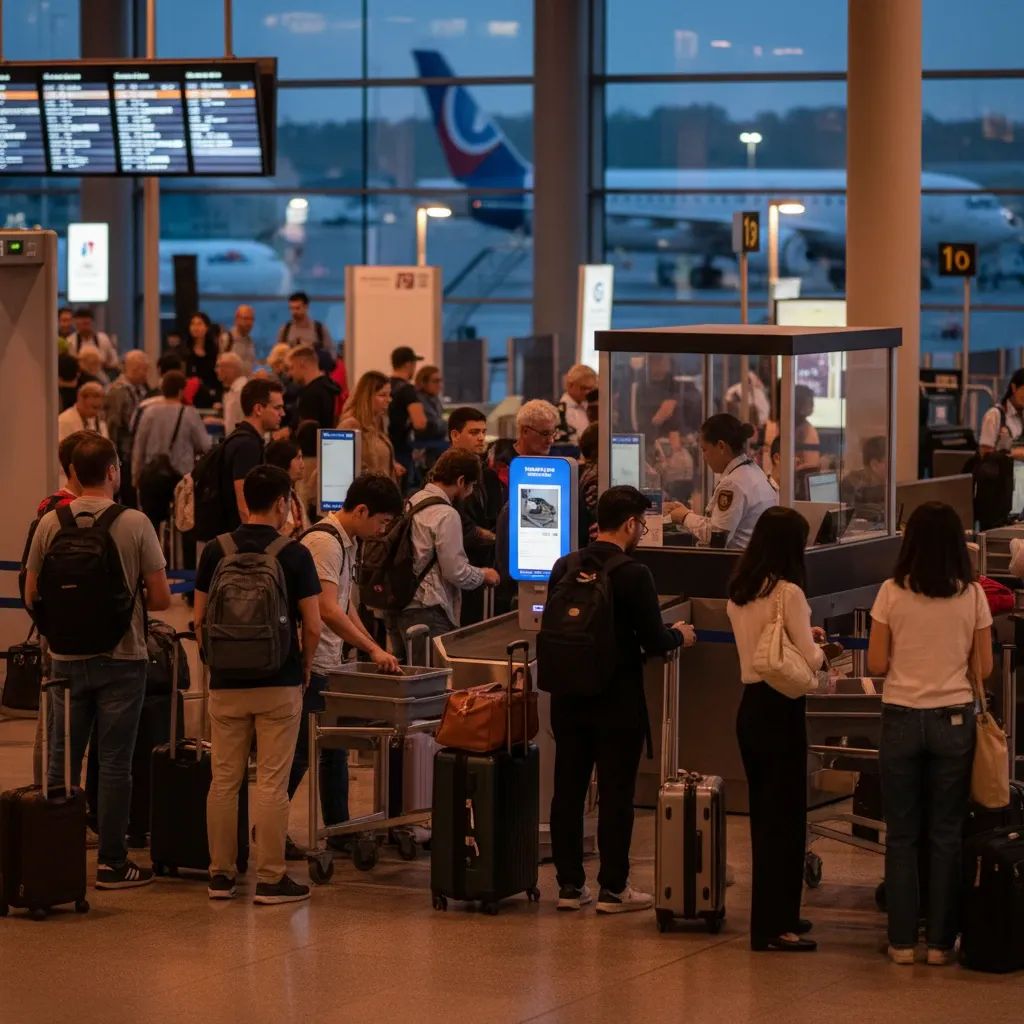
Portugal's Public Security Police (PSP) has begun routinely suspending biometric data collection at the country's three busiest airports to prevent passengers from missing flights, a sign that the European Union's Entry/Exit System (EES) continues to cause operational friction despite six months of phased implementation.
The suspension mechanism now operates as standard protocol across Lisbon's Humberto Delgado, Porto's Francisco Sá Carneiro, and Faro's Gago Coutinho airports whenever wait times exceed internal reference thresholds. When queues threaten flight departures at departure control points, border agents revert to traditional passport checks without biometric scanning, then reactivate fingerprint and facial image capture once traffic eases.
Why This Matters
• Travel disruption risk: Biometric collection is being switched on and off multiple times per day at Portugal's departure controls, creating uncertainty for non-EU travelers leaving the country.
• Security vs. speed trade-off: The PSP insists border security remains intact even without biometrics, but the system was designed specifically to enhance tracking of overstays and border crossings.
• Economic vulnerability: Portugal's tourism sector generated €27.7B in 2024 (20% of national exports), and persistent airport chaos threatens the country's reputation as a hassle-free destination.
Weekend Chaos Repeats
Intendente Sérgio Soares, PSP's national spokesperson, confirmed that biometric collection was halted Saturday morning at departure controls to clear backlogs, resumed by early afternoon, then shut down again as passenger volumes surged. The same cycle repeated through the weekend, with all three airports experiencing multiple suspension windows at exit points.
"Whenever we exceed the reference time, we automatically suspend biometric collection," Soares told Lusa news agency. "Biometric collection does not influence normal border control whatsoever, and we are complying with all protocols under the Schengen Borders Code."
The PSP emphasized that all available border posts are staffed at maximum capacity, yet the system's design—requiring four fingerprints and a facial scan for every non-EU traveler at departure—creates bottlenecks that manual passport stamps never did.
What This Means for Residents
If you're traveling through Portuguese airports or picking up arriving visitors, here's what you need to know:
For travelers departing Portugal: If you hold a non-EU passport and are leaving the Schengen zone, you may experience significant delays at departure control. The biometric suspensions are happening specifically at these exit points. Factor in extra time—wait times can stretch from 70 seconds (the EU's official benchmark) to several hours during peak periods, depending on whether biometric collection is active or suspended that day.
For arrivals: Non-EU visitors entering Portugal go through entry registration, which currently remains operational. However, EES applies to both entry and exit, so the system can also suspend biometrics at arrival points when needed.
For businesses: If your team includes non-EU nationals or you regularly coordinate with international clients from outside the EU, factor unpredictability into travel planning. Delays at departure controls may affect your employees or visitors leaving Portugal.
For tourism-dependent regions: The Algarve, Lisbon, and Porto metro areas—which rely heavily on non-EU visitors, particularly from the UK, Brazil, and the United States—face reputational damage if word spreads that Portugal's airports are less functional than competitors in Spain, France, or Greece.
How the EES Rollout Unfolded in Portugal
The European Entry/Exit System launched across the Schengen zone on October 12, 2025, replacing ink stamps with digital records of entry and exit dates, plus biometric data (facial image and fingerprints) for third-country nationals staying up to 90 days within any 180-day period.
Portugal implemented the system in two phases:
Phase 1 (October 12, 2025): Digital registration of entry/exit dates, photos, and basic passport data—but without fingerprints. Wait times immediately spiked, especially at Lisbon's hub, where queues occasionally stretched to seven hours.
Phase 2 (December 10, 2025): Full biometric capture, including fingerprints, rolled out at Portuguese airports. The operational strain became unsustainable within weeks. By late December, the Portuguese Cabinet suspended EES at Humberto Delgado for three months, reverting to traditional stamping.
Full reactivation (April 10, 2026): The system resumed nationwide, with new self-service kiosks and the "Travel to Europe" mobile app—developed by Frontex and adopted by Portugal as the second EU country after Sweden—intended to allow pre-registration up to 72 hours before arrival.
Yet within days, the suspension-and-reactivation cycle began, indicating that infrastructure improvements have not yet solved the throughput problem.
Technical Fixes and Structural Limits
Portugal has attempted several interventions:
Equipment expansion: The Humberto Delgado hub increased electronic and physical border control capacity by approximately 30%, pushing infrastructure to the airport's structural maximum.
Personnel reinforcement: The National Republican Guard (GNR) deployed certified officers to support PSP staff, particularly in arrivals and departures zones.
Self-service kiosks: Installed at all three major airports to offload routine data entry, though early reports from France suggest similar kiosks transmit data correctly only 50% of the time, requiring manual re-processing.
Mobile pre-registration: The "Travel to Europe" app allows travelers to upload passport data and facial images in advance. However, it is important to note that pre-registration does not eliminate the need for in-person fingerprint capture at the airport—this remains the primary bottleneck. Adoption remains limited, as travelers still must complete biometric registration on-site regardless of prior app registration.
Operational flexibility: EU rules permit member states to suspend EES for up to 90 days during peak periods, with a possible 60-day extension. However, Portugal can only suspend biometric collection temporarily—full reversion to the previous passport stamping system is no longer permitted after April 10, 2026, meaning the country can only toggle biometrics on and off at specific control points.
Europe-Wide Struggle
Portugal is far from alone. Spain has deployed 100 mobile registration teams to relieve pressure at Alicante, Málaga, and Tenerife Sur, and created UK-only lanes at Palma de Mallorca after wait times jumped 70% during peak periods. Technical failures at Gran Canaria forced staff back to manual stamping.
France delayed full EES implementation at the English Channel crossings (Eurostar, Calais ferry ports) due to software bugs and space constraints. Paris airports reported 90-minute queues in March 2026 when kiosks malfunctioned, and operators requested a postponement until after the summer travel peak.
Germany took a phased approach, starting with Düsseldorf in October 2025 and gradually expanding. Frankfurt Airport reports that approximately 80% of border checks are now EES-linked, with minimal delays—though officials still advise extra time during rush hours.
The Airports Council International (ACI) Europe warned that processing times have increased up to 70% across the continent and predicted potential four-hour delays during 2026 summer peaks unless operational flexibility improves.
The Economic Risk
Tourism represents a €27.7B annual sector for Portugal, and the country processed a record 72.5M passengers across all airports in 2025, with Lisbon handling 36.1M. Any sustained degradation in airport experience directly threatens this revenue stream.
While precise economic loss figures for 2026 are not yet public, the cascading effects are clear: missed flights lead to hotel cancellations, lost restaurant bookings, and negative online reviews that discourage future bookings. Business travelers may shift conferences to competitor cities, and remote workers—whom Portugal has actively courted with favorable visa policies—may choose alternative bases.
What Happens Next
The EES is not optional. It serves as the foundation for the European Travel Information and Authorization System (ETIAS), an electronic pre-authorization mechanism similar to the U.S. ESTA, expected to launch later in 2026. ETIAS will cross-check EES records and can deny authorization to travelers who have previously overstayed, making biometric data capture a permanent fixture of Schengen border management.
Portugal's ability to stabilize airport operations over the coming months will determine whether the country maintains its competitive edge as a welcoming, efficient destination or becomes a cautionary tale in how not to implement EU-wide systems.
For now, travelers and residents alike should prepare for continued on-off biometric cycles at departure controls, unpredictable wait times for those leaving Portugal, and the possibility that non-EU travelers will need to build multi-hour buffers into their travel plans—at least until the system's teething problems are finally resolved.


