

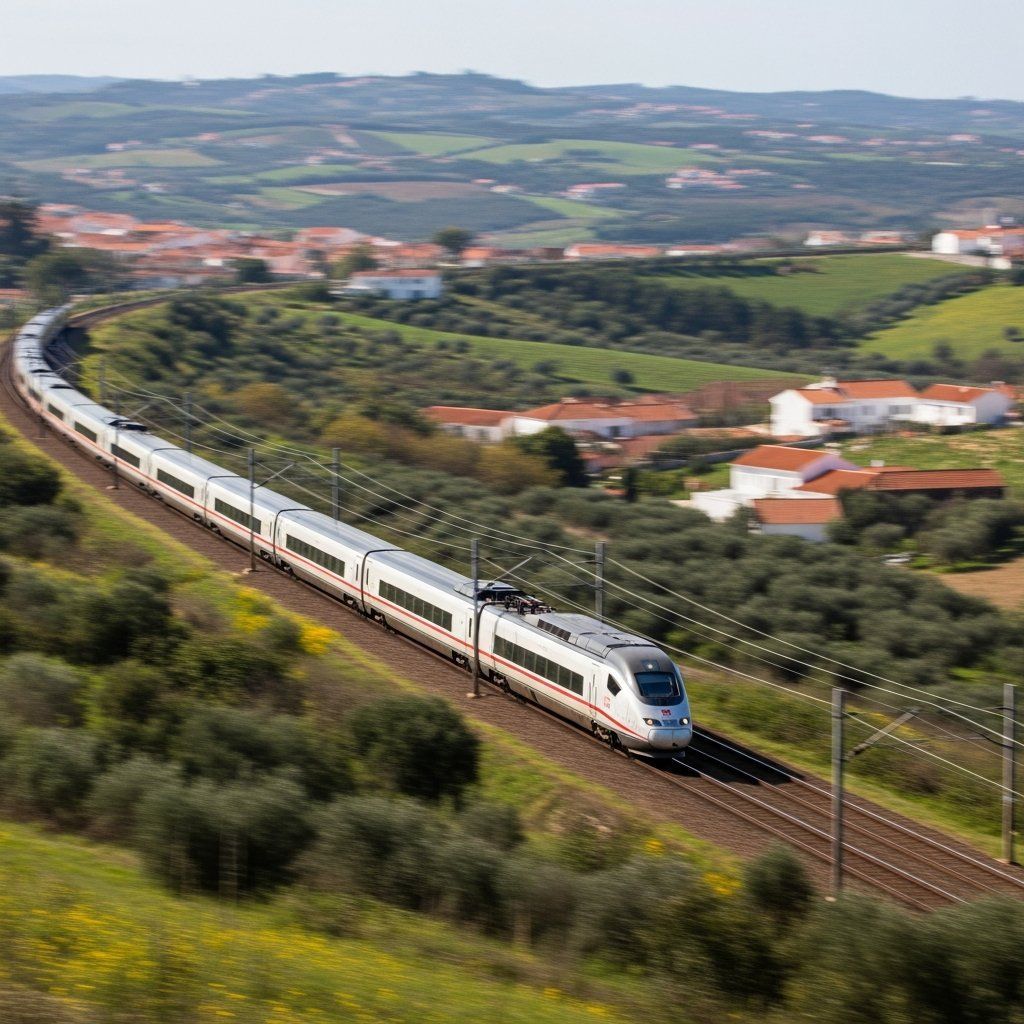
Portugal's CP – Comboios de Portugal is now hunting for a train manufacturer willing to build the country's fastest rail link. The national railroad operator opened bidding this month for 12 high-speed trains—with an option to add 8 more—that will cut the journey between Lisboa and Porto to 1 hour 15 minutes starting in 2031. At €504M for rolling stock, plus up to €45M for workshop upgrades, this represents Portugal's largest single train purchase in history and signals a decisive pivot away from decades of underfunded rail infrastructure.
Why This Matters
• Tender launched May 2026. Proposals must cover train delivery, maintenance contracts, and operational compatibility with the new Porto-Lisboa high-speed line, which itself opens in 2032.
• Travel revolution: The current Alfa Pendular service takes 2h49m; the new trains will shave roughly 1h34m off the journey, making rail faster than driving for the first time.
• Capacity and access: Each train holds 500+ passengers with wheelchair lifts, bicycle storage, Wi-Fi, and power outlets—amenities currently reserved for first-class only.
• Portugal's broader rail commitment: The Portuguese Government authorized €1.6B in total rail spending, which includes this €504M high-speed train procurement plus €584.28M allocated to rolling stock and infrastructure upgrades, marking the country's largest transport investment in modern history.
The Procurement: What's Being Bought
Portugal's Infrastructure Ministry has laid out specific requirements for this procurement. The winning bid must deliver 12 trainsets capable of 300 km/h or higher, built to run on both the narrow Iberian gauge (1,668 mm) currently used in Portugal and the standard European gauge (1,435 mm) for cross-border service. Each unit must carry onboard catering, reserved seating for travelers with reduced mobility, and real-time passenger information systems.
The contract mandates a 35-year maintenance and support agreement starting from 2031. The supplier will establish or upgrade maintenance facilities to handle routine servicing, major overhauls, and component replacement. This requirement locks the winning manufacturer into Portugal's economy for a generation, creating permanent jobs beyond initial delivery.
Infrastructure Minister Miguel Pinto Luz has emphasized the importance of this investment, stressing that rail infrastructure is critical to Portugal's economic development and modernization. Major European manufacturers with high-speed experience—Alstom (French, already supplying 153 regional trains to Portugal), Siemens (German), Talgo (Spanish), CAF (Spanish), and Stadler (Swiss, also contracted for Portuguese trains)—are expected contenders.
How This Fits into Portugal's Larger €1.6B Rail Bet
This €504M procurement is one piece of a substantial infrastructure overhaul. In January 2026, the Portuguese Government authorized €1.6B in total rail spending—the single largest transport investment in the country's modern history. The breakdown includes: the high-speed train procurement and workshop upgrades; 153 regional and suburban trains already contracted to Alstom; acceleration funding to advance delivery schedules; and additional regional units from other manufacturers.
The financial framework reflects Portugal's post-2024 EU budget negotiations. The country secured €5.3B in transport and energy allocations through 2030, and rail—historically starved of investment—is now a priority. The decision to invest substantially in high-speed rail reflects confidence that EU support will continue flowing.
The High-Speed Corridor: Strategic Route Design
The high-speed line will connect major urban centers along the Lisboa-Porto corridor, positioning intermediate cities to benefit from improved connectivity. This infrastructure investment is designed to ease congestion on existing rail networks while making rail travel more competitive with other transport modes.
For residents and businesses across central Portugal, the new high-speed service will substantially reduce travel times between the country's two largest metropolitan areas. The project represents a significant modernization of Portugal's rail capabilities and reflects long-term strategic planning to position rail as a competitive transport option.
The Political and Economic Context
The Portuguese Government has made a public commitment to this rail modernization program. Infrastructure Minister Pinto Luz has emphasized that rail investment is essential to Portugal's economic future, warning against the kind of project disruptions that occurred in previous decades.
Portugal is making a genuine bet on rail infrastructure after years of underinvestment. The €1.6B commitment, with European Union backing, represents the country's most substantial commitment to rail modernization in recent decades. If execution delivers, the Lisboa-Porto corridor will become competitive with air travel by 2032, strengthen regional connectivity, and enhance freight capacity at Portuguese ports.
For residents planning to rely on high-speed rail for commuting or business travel, the 2032 opening provides a concrete target date for this significant improvement to transportation infrastructure. The procurement of these 12 trains represents a tangible step toward modernizing Portugal's rail network.


