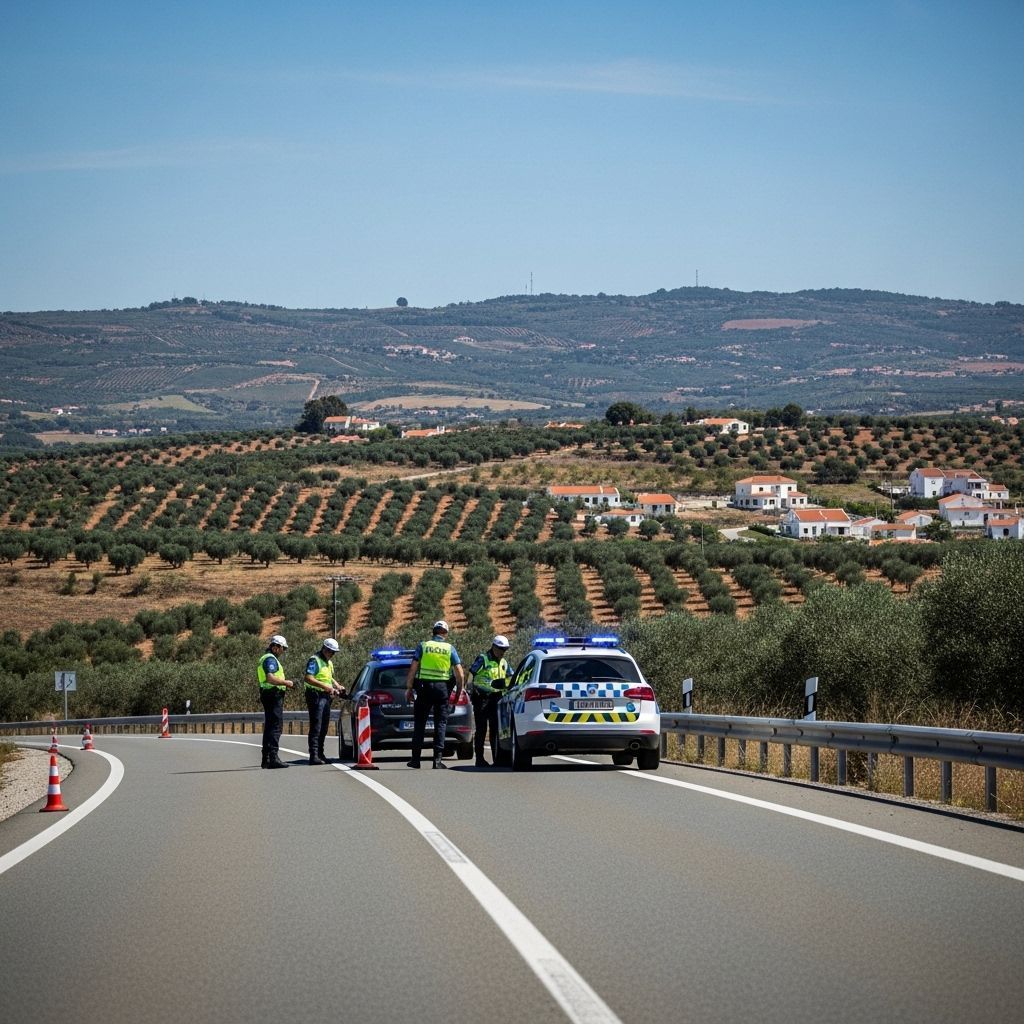
The Portugal National Road Safety Authority (ANSR), working alongside the Portuguese Public Security Police (PSP) and the Republican National Guard (GNR), has launched an intensive enforcement blitz targeting two-wheeled motor vehicles through May 25, confronting a troubling spike in motorcycle and moped fatalities that now account for roughly 1 in 4 road deaths nationwide—significantly above the European Union average of 19%.
Why This Matters
• 439 people died in motorcycle and moped crashes between January 2023 and December 2025, with an additional 3,028 suffering serious injuries.
• Nearly 50% of serious two-wheeler collisions happen on urban streets and national highways, where riders face the greatest vulnerability.
• Enforcement operations run until Monday, May 25, with intensified checkpoints and zero tolerance for speeding, dangerous overtaking, and protective gear violations.
• Portugal's motorcycle fatality rate sits at 60 deaths per million residents—well above the EU benchmark of 45.
The Numbers Behind the Alarm
Over the 36-month stretch ending December 2025, authorities logged 34,177 crashes involving scooters and motorcycles. Those incidents left 439 people dead, 3,028 with life-altering injuries, and another 34,514 with lighter wounds. While most casualties ride the bikes themselves, the toll extends to pedestrians and occupants of cars caught in the collisions.
The broader picture shows Portugal struggling to meet continental safety goals. Between 2014 and 2024, the country trimmed road deaths by a mere 0.6%, while the EU-27 bloc achieved a 17.2% reduction over the same period. Riders of powered two-wheelers remain disproportionately exposed: in 2024 alone, they represented 30% of all road fatalities despite making up a fraction of registered vehicles.
Urban environments and two-lane national routes emerge as the deadliest settings. The 2026 National Enforcement Plan confirms that half of all serious two-wheeler incidents unfold in these zones, where mixed traffic, tight intersections, and higher speed differentials collide with rider vulnerability. In crash-severity terms, motorcyclists face a risk 48 times greater than car drivers of dying in a collision—a disparity that persists even as helmet laws and protective gear standards tighten.
What This Means for Residents
If you ride—or share the road with those who do—expect heightened police presence through the weekend. Checkpoints will prioritize speeding violations, lane-splitting between queued traffic, and failure to wear certified helmets. Officers are authorized to conduct unannounced "stop-and-check" sweeps, a tactic the government reactivated in April 2026 as part of a broader crackdown on road trauma.
For urban commuters, the campaign doubles as a reminder that visibility gaps cause many collisions. Drivers turning left at intersections frequently fail to spot oncoming scooters, leading to right-of-way crashes that account for a significant share of serious injuries. The ANSR urges car and truck operators to perform deliberate shoulder checks and anticipate the presence of smaller, faster-moving vehicles.
Residents living along national highways should also note that infrastructure audits are underway. The government pledged in April to accelerate repairs of potholes, faded road markings, and missing guardrails—especially the motorcycle-friendly barriers designed to prevent riders from sliding into rigid posts. These upgrades target accident concentration zones identified through geospatial crash data, though rollout timelines remain vague.
"Two Wheels – Hold On to Life"
Dubbed "Duas Rodas – Agarre-se à Vida" (Two Wheels – Hold On to Life), the current push is the fifth of 11 enforcement waves scheduled for 2026 and the second dedicated exclusively to powered two-wheelers. The slogan underscores the fragility of the rider: unlike car occupants cocooned in crumple zones and airbags, motorcyclists rely on distance, anticipation, and protective clothing to survive impact.
Authorities stress that correct helmet use remains non-negotiable. A properly fastened, certified helmet can cut the risk of fatal head injury by nearly 40%, yet roadside spot checks routinely uncover riders wearing novelty shells, unfastened chin straps, or visors obscuring peripheral vision. The campaign also targets the absence of reinforced jackets, gloves, and knee protection—gear that can mean the difference between road rash and compound fractures.
Beyond equipment, the enforcement focuses on the behavioral triad driving most serious crashes: excessive speed, abrupt maneuvers, and weaving between lanes. Data from the ANSR indicate that speeding correlates directly with fatality rates, while distracted driving—including smartphone use—multiplies crash risk by a factor of 20. The combination of speed and inattention proves especially deadly on winding rural roads, where guardrail gaps and unforgiving verges leave little margin for error.
Portugal's Struggle to Keep Pace with Europe
While countries such as the Netherlands and Denmark have slashed two-wheeler fatalities through lower speed limits, separated cycle lanes, and mandatory anti-lock braking systems (ABS) on new bikes, Portugal lags behind. The Vision Zero 2030 commitment—halving deaths and serious injuries by decade's end—looks increasingly out of reach unless enforcement and infrastructure investment accelerate.
Several European states have adopted measures Portugal has yet to fully embrace. Mandatory daytime running lights for motorcycles, standard across Austria, Germany, Belgium, France, Spain, and Portugal, have demonstrated 10% to 16% reductions in visibility-related crashes. Yet compliance remains patchy, and older scooters often lack the wiring for always-on lamps. Engine displacement caps for novice riders—restricting beginners to 125 cc machines with 9 kW power ceilings—cut youth casualties by 25% in the United Kingdom during the 1980s. Portugal imposes similar graduated licensing, but enforcement of power restrictions is inconsistent.
Road design also diverges sharply from best practice. Dutch rural highways feature wide, paved shoulders and flexible barrier posts that absorb energy rather than snagging riders. Portuguese national roads, by contrast, often feature narrow lanes, abrupt drainage gullies, and steel guardrails whose horizontal cables can decapitate a sliding motorcyclist. The government's April 2026 pledge to audit and upgrade these sections marks a policy shift, yet municipal budgets and inter-agency coordination will determine whether the promise translates into safer tarmac.
What Riders Can Do Now
The ANSR and police forces offer straightforward advice: slow down, signal intentions early, avoid weaving through stalled traffic, and never ride impaired. Alcohol and drug screening will intensify during the campaign, with officers deploying portable breath analyzers and oral-fluid test kits at evening checkpoints.
For those commuting daily, investing in high-visibility clothing and retrofitting older bikes with brighter brake lights can materially reduce the chance of being struck from behind or broadsided at intersections. Defensive riding courses—some subsidized by insurers—teach emergency braking, cornering on wet surfaces, and hazard anticipation. While not mandatory for license renewal, these workshops correlate with lower claim rates and, anecdotally, fewer hospital admissions.
The Road Ahead
Preliminary results from the May 19–25 operation will be published after the campaign concludes, offering a snapshot of infraction rates and compliance trends. Past sweeps have yielded thousands of citations for speeding, dozens of suspended licenses, and occasional vehicle impoundments for egregious modifications—straight-pipe exhaust systems and disabled speed governors chief among them.
Whether this latest blitz bends the curve on two-wheeler deaths depends on sustained pressure beyond a single week. Riders, drivers, road engineers, and policymakers all share responsibility for closing the gap between Portugal's current fatality rate and the EU benchmark. Until enforcement becomes routine, infrastructure upgrades widespread, and risk-taking culturally unacceptable, the morgue will continue to receive bodies that helmet laws and slogans alone cannot save.