

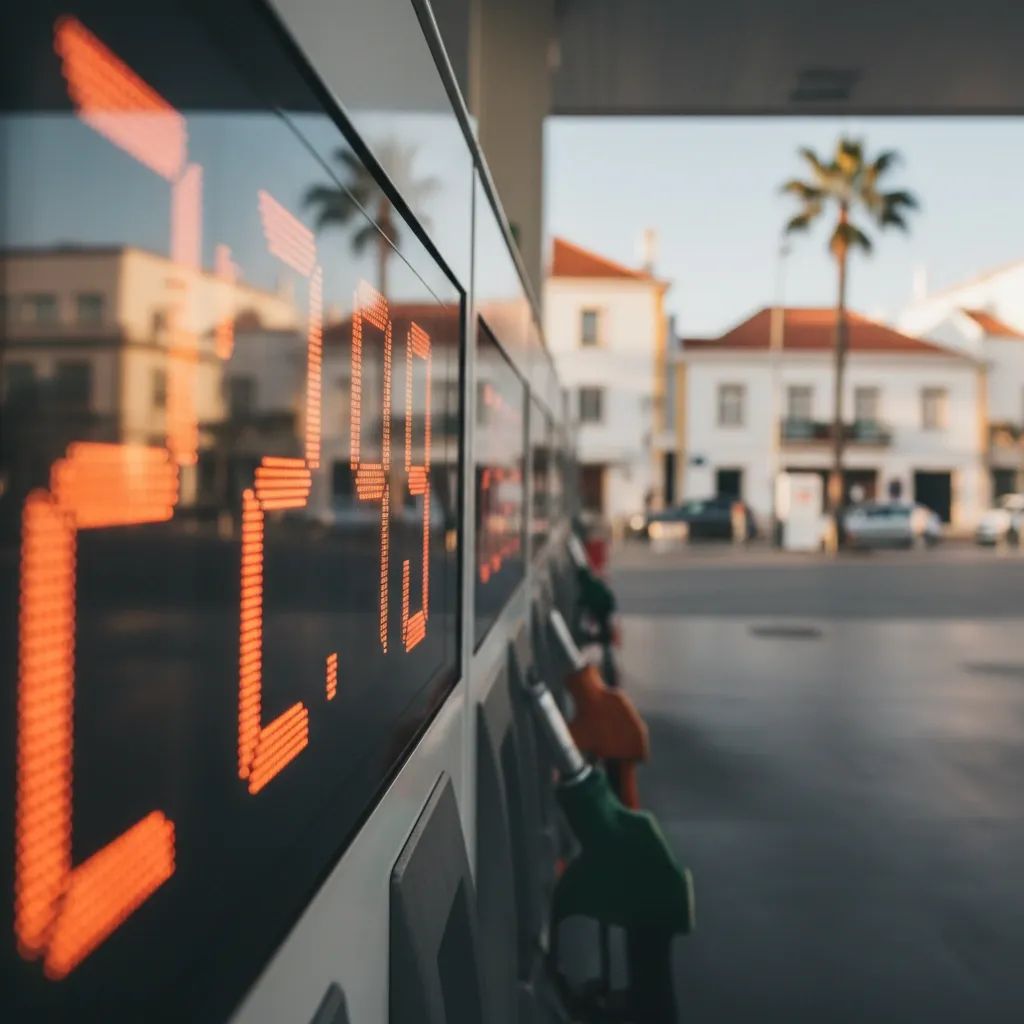
The Portugal Revenue Department has announced an emergency fuel tax reduction as oil prices surge past $87 per barrel, driven by a seventh consecutive night of American airstrikes on Iranian territory and retaliatory attacks across the Gulf region. The move aims to cushion Portuguese consumers from what industry groups warn could be a 12-cent increase per liter of diesel and a 5-cent jump for petrol by week's end.
Why This Matters
• Fuel prices expected to jump: Diesel could rise 12 cents/liter, petrol 5 cents, starting next week unless oil markets stabilize.
• Government intervention active: Tax relief of 7.4 cents/liter on diesel and 5.7 cents on petrol (including VAT) has been approved to offset increases.
• Global supply chain disruptions likely: Shipping insurance costs and alternate routing around the Strait of Hormuz will ripple through consumer goods pricing in Portugal within weeks.
• Energy security implications: IMF warns 2-3 months to normalize global oil flows after the Strait of Hormuz reopens—if it reopens.
Military Escalation Enters Seventh Day
The United States Central Command (Centcom) confirmed overnight strikes targeting dozens of Iranian military installations, including a surveillance tower at Chabahar port on the Gulf of Oman—a critical commercial gateway for landlocked Afghanistan and a node in Iran's supply chain. U.S. Defense Secretary Pete Hegseth released footage showing the tower's collapse, underscoring Washington's strategy to choke Iranian control over maritime chokepoints.
At least 8 people died and 20 were wounded in the latest wave of American bombardments across southern and western Iran, according to Iranian state media. The attacks destroyed six bridges in Fars province, severed a key tunnel, and obliterated a desalination plant in Hormozgan province that supplied potable water to approximately 10,000 residents across 20 villages. "The supply of drinking water has been completely interrupted," said Abdolhamid Hamzehpour, director of the Bandar Abbas provincial water authority.
American forces have systematically targeted road and rail infrastructure leading to Bandar Abbas, Iran's largest port, in what analysts interpret as an effort to sever military logistics and commercial flows to Iran's 90M population. The cumulative death toll from the conflict, which erupted on February 28 with joint U.S.-Israeli strikes, has climbed to approximately 40 dead and over 400 wounded on the Iranian side alone.
Iranian Counterstrikes Hit Gulf Allies
Iran's Islamic Revolutionary Guard Corps (IRGC) launched a coordinated missile and drone campaign against American military installations and critical civilian infrastructure in Kuwait, Bahrain, Qatar, and Jordan. The attacks mark a deliberate escalation beyond military targets, striking desalination and power plants in Kuwait—a particularly vulnerable nation where 90% of potable water comes from desalinated seawater.
The Kuwait Ministry of Electricity, Water and Renewable Energy confirmed that Iranian strikes caused fires at two separate desalination facilities, forcing the shutdown of multiple production units and triggering widespread water supply disruptions. Kuwait Airways temporarily suspended operations at Kuwait International Airport as defense systems intercepted inbound projectiles.
The IRGC claimed direct hits on U.S. forces at Camp Arifjan in Kuwait, asserting "several military personnel" were killed, though the U.S. Department of Defense has denied any American combat deaths in the current phase of hostilities. The Revolutionary Guard also reported destroying radar systems at Ali Al Salem Air Base in Kuwait, a hangar for weapon maintenance, and fuel depots.
In Bahrain, air raid sirens sounded four times Saturday morning as the Bahrain Defence Force intercepted "treacherous Iranian aerial attacks." An AFP journalist in Manama reported hearing multiple explosions. The IRGC stated it destroyed hangars and fuel storage at Sheikh Isa Air Base, a facility hosting U.S. Air Force operations.
The most dramatic claim came from an attack on Al Udeid Air Base in Qatar, the largest American military installation in the Middle East. The IRGC announced it had "completely destroyed" long-range radar systems and "several strategic aerial refueling aircraft" in what it called a "heavy surprise attack" to "punish the aggressor." The Qatar Ministry of Interior confirmed one child was injured by shrapnel during interception operations but did not verify the extent of damage to the base. Qatar has served as a diplomatic mediator in ceasefire negotiations, making the strike particularly provocative.
Collapse of June Ceasefire Agreement
The current hostilities represent the total breakdown of a memorandum of understanding signed between Washington and Tehran on June 18, which established a 60-day ceasefire framework intended to facilitate negotiations on Iran's nuclear program, sanctions relief, and the reopening of the Strait of Hormuz to commercial shipping.
On July 8, U.S. President Donald Trump declared the ceasefire "no longer in effect," citing Iranian attacks on merchant vessels in the Strait of Hormuz. Trump warned the military campaign would expand to include power plants and bridges if Tehran refused to resume talks. Within 48 hours, American bombers began systematic strikes against Iranian infrastructure.
Iranian Supreme Leader representatives accused Washington of violating the agreement first, pointing to a U.S. naval blockade reimposed in the Gulf of Oman as evidence of bad faith. U.S. Vice President JD Vance alleged on July 17 that "Israeli-funded campaigns" actively worked to undermine the diplomatic process, though he provided no public evidence.
The United Nations Secretary-General condemned attacks on civilian infrastructure as "unacceptable," reiterating that "there is no military solution to this conflict." The European Union's foreign policy chief, Kaja Kallas, called Iranian strikes on Bahrain and Kuwait "unacceptable" but also pressed for immediate de-escalation and the restoration of freedom of navigation through the Strait.
Diplomatic sources suggest any renewed ceasefire talks would need to start "from scratch," with trust between the parties now at historic lows. The International Monetary Fund (IMF) warned that even after hostilities cease, global oil flows may require 2-3 months to normalize, and prolonged disruptions risk permanent losses to production capacity in cases where financing to restart oil wells becomes unavailable.
What This Means for Residents
For households and businesses in Portugal, the immediate concern centers on energy costs. The Brent crude benchmark surged above $87.50 per barrel Saturday, while West Texas Intermediate (WTI) hit $82.15—gains of roughly 4% in a single trading session. The National Association of Fuel Retailers (Anarec) projects diesel will rise 12 cents per liter and petrol 5 cents by next week if current trajectories hold.
The Portugal Cabinet responded with an expanded fuel tax rebate: 7.4 cents per liter on diesel and 5.7 cents on petrol, inclusive of VAT. The measure is designed to absorb the price shock at the pump, though it places additional strain on public finances already stretched by inflation and elevated borrowing costs.
Beyond the fuel station, Portuguese consumers should brace for secondary price effects. Shipping insurance premiums for vessels transiting the Gulf have tripled, and many carriers are now routing around the Arabian Peninsula entirely—adding 10-14 days to delivery schedules and thousands of dollars in fuel costs per voyage. These expenses will filter into the prices of imported goods, from electronics to textiles, within the next 4-6 weeks.
Airlines operating routes to Asia and the Middle East may impose fuel surcharges or reduce frequency as geopolitical risk premiums rise. The Portugal Civil Aviation Authority has not issued advisories restricting Portuguese carriers from Gulf airspace, but insurance considerations may force route changes that extend flight times and raise ticket prices.
For Portuguese exporters—particularly in the textiles, footwear, and agricultural sectors—shipping delays and higher logistics costs threaten competitiveness in Middle Eastern and Asian markets. Small and medium-sized enterprises with thin margins may find themselves squeezed between rising costs and reluctance from buyers to accept price increases.
Financial markets have responded with flight-to-safety positioning. The euro weakened against the Swiss franc and U.S. dollar as investors sought havens, while Portuguese government bond yields ticked higher on fears that prolonged conflict could tip the eurozone into recession. Retirement funds and pension portfolios with significant equity exposure have seen value erosion, though diversified holdings in gold and defensive sectors have partially offset losses.
Energy Security and Strategic Risk
The Strait of Hormuz, a 21-mile-wide channel between Iran and Oman, carries roughly 21% of global petroleum liquids and a similar share of liquefied natural gas (LNG). Iran has periodically threatened to close the waterway, and the current conflict represents the most serious disruption risk since the Iran-Iraq War of the 1980s.
Although Portugal sources most crude from the North Sea, West Africa, and the Americas, global oil pricing is fungible—a supply shock in the Gulf affects European refineries regardless of origin. The Portuguese refining sector, anchored by the Sines facility, must compete on international markets for feedstock, meaning price spikes cascade directly into domestic fuel costs.
The broader European energy mix, still recovering from the 2022 natural gas crisis triggered by the war in Ukraine, remains vulnerable. LNG shipments from Qatar—Europe's second-largest supplier after the U.S.—transit the Strait of Hormuz. Prolonged conflict or closure of the waterway would force European utilities to scramble for alternative supplies, potentially reigniting the price spikes and rationing debates of two years ago.
Portugal's renewable energy capacity, which now supplies over 60% of domestic electricity, provides some insulation from fossil fuel volatility. However, transportation fuels remain almost entirely petroleum-dependent, and heavy industry reliant on natural gas feedstock could face production slowdowns if LNG prices surge.
Diplomatic Deadlock and Next Steps
European foreign ministers are scheduled to meet with Gulf Cooperation Council counterparts in the coming week to discuss freedom of navigation and the implementation of the collapsed June framework. France and Germany have privately urged the White House to pause strikes and return to negotiations, though Washington has signaled no intent to halt operations until Iran "ceases aggression" in the Strait.
Iran, for its part, has warned that countries hosting U.S. military bases "must prepare to receive an equivalent response" and hinted that future retaliation could extend beyond military targets to economic infrastructure. The IRGC's statement Saturday emphasized that targeting civilian water and power supplies in Gulf states was a deliberate signal: "Crossing red lines and attacking the population and infrastructure will have very grave consequences."
Analysts at the Institute for Strategic Studies in Lisbon note that the conflict's trajectory now resembles a "tit-for-tat escalation spiral" with no clear off-ramp. Absent a diplomatic breakthrough—or exhaustion on one or both sides—the current pattern of strikes and counterstrikes could persist for weeks or months, with compounding effects on global supply chains, energy markets, and regional stability.
For Portugal, the priority remains mitigating economic fallout through fiscal tools like fuel subsidies, monitoring supply chain vulnerabilities, and coordinating with EU partners on energy contingency planning. The Finance Ministry has not disclosed the cost of the expanded fuel tax rebate, but similar measures during the 2022 energy crisis consumed over €500M in a six-month period.
Broader Economic Implications
The Portugal Chamber of Commerce has warned that prolonged conflict could shave 0.3-0.5 percentage points from GDP growth projections for 2026 if energy costs remain elevated and consumer confidence deteriorates. Tourism, a pillar of the Portuguese economy, faces headwinds from reduced discretionary spending and higher airfares, though domestic and intra-European travel may prove more resilient than long-haul segments.
Construction and manufacturing sectors—already grappling with high interest rates—will confront rising input costs for petroleum-derived materials like plastics, asphalt, and chemical feedstocks. Builders report that asphalt prices have climbed 8% in the past two weeks, threatening margins on public infrastructure projects contracted at fixed rates months ago.
The Portugal Central Bank has not issued revised inflation forecasts since the conflict intensified, but private-sector economists project headline inflation could accelerate to 3.5-4% by year-end if oil remains above $85/barrel. That would keep pressure on the European Central Bank to maintain restrictive monetary policy, delaying rate cuts that Portuguese households and businesses have anticipated to ease mortgage and loan burdens.
For now, the government's fuel subsidy buys time—but it is a temporary patch on a problem rooted in geopolitical forces beyond Lisbon's control. The coming weeks will determine whether diplomacy can arrest the spiral, or whether Portugal and the rest of Europe must prepare for a protracted period of energy insecurity and elevated costs.


