Portugal's Energy and Geology Directorate (DGEG) has confirmed another round of fuel price increases set to take effect Monday, July 20, 2026, with diesel and petrol both climbing sharply as Middle East tensions push international oil markets higher—a move that will cost drivers up to €13.50 more per 50-liter tank.
Why This Matters:
• Diesel jumps 12–13.5 cents per liter, pushing average pump prices to €1.97–€1.99 per liter, just shy of the €2.00 mark.
• Petrol rises 5–6.5 cents per liter, settling around €1.97–€1.98 per liter nationally.
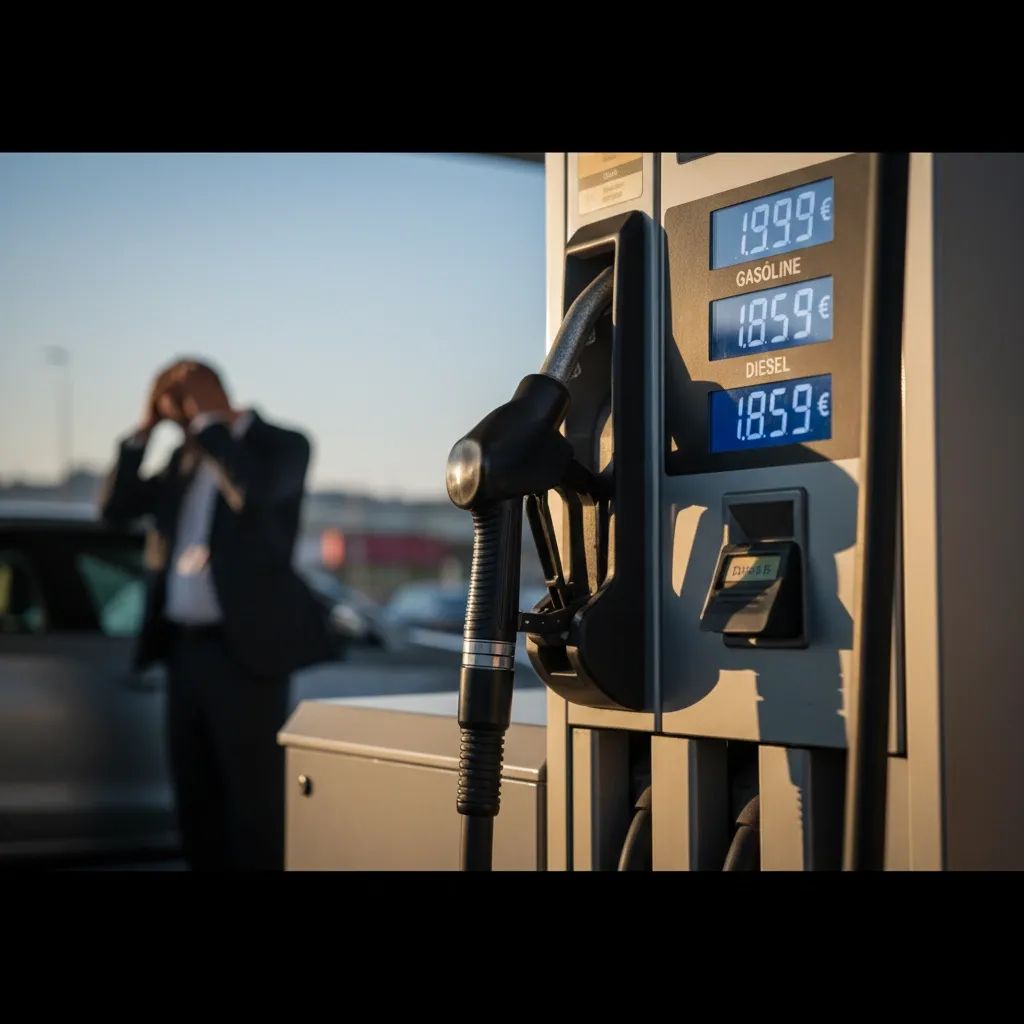
• Current prices remain valid until Monday morning: Diesel stands at €1.85/L and petrol at €1.92/L through this weekend, per DGEG data.
• Government intervention may follow: Ministers have requested an urgent study on margin controls as the gap with Spain widens again.
The Geopolitical Engine Behind the Surge
The upcoming price hike reflects a 10% surge in Brent crude over the past seven trading days, driven by renewed hostilities between Washington and Tehran and logistical disruptions through the Strait of Hormuz—the maritime chokepoint through which 15 million barrels of crude oil and 5 million barrels of refined products flow daily. By midmorning Friday in Lisbon, Brent futures for September delivery had climbed 1.4% to $85.42 per barrel, up from roughly $76 a week earlier.
Portugal's energy regulator calculated that international quotations for refined gasoline jumped 4.3% last week, while diesel surged 9.7%—the most relevant benchmarks for retail pricing. These products trade on their own distinct markets, separate from crude oil, and are particularly sensitive to refining capacity, freight costs, and geopolitical risk premiums. Europe remains a net importer of diesel, making it especially vulnerable when Gulf supply chains tighten.
Though Portugal sources only a fraction of its crude from the Persian Gulf—42% comes from Brazil, 20% from Algeria, 11% from Nigeria, with the U.S. and Azerbaijan rounding out the top five—fuel pricing operates in a globalized market. A supply shock in Hormuz ripples worldwide, lifting costs for all buyers regardless of their direct exposure.
What This Means for Motorists and Freight
For the average Portuguese household, Monday's adjustment translates to an additional €6.00–€6.75 to fill a standard 50-liter petrol tank, or €6.00–€6.75 more for diesel. Commercial hauliers and fleet operators face steeper bills: A 100-liter fill for a light commercial vehicle will cost an extra €12–€13.50 in diesel alone.
The national fuel retailers association confirmed the projections Friday but cautioned that final prices could shift slightly depending on late-day market volatility. Actual pump prices also vary by brand, location, and discount programs—hypermarket chains and low-cost operators typically offer steeper cuts than traditional branded stations.
According to the latest energy efficiency pricing report for the week of July 6–12, advertised "gantry prices" (pre-discount) sat 2.7 cents per liter above the regulatory benchmark for petrol and 3 cents above for diesel. However, once loyalty cards and fleet discounts were applied, consumers paid an average of 1.6 cents per liter below the efficient price for petrol and 3.4 cents below for diesel—suggesting competitive pressure remains alive in the retail segment, even as wholesale costs climb.
The Spanish Price Gap Widens Again
After Spain's extraordinary fiscal relief expired June 30, 2026—ending a three-month period of 10% VAT on fuels instead of the standard 21%—the cross-border price differential has narrowed but remains substantial. However, Madrid continues a gradual fuel discount of 15 cents per liter through July 2026, scaling down to 10 cents in August and 5 cents in September. As of mid-July, Spanish petrol averaged €1.54–€1.56 per liter, while diesel sat at €1.55–€1.57 per liter, roughly 30–37 cents cheaper than Portugal for petrol and 28–30 cents for diesel.
The structural price gap between the two Iberian neighbors stems overwhelmingly from fiscal policy rather than pre-tax costs: Portugal's fuel taxes (excise duties, carbon levy, and VAT) accounted for 50.5% of the petrol price and 44.7% of diesel as of the latest regulatory data—equivalent to €0.98/L and €0.85/L respectively.
Border-region residents continue to make fuel runs to Spain, though the savings must now be weighed against increased time and traffic, especially with the July discount tapering off in the coming months.
Government Weighs Unprecedented Market Controls
Facing public pressure over the asymmetry between crude declines and retail price adjustments, Portugal's Minister for Environment and Energy, Maria da Graça Carvalho, sent a formal letter to the energy regulator this week demanding a 20-day study on the transmission mechanisms of international price movements to domestic pumps. The directive explicitly instructs the regulator to assess whether "serious distortions" exist in the market and, if so, to draft a proposal for exceptional maximum margin caps on any commercial component of the retail price—a move without precedent in Portugal's liberalized fuel sector.
The national fuel retailers association pushed back sharply, arguing that the minister's comments risk stoking "unjustified suspicion" among the public and penalize resellers for dynamics beyond their control. The association emphasized that resellers have zero capacity to influence international quotations, maritime freight rates, or refining margins, and that the delay in downward price transmission reflects structural factors: high fixed costs in refining, limited European storage capacity, and the slower pass-through of cost reductions compared to cost increases.
Portugal's fuel and lubricant companies also echoed the sentiment, noting they could vouch for the market's average behavior but not for "every single operator" individually. Industry representatives added that the sector's aggregate margins remain within normal bounds according to regulator data on discounted prices.
Portugal's competition authority has also been tasked with a parallel investigation into pricing practices, with results expected by early August.
Why Prices Rise Faster Than They Fall
The phenomenon—familiar to drivers across Europe—stems from the different speeds at which cost shocks and cost reliefs propagate through the supply chain. Portugal's energy regulator identifies two primary culprits:
High fixed costs in refining and distribution: Refineries operate on thin margins with large capital commitments. When crude falls, refiners do not immediately slash output prices because their operational overhead remains constant.
Scarce storage infrastructure in Europe: Limited tank capacity means suppliers cannot build inventory when prices drop, forcing them to purchase closer to real-time need. This structural bottleneck slows the translation of lower input costs into consumer savings.
Since the Hormuz crisis began earlier this year, refined product cost increases have reached 25% for diesel and 35% for petrol at various peaks—far outpacing the movement in Brent crude, which has oscillated between $76 and $85 per barrel over the same period.
Portugal's weekly pricing cycle—which updates every Monday based on the prior week's international averages—also differs from Spain's daily adjustment model, meaning Portuguese drivers experience less volatility day-to-day but can lag behind sharp market moves in either direction.
Fiscal Tools in Play
The Portuguese government has already deployed modest relief through a temporary fuel excise discount, cutting the fuel tax by approximately 0.54 cents per liter for petrol and 1.20 cents for diesel (pre-VAT) for the week of July 13–19, 2026. This intervention partially cushioned what would otherwise have been an even steeper climb at the pump.
However, any deeper fiscal response—such as a VAT reduction mirroring Spain's earlier move—would require European Union approval under state aid rules and would cut directly into public revenue at a time when budgetary discipline remains a policy priority. The carbon levy, suspended during the pandemic-era energy crisis, is also under review for gradual reinstatement in late 2026, which could add further upward pressure once geopolitical tensions ease.
What Drivers Can Do Now
Fill up this weekend: Prices remain at current levels (€1.85/L diesel, €1.92/L petrol) until Monday morning, July 20, 2026. Topping off tanks before the weekly reset offers modest savings.
Compare discount programs: DGEG publishes weekly price comparison data showing meaningful variation between operators. Hypermarkets and independent low-cost stations often beat branded chains by 3–5 cents per liter after loyalty schemes are applied. You can access this data through DGEG's official website.
Monitor cross-border options: If you live within 30 km of the Spanish frontier, factor in the €0.30–€0.37/L savings on petrol and €0.28–€0.30/L on diesel against travel time and fuel consumption. For a 50-liter fill, the round-trip could still net €10–€15 in savings through at least September 2026. Most fuel retailers accept EU-resident credit cards without issue.
Track crude oil and refined product quotations: DGEG publishes weekly efficiency price breakdowns. Understanding the components—crude, refining margin, freight, biofuel blending, taxes—provides clearer insight into where pump prices are headed.
Looking Ahead
Analysts caution that volatility will persist as long as the Strait of Hormuz remains contested. A ceasefire or diplomatic thaw could reverse recent gains in crude and refined products quickly, though European diesel inventories—already at five-year lows before the conflict escalated—will take time to rebuild even if supply normalizes.
In the near term, Portugal's regulatory and competition authorities face a tight timeline to deliver findings on market distortions. If margin caps are ultimately imposed, the mechanism would likely target specific supply-chain segments—such as wholesale markups or retail margins—rather than a blanket price ceiling, to avoid triggering shortages or undermining the commercial viability of smaller independent stations.
For now, the immediate reality is unambiguous: Portuguese drivers will pay nearly €2.00 per liter for both diesel and petrol starting Monday, July 20, 2026, with the next update scheduled for July 27. Barring a sharp geopolitical de-escalation or a collapse in Brent, further increases remain possible through the late summer.