

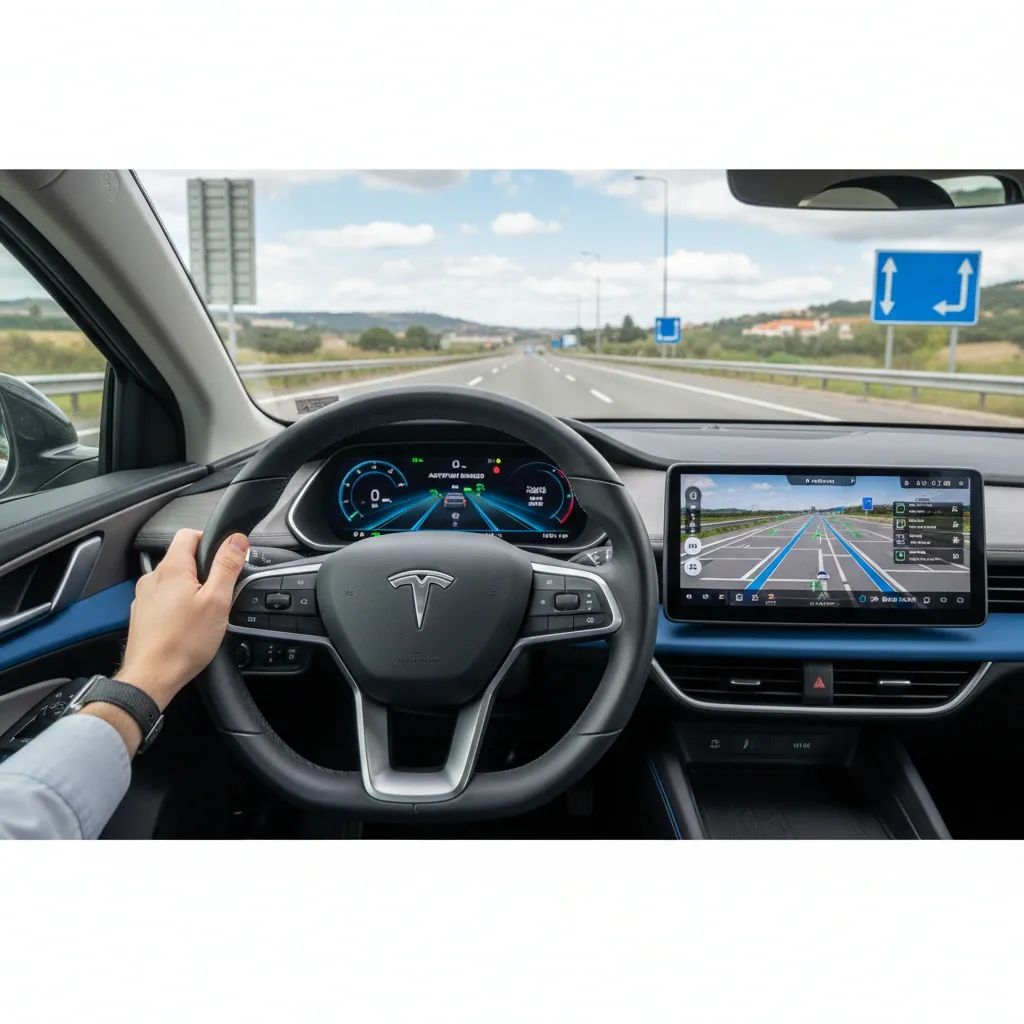
Waymo, the autonomous vehicle subsidiary of Alphabet, has registered a business entity in Madrid named Waymo Iberia SL, a move that signals the company's intent to establish operations across the Iberian Peninsula—potentially including Portugal. The timing aligns with Portugal's recent rollout of a legal framework permitting autonomous vehicle testing on public roads, raising the question of whether self-driving taxis could soon arrive in Lisbon, Porto, or other Portuguese cities.
Why This Matters
• Legal groundwork laid: Waymo's new Spanish entity uses the term "Iberia," covering both Spain and Portugal, rather than limiting itself to a single country.
• Portugal ready for tests: Since 9 July 2026, Portugal's Decree-Law 113/2026 has allowed supervised autonomous vehicle trials under strict safety and insurance conditions.
• No immediate launch: The company has not confirmed when robotaxi services will begin operating in Portugal or Spain, with London expected to serve as Waymo's first European commercial market.
What Portugal's New Law Actually Permits
Portugal's newly effective legislation marks a shift in how the country approaches autonomous mobility, positioning it among a select group of European nations with a dedicated legal regime for public road testing. Yet the law draws clear boundaries: it authorizes supervised trials, not open commercial deployment.
Under the decree, autonomous test vehicles must carry a licensed human supervisor—either physically present or monitoring remotely—who can intervene at any moment. Speed limits during trials are reduced by 20 km/h below normal thresholds, and vehicles must be equipped with comprehensive data-logging systems, often referred to as "black boxes," that capture every aspect of system performance, from braking patterns to remote commands.
Cybersecurity measures are compulsory, as is elevated insurance coverage well beyond standard policies. Operators and drivers must hold a driving license for at least six years with a clean record over the past five. These safeguards aim to mitigate risks inherent in AI-driven mobility while creating an environment where innovators can test technology in real-world conditions.
What the law does not permit is the kind of commercial, driverless robotaxi service that Waymo currently runs in parts of the United States. That level of operation remains contingent on future regulatory steps and the proven safety of autonomous systems in Portuguese traffic.
Waymo's European Strategy
The registration of Waymo Iberia SL forms part of a broader European expansion plan. According to industry tracking accounts and public filings, the company has also incorporated entities in Germany, France, and the Netherlands. This pattern suggests a methodical rollout of corporate infrastructure across key European markets, preparing the legal and operational scaffolding necessary for eventual service launches.
London is widely expected to be the first European city where Waymo operates a commercial robotaxi service, with specialist-supervised trials already underway since early this year. The company has not disclosed a timeline for Iberian operations, but the creation of Waymo Iberia SL indicates that Spain and Portugal are on the roadmap.
In the United States, Waymo has scaled rapidly, covering more than 1,400 square miles across 11 cities and targeting one million paid rides per week by the end of the year. Replicating that pace in Europe will depend on how quickly national regulators and local authorities grant operational permits, and whether the company can adapt its technology to the unique traffic patterns, infrastructure, and regulatory requirements of European cities.
How Portugal Compares to Other European Markets
Portugal's cautious, phase-by-phase approach mirrors the broader European regulatory philosophy, which prioritizes safety, harmonization, and legal clarity before opening the gates to full commercial deployment.
Germany has moved faster than most, passing legislation in 2021 that permits driverless vehicles in specified operational zones, with a separate 2025 framework for remotely controlled vehicles entering force by year-end. France authorized Level 4 autonomous operations—vehicles with no driver on board—under strict supervision in 2021. The United Kingdom enacted its Automated Vehicles Act in 2024, enabling authorized services to launch on public roads starting this year, with full rollout expected by late 2027.
The European Union is working toward a unified regulatory framework expected to be in place by the end of this year, standardizing testing routes, vehicle approvals, and licensing procedures across member states. In June, UN regulations for automated driving systems (ADS GTR), co-led by China and the EU, were adopted, establishing unified safety requirements and testing methods that will serve as a global reference.
Portugal's entry into this landscape is measured but meaningful. By establishing a clear legal regime for testing, the country positions itself as a viable market for companies like Waymo, while ensuring that public safety remains non-negotiable during the experimental phase.
What This Means for Residents
For people living in Portugal, the arrival of autonomous vehicle testing represents an opportunity to observe—and potentially participate in—the next wave of urban mobility. However, expectations should be tempered: the vehicles you might see on Portuguese roads over the next 12 to 18 months will be test units, not commercial services you can hail from a smartphone app.
The immediate impact is more about infrastructure readiness and regulatory credibility. If Portugal can demonstrate a safe, well-managed testing environment, it strengthens the country's appeal to global tech companies evaluating where to deploy next-generation transport solutions. That, in turn, could attract investment, create specialized jobs in engineering and AI, and position Portuguese cities as early adopters of autonomous mobility.
For urban planners and policymakers, the law provides a sandbox for understanding how autonomous vehicles interact with existing traffic, pedestrian flows, and public transport networks. The data captured during trials—speed, braking, system interventions, remote commands—will inform future regulatory decisions and help shape the conditions under which commercial services might eventually be authorized.
For drivers and transport workers, the development is more ambiguous. While widespread displacement of traditional taxi and ride-hailing jobs is not imminent, the technology is advancing, and the long-term trajectory points toward greater automation in passenger transport. How Portugal manages this transition—balancing innovation with social impact—will become a central policy question in the years ahead.
The Broader European Race
Europe's approach to autonomous vehicles stands in contrast to the acceleration seen in markets like China, which aims to deploy 500,000 robotaxis by 2030 and has set mandatory national safety standards for Level 3 and 4 vehicles to take effect in July 2027. In the United States, regulation remains fragmented at the state level, but companies like Waymo and Cruise already operate commercial fleets in California, Arizona, and Nevada.
The European Union's emphasis on harmonization and safety before commercialization reflects a different philosophy: prioritize uniformity and public trust, even if it means moving more slowly than competitors in Asia or North America. Portugal's new law fits this model, offering a controlled environment for innovation without sacrificing oversight.
Yet the risk of moving too cautiously is that European cities could fall behind in attracting the investment, talent, and infrastructure development that accompany autonomous vehicle deployment. Striking the right balance—between safety and speed, between caution and competitiveness—will define how quickly Portugal and its neighbors can turn regulatory frameworks into real-world services.
What Comes Next
For now, the question of when residents in Lisbon, Porto, or Faro might hail a Waymo robotaxi remains unanswered. The company has not issued any official statement on Iberian operations, and the creation of a legal entity is only the first step in a long process that includes vehicle testing, regulatory approvals, partnerships with local transport authorities, and public acceptance campaigns.
Madrid is expected to launch its own robotaxi service later this year through a partnership between WeRide, Uber, and AVOMO, with trained safety operators on board during the initial phase. That development could serve as a reference point for Portugal, offering insights into how autonomous taxis perform in a Southern European urban environment with dense traffic, narrow streets, and mixed vehicle types.
Portugal's role in this unfolding story will depend on how effectively the country uses the testing phase authorized under the new law. If trials proceed smoothly, if data collection is rigorous, and if public confidence grows, Portugal could position itself as a viable early market for Waymo and other autonomous vehicle operators. If not, the Iberian expansion may focus primarily on Spain, leaving Portugal as a secondary consideration.
The legal door is now open. Whether it leads to a driverless future on Portuguese roads—or merely to a series of controlled experiments that inform policy elsewhere—remains to be seen.


