.jpg)
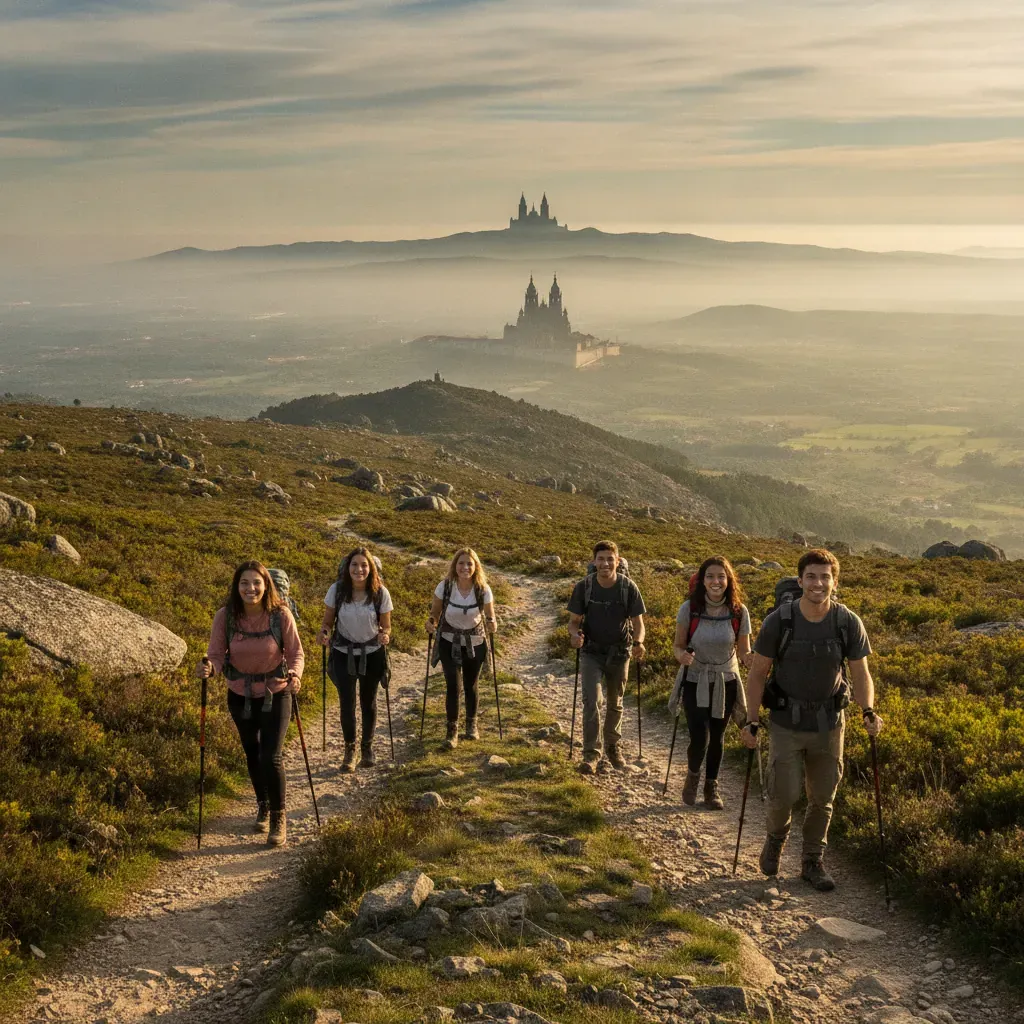
The Portugal-based Amor de Deus Foundation has deployed its annual pilgrimage scheme, escorting over 100 students from Cascais and Porto toward Santiago de Compostela—a 110-kilometer trek designed to teach endurance, introspection, and teamwork in equal measure. The initiative, now in its 23rd year, treats long-distance walking not as mere recreation but as a core pedagogical tool, one that targets competencies the classroom cannot replicate.
Why This Matters:
• Over 500 students since 2003 have completed the multi-day journey, which removes pupils from urban rhythms and places them under physical and psychological strain.
• The route begins in Valença, crosses into Galicia, and culminates in Santiago's Praça do Obradoiro, a symbolic endpoint for pilgrim culture.
• Monitors report that the hardest lesson is patience management—coordinating groups with wildly different stamina levels and morale thresholds.
• Similar experiential programs are proliferating across Portuguese schools, signaling a wider pivot toward outdoor education as complement to traditional academics.
Learning Through Physical Struggle
António Filipe Barbosa, president of the Amor de Deus Foundation, frames the pilgrimage as metaphor. "The path is a representation of life itself," he said before this week's departure. "You manage your own fatigue, but also that of your companions. That negotiation is rarely taught in a city that values speed over deliberation."
The route is neither trivial nor symbolic. Students wake before dawn, shoulder rucksacks, and clock between 20 and 25 kilometers daily for six consecutive stages. The final leg—Padrón to Santiago—serves as a climax, funneling weary teenagers into the heart of Galician pilgrimage tradition. Muscle soreness is guaranteed; blisters are common. Yet organizers insist the discomfort is the curriculum.
Benedita and Beatriz, both 20 and enrolled at the Porto campus, returned this year as volunteer monitors after completing the trail as students. Their brief: shepherd groups of 15-year-olds, some brimming with energy, others dragging behind. "The most challenging aspect is patience," Benedita explained. "You have wildly different rhythms in a single cohort. Keeping everyone moving without losing cohesion is complicated logistics."
Beatriz, in her fourth consecutive year as a monitor, has refined her strategy: "You need to pull music out when morale dips, push them forward physically when legs falter, and sustain energy reserves when your own are depleted. It's essentially crisis management stretched over multiple days."
The Scale of Pilgrimage in Iberia
The Camino de Santiago network recorded 530,987 Compostela certificates issued in 2025—the highest figure on record. Portuguese pilgrims accounted for 22,821 arrivals, making Portugal the fourth-largest source nation. The Caminho Português, the route most accessible to residents of Portugal, surpassed 100,000 walkers for the first time, growing 20% year-on-year and cementing its status as the second-busiest trail after the Camino Francés.
That surge has educational implications. Schools across Portugal now view the Caminho not merely as religious infrastructure but as a ready-made laboratory for character formation. The Politécnico de Viana do Castelo recently concluded a three-year Projeto Pegadas, co-financed by the Interreg VI-A Espanha-Portugal 2021–2027 program, which sent 158 young people on nine expeditions blending hiking, vocational skills workshops, and cross-border collaboration. The initiative closed in February 2026 with a mandate to improve youth employability through experiential learning.
Earlier this June, students from the Agrupamento de Escolas de Barroselas completed a final-stage walk from São Martinho de Teo to Santiago's cathedral, framing it as an interdisciplinary exercise spanning history, geography, and religious studies. Meanwhile, the Federação Portuguesa do Caminho de Santiago is recruiting volunteers aged 18–30 for its "New Footsteps on the Camino" program, with a 14-day team expedition scheduled along the Caminho Português Interior this week.
What This Means for Residents and Families
For families in Cascais and Porto with children enrolled in Amor de Deus schools, participation is voluntary but strongly encouraged from grade 9 onward. The foundation also organizes adult pilgrimages for parents and alumni, having run a Camino Francés edition for guardians between April 26 and May 2 this year. Fees cover transport, accommodation in hostels, and group meals, though exact figures were not disclosed.
The broader trend suggests that outdoor pedagogy is embedding itself in Portugal's private and public school sectors. International schools worldwide have adopted similar models—forest schools, winter yurt camps, and multi-day alpine treks—treating nature as a classroom annex. In Portugal, the Caminho's proximity and cultural resonance offer a turnkey solution: a well-marked, historically dense trail network that requires little infrastructure investment yet delivers measurable developmental outcomes.
Parents weighing participation should anticipate genuine physical demands. Students report blisters, exhaustion, and emotional volatility during the journey. Monitors emphasize that the learning hinges on discomfort—on the gap between expectation and reality, between what the body can tolerate and what the mind believes it can endure.
The Introspective Dimension
Rui Marques, a 21-year-old Cascais native who has completed the pilgrimage multiple times, identifies a quieter dimension. "Physically, you learn to sacrifice—to keep moving despite pain," he said. "Mentally, the real achievement is introspection. You exit your routine, stop, and confront internal problems. If you cannot do that on the trail, navigating normal life becomes exponentially harder."
Barbosa echoes that sentiment. "The idea of slowness—that the path requires the necessary steps and the necessary time—offers a radically different lens on reality," he noted. "It creates space for an encounter with oneself. In a context where urban life is acceleration and distraction, that encounter is rare."
The Foundation's 2003 founding principle held that schools cannot remain walled institutions if they aim to cultivate resilient adults. Two decades later, the hypothesis has evolved into doctrine. The Caminho, in this framework, is not an escape from education but a concentrated dose of it—one where the syllabus is humility, the exam is exhaustion, and the grade is self-knowledge.
The Broader Educational Pivot
Research on religious and cultural pilgrimages confirms measurable developmental gains. Studies indicate that adolescents who engage in structured spiritual or cultural journeys show improved life satisfaction, emotional resilience, and cooperative behavior in adulthood. The mechanism is multifactorial: enforced social proximity builds empathy; physical challenge recalibrates stress tolerance; and the removal of digital distractions allows cognitive reset.
International schools have long integrated multi-day expeditions into curricula, framing them as non-negotiable rather than extracurricular. The Riverstone International School, for instance, mandates winter camping, rafting, and multi-day trekking. The Hakuba International School ties academic content—geology, ecology, history—to field experiences, arguing that embodied learning produces deeper retention than textbook study.
Portugal's growing adoption mirrors that logic. The Caminho offers a pedagogical asset that requires no invention—only activation. The trail already exists; the cultural narrative already resonates; the infrastructure already functions. Schools need only commit to the principle that walking 110 kilometers is as educationally valid as sitting through 110 hours of lectures.
Volunteers who staff these expeditions, many of them former participants, describe a feedback loop. Beatriz noted that mentoring younger students while managing her own fatigue sharpened her leadership instincts more effectively than any classroom simulation. "You cannot fake patience when someone's feet are bleeding and they refuse to move," she said. "You either learn to motivate under pressure or you fail visibly."
The Praça do Obradoiro awaits, 60 kilometers from where this year's cohort stood mid-week. The final stretch—Padrón to Santiago—will compress the lessons of previous days into a single, ceremonial push. Monitors will sing; students will limp; someone will cry. And when the cathedral's spires appear, the metaphor Barbosa invokes will resolve into concrete memory: the body remembers what the mind forgets, and the path, however slow, eventually ends.