

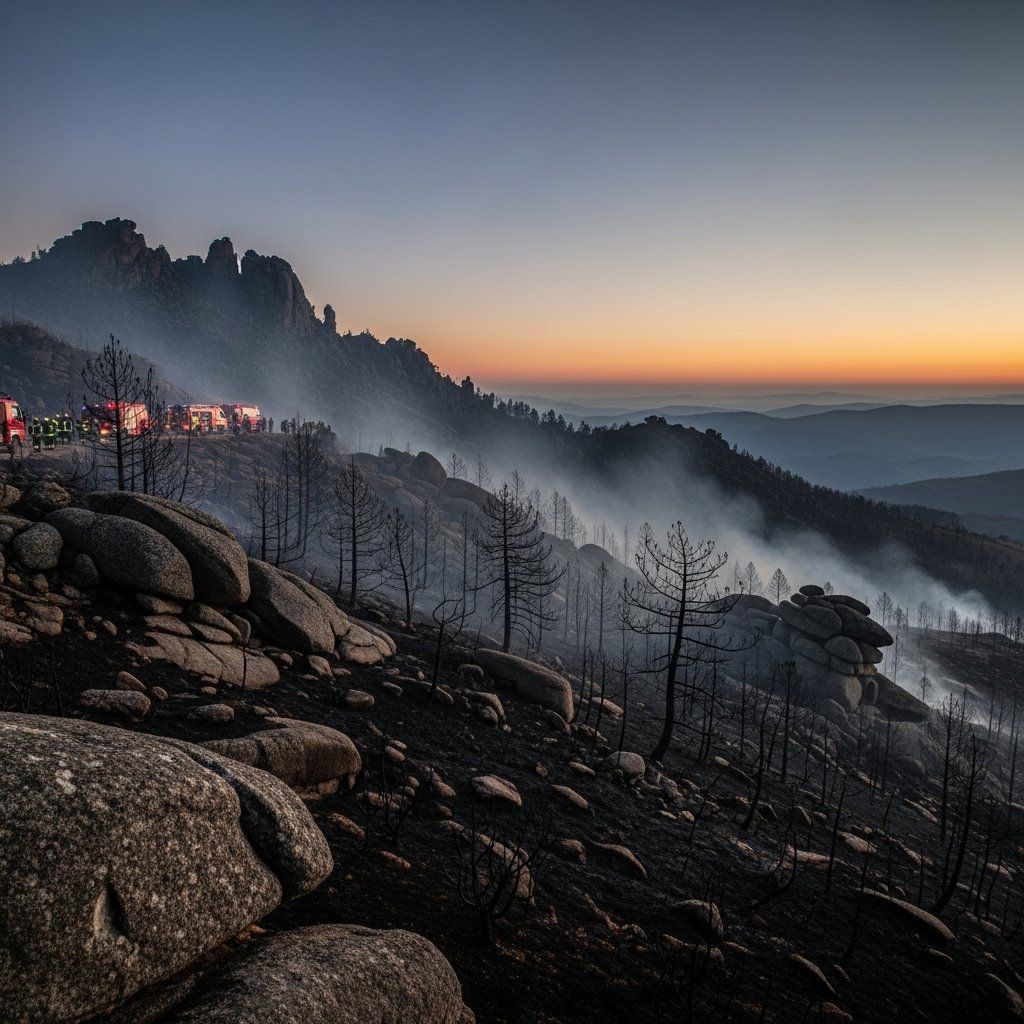
Firefighters brought a rural blaze in Lourinhã under control within hours, preventing any threat to homes in a region where September's extreme heat and dry conditions keep emergency teams on constant alert.
Why This Matters
• No homes at risk despite the fire spreading through forest and brushland in the Planalto das Cezaredas plateau
• Peak response involved 4 aircraft, 172 firefighters, and 49 vehicles mobilized across the Lisbon District
• Resolution phase declared by late afternoon on 3 September, with operations scaling down significantly
• The incident underscores persistent wildfire risks throughout Portugal's early September period
Rapid Response Contains Blaze
The Sub-Command of Emergency and Civil Protection of the West confirmed that the fire entered resolution status shortly after 16:30. What began at 12:46 in the Planalto das Cezaredas — a plateau characterized by dense scrubland and forest cover — required a substantial deployment from emergency services across the region.
At its height, the operation involved four water-dropping aircraft coordinating with ground teams. By 15:00, with flames still active across forest and mato (brushland) terrain, 169 firefighters supported by 47 vehicles were engaged in suppression efforts.
The scale-down proceeded quickly. By 16:45, aerial support had reduced to a single aircraft monitoring hotspots, with 161 personnel remaining to ensure complete containment.
Geography That Challenges Firefighters
Planalto das Cezaredas presents particular difficulties for fire suppression. The plateau's continuous forest cover and accumulated biomass create conditions where flames can intensify rapidly and spread across tree canopies. The area's mix of eucalyptus and pine — species known for high combustibility — adds to the strategic complexity.
No residential areas faced direct threat during this incident, a notable outcome given the plateau's proximity to scattered rural properties typical of the Lourinhã municipality.
Context: A Season of Elevated Risk
The fire erupted during a period when Portugal's Institute for Nature Conservation and Forests (ICNF) had signaled heightened danger. Weather forecasts for 2-4 September indicated high temperatures combined with low humidity — classic conditions for rapid fire spread.
National data from 2025 reveals a troubling pattern in wildfire causes: approximately 31% of investigated fires proved intentional, while another 23% stemmed from controlled burns that escaped management. The presence of so-called "ultra-combustible eucalyptus" continues to feature in discussions about Portugal's fire vulnerability.
While authorities have not specified the cause of the Lourinhã incident, the broader context of inadequate fuel management remains a systemic concern. Dense forest stands, insufficient clearing of dead organic matter, and lack of firebreaks all contribute to conditions where suppression becomes exponentially more difficult.
Municipal Prevention Infrastructure
The Lourinhã Municipal Civil Protection Service operates under a Program of Integrated Rural Fire Management, successor to earlier municipal defense plans. Its responsibilities include annual operational planning, forest space management oversight, and public awareness campaigns.
The municipality's Commission for Integrated Rural Fire Management coordinates prevention and response strategies, balancing local needs with national protocols. However, the persistence of fires like this one highlights the gap between policy intentions and on-the-ground forest management realities.
What This Means for Residents
Immediate Impact: Residents in the Planalto das Cezaredas area can expect continued firefighter presence through the weekend as teams complete mop-up operations and monitor for rekindling. Smoke may linger in low-lying areas during morning hours.
Prevention Requirements: Property owners in forest-adjacent zones maintain legal obligations to create defensible space buffers around structures. The 50-meter management zone requirement remains enforceable, with municipal inspectors authorized to issue compliance orders.
Insurance Considerations: Fire incidents during high-risk periods typically trigger claims review processes. Affected landowners should document any losses before cleanup begins.
Broader Implications: Each September wildfire reinforces Portugal's vulnerability during the critical late-summer window. The national emergency response system demonstrated its capacity to mobilize quickly, but prevention through forest management reform remains an unresolved challenge. For residents across the Lisboa District, particularly those in the western coastal municipalities, monitoring emergency alerts through official channels remains essential throughout the current high-risk period.
The Lourinhã incident ended without structural damage or injuries — a measure of success. But the conditions that made it possible persist across thousands of hectares of Portuguese forest, where accumulated fuel loads and continuous tree cover await the next ignition source.


