
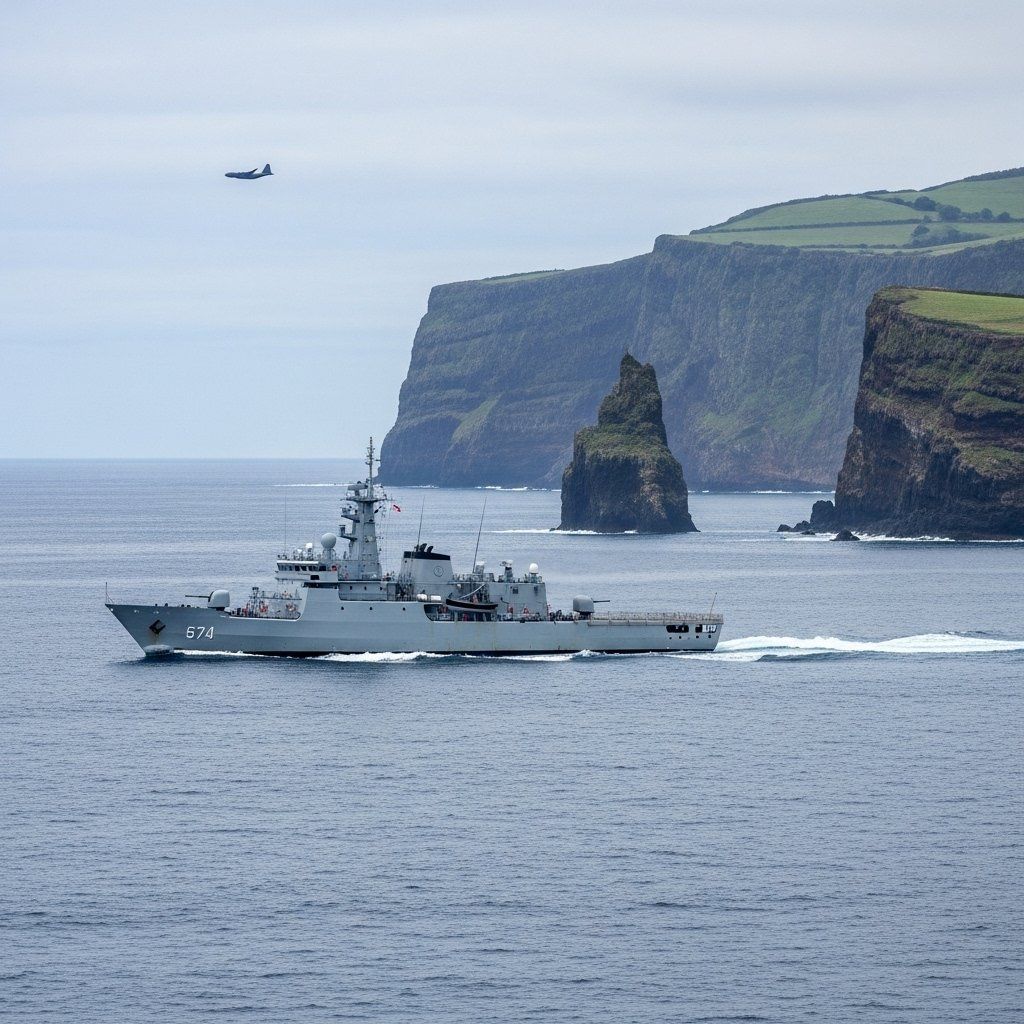
A Northern Gamble: Why Portugal Is Betting on Arctic Security
Portugal is positioning itself as a serious Arctic player—not because the nation has territorial claims in the High North, but because geopolitics increasingly demands it. The decision to commit resources and naval capacity to NATO's Arctic Sentry mission signals that Lisbon recognizes the thawing polar frontier as central to European security, economic opportunity, and strategic autonomy. Augusto Santos Silva, the former defense and foreign minister, framed the move plainly: a modern European Atlantic nation cannot remain indifferent to what happens above the Arctic Circle.
Why This Matters
• Portugal joins a NATO maritime coalition tasked with strengthening security across Atlantic and Arctic waters—a commitment that will reshape defense spending priorities.
• Greenland's status remains a significant concern for Lisbon and the entire EU; Portuguese leaders have emphasized that territorial integrity and international law cannot be compromised.
• Europe is mobilizing substantial joint defense resources for maritime and strategic initiatives, with Portugal participating in efforts that will demand sustained investment.
• Melting ice opens new shipping lanes and mineral reserves, making Arctic engagement an economic calculation, not just a military one.
The Atlantic Identity Card
When Portuguese leaders talk about the Arctic, they rarely mention polar bears or ice caps. Instead, they invoke geography. During a debate at the Palacete Silva Monteiro in Porto, Santos Silva delivered remarks emphasizing a central assertion: Portugal is not just European; it is profoundly Atlantic. That identity, he insisted, obliges the country to engage wherever Atlantic security is challenged, even if that means deploying naval assets to distant waters.
This framing matters because it allows Portugal to frame Arctic participation not as mission creep or opportunism, but as a natural extension of existing commitments. The nation already carries responsibility for vast oceanic airspace and maritime jurisdiction spanning from the continental shelf to waters near Greenland. The Portuguese Navy has operational experience in challenging maritime environments, yet the country lacks a formal national Arctic policy. That gap underscores how quickly the strategic landscape shifted. Three years ago, Arctic engagement would have seemed peripheral. Today, it is unavoidable.
The Greenland Question and Strategic Concerns
Lurking beneath every Portuguese statement about Arctic commitment is a singular concern: what happens if territorial integrity and international law become negotiable? U.S. President Donald Trump has repeatedly asserted interest in Greenland, challenging Danish sovereignty and suggesting that economic pressure or other means might change Copenhagen's mind. That rhetoric, which most European capitals initially dismissed as posturing, has become a serious point of diplomatic focus.
Santos Silva's response was direct and historical. He emphasized that Portugal must tell Washington "no—with firmness and clarity." More pointedly, he invoked historical lessons, noting that democracies have made grave errors through appeasement, and Europe must avoid similar mistakes in its approach to any actor—even an ally.
Portuguese leaders have signaled unified concern about Greenland's status. The consistent message from Lisbon is that Greenland's future must be determined by Greenlanders and Denmark according to international law and principles. These are not rhetorical gestures. They represent a fundamental recalibration—Portugal is signaling that when core international norms are threatened, European solidarity is essential.
The Cost of Commitment
Here's where abstraction meets practical reality. Portugal's Arctic pledge translates into specific defense outlays. NATO members have committed to expanding maritime and polar capabilities in coming years. For a medium-sized economy like Portugal, already under pressure from Brussels to hit the 2% of GDP defense spending floor, this means sustained investment.
The European Union has proposed joint defense initiatives requiring significant combined commitment through the coming decade. Portugal is engaged in maritime and strategic security tracks—critical infrastructure protecting transatlantic connectivity, undersea communications, and new strategic corridors. Yet Santos Silva explicitly rejected the premise that social spending must shrink to accommodate military investment. He called the idea a "dangerous and impossible trade-off", advocating instead for a "gradual approach" that extracts economic and technological returns from defense outlays.
That argument carries political weight at home, where social services remain fragile and public skepticism about military budgets runs deep. The government's position is that investing in modern maritime capabilities, training infrastructure, and command-and-control systems also generates commercial spillovers—private shipyards gain expertise, workers acquire specialized skills, dual-use technologies proliferate into civilian sectors. Whether this materializes as promised is another question.
Resources, Routes, and Rivalry
Strip away the geopolitical posturing, and the Arctic engagement becomes intelligible through supply chains. Climate change is opening year-round shipping corridors between Europe and Asia, slashing transit times and disrupting established trade patterns. More crucially, melting ice exposes mineral deposits—rare earth elements, copper, nickel, zinc—that Europe desperately needs for renewable energy systems, battery production, and semiconductor fabrication.
The European Union has invested substantial resources in Arctic research, seeking to map resources while maintaining environmental stewardship. China has quietly expanded its Arctic footprint through investments in Greenlandic infrastructure and mineral exploration. Russia has militarized its polar territories aggressively. For Lisbon, the calculus is clear: absence from Arctic governance means exclusion from resource negotiations, shipping route protocols, and strategic alliance-building in a region reshaping global economics.
Portuguese engagement in Arctic security initiatives also anchors the country's relevance within NATO at a fraught moment. When U.S. reliability appears uncertain and European capitals are questioning whether transatlantic solidarity is reciprocal, Portugal's willingness to contribute to Arctic operations signals steadiness. That matters for a nation whose geographic position—commanding Atlantic approaches and anchoring NATO's southern flank—gains new strategic weight as Arctic sea lanes merge with traditional North Atlantic corridors.
The Infrastructure Question
Operationalizing Arctic commitment requires tangible infrastructure investments. NATO coordination structures are expanding to synchronize national Arctic contributions into coherent operational approaches. For Portugal, this means several practical changes.
First, specialized training. Portuguese military personnel operating in Arctic conditions will require appropriate qualifications—understanding operations in extreme cold, managing equipment in harsh environments, and specialized safety protocols. Personnel will need winterized gear and specialized training for polar operations. Portugal already participates in allied exercises involving Arctic-capable nations, but institutionalizing this capability demands investment.
Second, logistics. Existing Portuguese naval facilities will require upgrades to support Arctic-bound operations and maintain expanded capabilities. Supply chains for specialized equipment will need strengthening.
Third, intelligence. Portugal is committing to enhanced maritime domain awareness across Arctic waters—meaning expanded surveillance coordination, enhanced monitoring capabilities, and deeper integration into NATO's intelligence-sharing architecture. This is expensive and ongoing.
What Ordinary Citizens Face
For residents and taxpayers, Arctic engagement translates into several second-order consequences. Defense spending will likely increase gradually but persistently—the government insists it won't slash pensions or healthcare, but budget pressures eventually trickle downward. Workers and investors eyeing Portuguese shipbuilding, aerospace, and dual-use technology sectors may find opportunities as defense capabilities expand. Conversely, if U.S.-EU trade tensions escalate—particularly over disputes involving Greenland or tariffs—Portugal's export-oriented economy could suffer collateral damage in wine, textiles, and tech sectors.
Energy security, another concern for residents managing heating and utility costs, could improve as Arctic engagement secures alternative shipping routes and access to resource-rich regions. Alternatively, prolonged geopolitical friction creates uncertainty that dampens investment and growth.
The Principle of Firmness
Santos Silva's historical references revealed something deeper than diplomatic rhetoric. They suggested that Portuguese and European strategic thinking has undergone a fundamental reorientation. The notion that Western security depends on unconditional deference to the strongest ally no longer commands consensus in Lisbon or Brussels. Instead, there is growing acceptance that effective multilateralism requires guardrails, including firmness toward partners when they violate shared norms.
This stance reflects a broader European consensus, with leaders across the continent emphasizing that territorial aggression—even by an ally—would trigger serious consequences. Germany, France, Poland, Spain, and the Nordic capitals have similarly emphasized red lines on international law and territorial integrity. The collective signal is unmistakable: Europe must act with unified strength.
For Portugal, a small nation historically cautious about openly contesting U.S. preferences, this marks a notable shift. Committing to Arctic security partnerships that strengthen NATO cohesion, while simultaneously affirming European red lines on Greenland and international law, represents a calculated bet that Europe's best interests lie in unified strength, not fragmented deference.
Decade of Test and Commitment
The coming years will determine whether Portugal's Arctic pivot becomes a credible strategic investment or remains symbolic. The nation's capacity to maintain capabilities, sustain defense budgets, and contribute meaningfully to Arctic operations depends on economic stability and political will. Both remain uncertain in an era of geopolitical volatility and budget pressures across the EU.
What is certain is that Portugal can no longer treat the Arctic as distant or irrelevant. Rising powers, melting ice, contested resources, and unpredictable allies have made the High North central to European security architecture. Lisbon's decision to engage seriously—anchored in Atlantic identity and buttressed by explicit commitment to international law and Greenland's sovereignty—suggests that Portugal's leadership recognizes the stakes. Whether citizens and taxpayers accept the implied costs is a separate, and ongoing, negotiation.



