

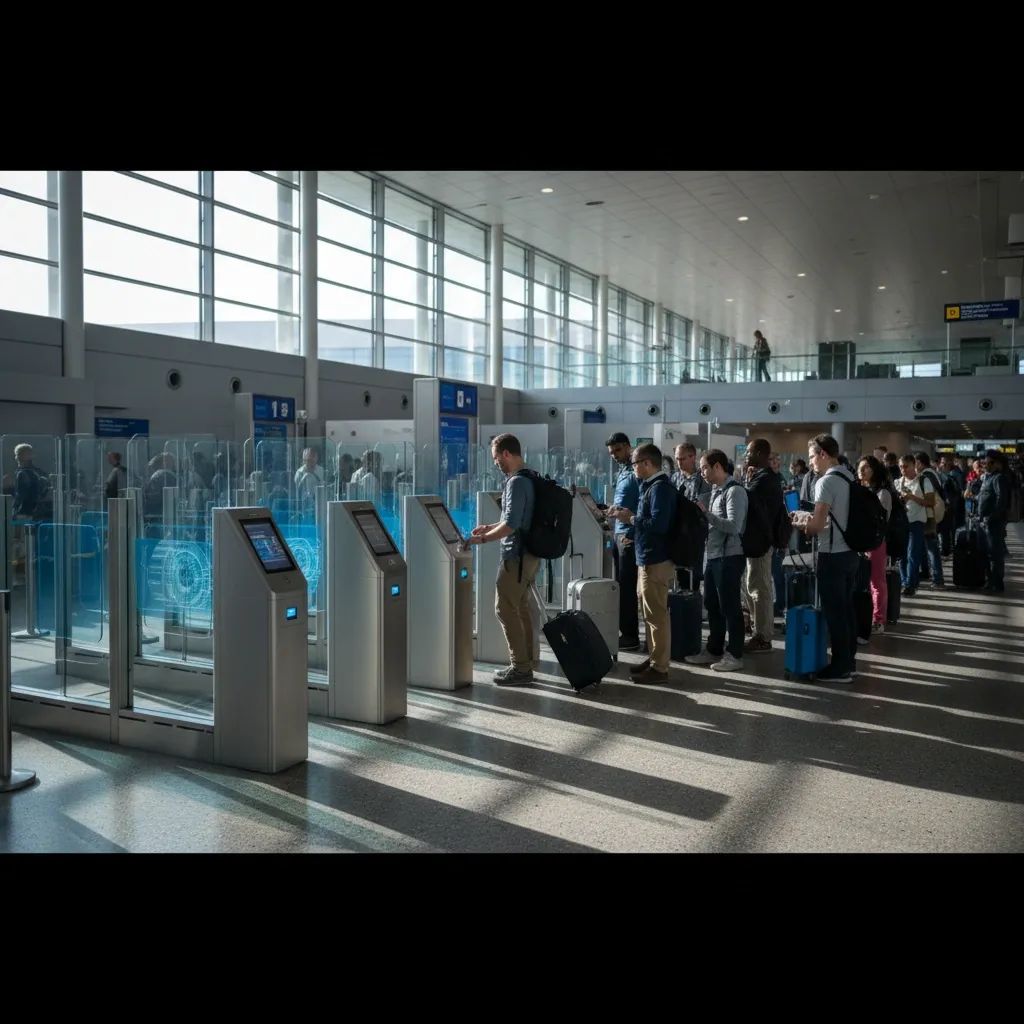
The Portugal Ministry of Internal Affairs has confirmed that Lisbon's Humberto Delgado Airport will deploy additional manual border control booths starting 29 May, alongside a phased rollout of more automated e-gates and a scheduled staffing surge in July. The measures aim to address mounting passenger frustration after repeated border control delays exceeded 2 hours at Porto and 90 minutes at Lisbon and Faro this past weekend.
Why This Matters
• Immediate relief: Extra manual control lanes open at Lisbon on 29 May, with more e-gates to follow and PSP staff reinforcements from July onward.
• EU system complications: The Entry/Exit System (EES), which collects facial images and fingerprints from non-Schengen travelers, has been operational since 12 October 2025 and remains the primary cause of backlogs.
• Summer peak ahead: With June and July arrivals projected to climb, authorities acknowledge that temporary suspension of biometric capture may be necessary during peak congestion or system outages.
• Reputation at stake: Prime Minister Luís Montenegro and Infrastructure Minister Miguel Pinto Luz both admitted that chronic delays are damaging Portugal's image as a reliable tourism gateway.
What Broke the System
Since the EES replaced passport stamps with digital biometric records last October, wait times have spiraled. The system requires border officers to photograph and fingerprint every arriving traveler from outside the Schengen Area—a process that averages 30 to 90 seconds per passenger in ideal conditions but can stretch beyond 5 minutes when systems falter. On 17 May, Porto's border hall logged 130-minute queues, Lisbon reached 110 minutes, and Faro hit 100 minutes, according to PSP data. Approximately 69,000 passengers passed through non-Schengen controls across the three airports that day alone.
Technical and software glitches compounded the problem. The ministry cited "sporadic IT failures" alongside ongoing construction in operational zones and the concentration of flights in short windows. On 16 May, departures at Lisbon slowed for more than an hour owing to what PSP described as "technical/IT difficulties." A 30-minute outage on 19 May triggered fresh delays.
Infrastructure and Staff Reinforcements
The Portugal Ministry of Internal Affairs has outlined a three-pronged response. First, expansion work in the arrivals hall at Lisbon will wrap up by the end of the month, adding square footage to ease crowding. Second, the number of manual control booths will rise from 29 May, giving officers more lanes to process passengers when biometric kiosks jam or slow. Third, the count of automated e-gates—which read passport chips and verify facial images without human intervention—will increase, though the ministry has not published a target figure. Finally, the PSP will deploy additional officers to border duty starting in July, a timeline that has drawn criticism given the summer surge is already underway.
Infrastructure Minister Miguel Pinto Luz told reporters on 18 May that the arrivals-zone expansion should yield "better service quality in the coming weeks, in the next month." He acknowledged that the EES has real problems and warned that Portugal's international standing is on the line. "We cannot compromise airport service, we cannot compromise the country's image," he said, adding that biometric collection will be paused whenever queues or server failures threaten to paralyze operations.
The Ryanair Ultimatum and Government Response
On 8 May, Ryanair publicly called on Lisbon to suspend EES until September, arguing that the high season will amplify current bottlenecks. The carrier pointed to parallel chaos at airports in Spain, France, and Italy, where similar biometric rollouts have generated three-hour queues and caused passengers to miss connections. France's Groupe ADP, which runs Paris Charles de Gaulle and Orly, had earlier requested a summer postponement, warning that the 30-to-90-second biometric capture per passenger would create congestion its terminals "cannot physically absorb." Milan's airport recorded over 100 missed flights in April due to EES delays.
Portugal's government rejected a blanket suspension. The ministry confirmed that the country "maintains its commitment to operate [EES] in compliance with European Union law" and that no general halt is planned. However, EU regulations permit temporary operational measures, including biometric-capture pauses, at individual border crossings when traffic intensity threatens excessive wait times. The PSP retains authority to toggle biometric collection on and off, and "during temporary suspensions, border control fulfills all defined security protocols," the ministry said, with fingerprint and photo capture resuming once queue benchmarks normalize.
Prime Minister Luís Montenegro echoed that stance during the inauguration of coastal stabilization works in Moledo, Caminha, on 18 May—a €180,000 project. He told journalists that the government is "dissatisfied" with border-service performance, particularly in Lisbon, and pledged to push reforms "to the limit." If delays persist, he said, "we will take tougher measures," leaving open the door to broader biometric suspension or even a formal EES pause.
What This Means for Residents
For anyone flying into or out of Portugal over the coming months, the practical advice is straightforward: add at least 90 minutes of buffer time to your airport arrival, especially on weekend mornings when non-Schengen flights cluster. If you hold dual citizenship—Portuguese plus a non-EU passport—use your Portuguese document at all touchpoints to bypass the biometric queue entirely. Schengen travelers, including those moving between Portugal and Spain or France by land, face no EES requirements because internal borders remain open.
The economic cost is mounting. In the first quarter of 2026, more than 2 million passengers at Portuguese airports experienced delays or cancellations, and 36.2% of all flights suffered disruption. Over 63,000 passengers qualified for EU compensation owing to delays beyond three hours, cancellations, or missed connections. For individual travelers, the average out-of-pocket expense from a significant delay—meals, replacement tickets, overnight accommodation—can reach €340 or more, according to industry surveys. Airlines and ground handlers bear additional losses; global estimates peg flight-disruption costs at roughly $60 billion annually, raising ticket prices by 5% to 15%.
Tourism operators worry that repeated headlines about six-hour waits will deter future bookings. Portugal welcomed record visitor numbers in 2025, and any perception of unreliable infrastructure risks steering travelers toward competing Mediterranean destinations. The ministry's timetable—expanded booths by late May, more e-gates through June, extra staff in July—suggests that meaningful relief may not arrive until mid-summer, precisely when demand peaks.
European Context and Long-Term Outlook
Portugal is not alone. Spain has seen similar bottlenecks at Madrid-Barajas, Barcelona-El Prat, and Málaga-Costa del Sol. Italy logged three-hour queues at Milan in April. France's Paris airports began phased EES deployment in October 2025 and reached full operation in April 2026, prompting the airport operator to warn publicly that summer volumes would overwhelm capacity. Across the Schengen zone, Airports Council International Europe, IATA, and the Association of European Airlines have flagged chronic understaffing at border posts and unresolved software bugs.
The European Commission designed EES to tighten security, automate the 90-in-180-day visa calculation, and eliminate passport stamps. The official "Travel to Europe" mobile app allows advance registration of personal details, but biometric capture—fingerprints and facial image—must still occur in person at the border. Some hubs have installed self-service kiosks to offload officers, yet uptake remains patchy and the technology prone to glitches.
Within Portugal, the Humberto Delgado hub has posted the worst on-time-departure rate among major European airports—only 49% in 2025—and ranks among the world's highest risks for missed connections. Construction of the new Lisbon airport at Campo de Tiro de Alcochete, with a first runway targeted for 2030, will eventually relieve structural congestion, but that solution lies four years away. Meanwhile, terminal-expansion works at the existing airport face environmental-assessment requirements and legal disputes.
Until July's staff reinforcements materialize and software stability improves, passengers should prepare for volatility. The government's willingness to pause biometric collection offers a safety valve, but it also underscores the system's fragility. Whether the Ministry of Internal Affairs and PSP can deliver the promised "better service quality in the next month" will determine whether Portugal salvages its summer season—or cements a reputation for border chaos that lingers far longer than any queue.


