The Portugal Judiciary will be the forum where former French police officer Cédric Prizzon faces justice for two homicides committed in March on Portuguese soil, despite pressure from French authorities for his return. The 42-year-old ex-cop remains in preventive detention at the Guarda Prison, charged with eight crimes including two counts of qualified homicide, two counts of corpse desecration, kidnapping, domestic violence against a minor, document forgery, and illegal firearm possession.
Why This Matters
• The Coimbra Court of Appeal rejected a European Arrest Warrant from France, ruling that because the killings occurred wholly or partially on Portuguese territory, the trial must proceed here.
• Prizzon faces life in prison under Portuguese law; he was intercepted by the Guarda Nacional Republicana (GNR) on March 24 during a routine traffic stop in Mêda, carrying two children, false documents, a firearm, and €17,000 in cash.
• The case showcases cross-border judicial cooperation between Portugal's Polícia Judiciária (PJ) and French investigators, who pieced together a timeline spanning three countries.
• Victims' families wanted the trial held in France, but Portuguese jurisdiction prevails because the fatal acts occurred within national borders.
How a Custody Battle Turned Into a Double Homicide
Court documents from Vila Nova de Foz Côa Tribunal and French police reports published by Le Monde paint a chilling picture of premeditation. Prizzon had lost custody of his 12-year-old son in 2021 after illegally taking the boy to Spain. That decision triggered a relentless online campaign against his ex-partner, Audrey Cavalié, whom he accused of endangering their child. He joined fathers' rights groups and posted videos on Facebook, casting himself as the "real victim" of the French justice system.
On March 19, Prizzon drove to Cavalié's home in Vailhourles, Aveyron, and launched what investigators described as a "violent and bloody assault." French forensic teams found blood spatter patterns in the bathroom—on the bathtub, walls, towel rack, and a bag left on the floor. Crucially, they also documented cleanup attempts, including wiped stairs leading to the property. Cavalié, 40, was bound at the wrists, gagged with adhesive tape, and forced into the trunk of Prizzon's vehicle. Their son was placed in the back seat.
After swapping vehicles—the van was later seized in Portugal—Prizzon drove to Lourdes, where he met his current partner, Angela Legobien-Cadillac, 26, and their 18-month-old daughter. According to the Portuguese judicial record, Angela confronted Prizzon because he had failed to fulfill his promise: abandoning Audrey alive on a roadside. The tension escalated.
The Final 72 Hours on Portuguese Roads
On March 22, Prizzon and Angela argued again. He strangled her. Immediately afterward, he dragged Cavalié from the van and killed her as well. The autopsy report, conducted in France, noted "particularly striking violence." Cavalié showed ligature marks on her wrists and ankles, leg bruising, and multiple signs of asphyxiation. Angela also died from asphyxiation and had facial trauma.
Prizzon loaded both bodies into the van, stopped at an agricultural equipment store to buy a shovel, and drove to the Serra da Nogueira, a remote mountain range in the Bragança district. Between the night of March 22 and 23, on a dirt track, he ordered his 12-year-old son to stand watch while he dug a shallow grave. The bodies were covered only with vegetation. The shovel was discarded a step away.
"I had no choice," he reportedly told the boy.
Interception and Jurisdictional Standoff
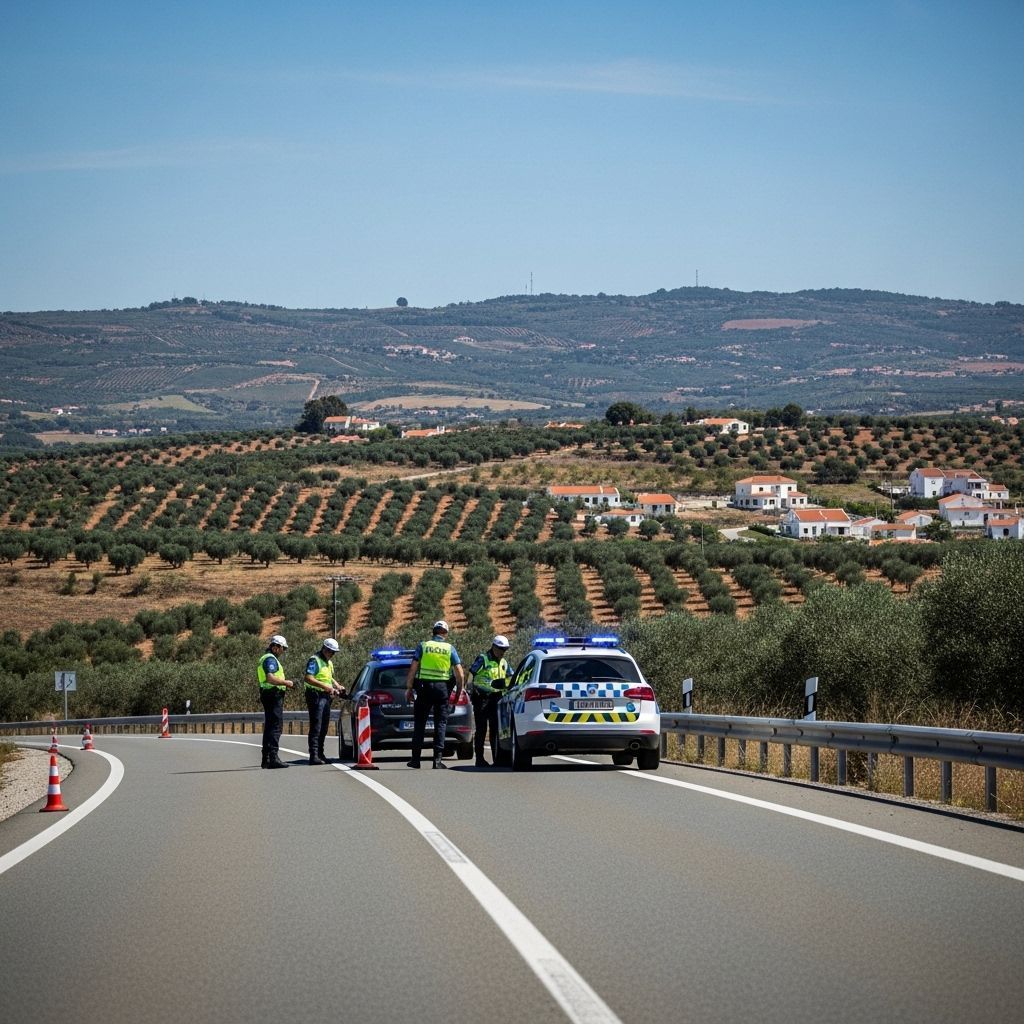
Around 3 p.m. on March 24, GNR officers conducting a routine traffic checkpoint near Mêda—roughly 100 kilometers from the burial site—stopped Prizzon. He was traveling with both children: the 12-year-old boy and the toddler. Authorities found forged identity documents, an illegal firearm, and €17,000 in cash. His stated destination was Morocco.
The Polícia Judiciária, working closely with French counterparts, used information provided by Prizzon's older son to locate the bodies. The collaboration between French magistrates in Montpellier and the PJ in Bragança was pivotal in reconstructing the crime timeline.
What This Means for Residents
Portugal's assertion of jurisdiction in this case reflects the principle of territoriality enshrined in criminal law: crimes committed on Portuguese soil are prosecuted under Portuguese statutes. The Coimbra Court of Appeal's refusal to honor the European Arrest Warrant from France sends a clear signal that when offenses—especially those as serious as qualified homicide—occur within national borders, the Portuguese legal system takes precedence, even when the suspect and victims are foreign nationals.
For expats and long-term residents, the case underscores the robustness of cross-border policing cooperation under the Schengen framework. The GNR's routine traffic stop, which snared a suspect carrying forged papers and a firearm, demonstrates the effectiveness of random law enforcement checks on secondary roads. The incident also highlights the role of the Polícia Judiciária's international liaison units, which coordinated evidence-sharing and forensic analysis between jurisdictions in real time.
From a legal standpoint, Prizzon's case illustrates the full range of criminal liability under Portuguese law, from homicide and kidnapping to document fraud and weapons offenses. The inclusion of a domestic violence charge related to the minor child reflects Portugal's expansive interpretation of victim status, recognizing psychological harm inflicted on witnesses to extreme violence.
Profiling a Perpetrator: Obsession, Control, and Masculinist Rhetoric
Prizzon's trajectory from law enforcement officer to double murderer reveals a pattern of obsessive control and escalating violence. He served as a police officer in Toulouse and Paris but faced disciplinary issues. After losing custody in 2021, he monitored Cavalié constantly, participated in fathers' rights protests, and aligned himself with groups espousing masculinist rhetoric and misogyny.
A journalist who covered his activism described Prizzon as "unstable," "cunning," and "manipulative." His social media presence painted him as a wronged father, despite a record of domestic violence convictions, harassment, and failure to present a child as ordered by a French court. Experts note that such crimes are driven not by genuine parental concern but by an inability to accept separation and a compulsion to possess.
In his confession to Portuguese authorities, Prizzon blamed the French judicial system and both women, maintaining his victim narrative even after strangling two people and forcing his son to witness the burial.
Trial Timeline and Next Steps
Prizzon awaits trial at the Guarda Prison. The Vila Nova de Foz Côa Tribunal is expected to handle preliminary hearings, with the full trial likely to proceed later this year. Given the gravity of the charges—qualified homicide under Portuguese law carries a maximum sentence of 25 years—the proceedings will be closely watched by legal observers in both countries.
The families of Cavalié and Legobien-Cadillac have expressed frustration that the trial will not occur in France, where they reside and where support networks are accessible. However, Portuguese law offers no discretion: crimes committed on national soil must be prosecuted domestically, regardless of the nationality of the accused or victims.
The case also raises questions about European Arrest Warrant protocols when criminal conduct spans multiple jurisdictions. While the warrant system is designed to facilitate swift extradition, national courts retain the authority to refuse transfer when they hold primary jurisdiction—a principle the Coimbra Court of Appeal firmly upheld.
For now, the two children—one of whom provided critical testimony that led investigators to the burial site—are in the custody of French social services. The older boy, who spent days traveling with his father after witnessing the killings, faces a long road to recovery. The toddler, just 18 months old, lost her mother and faces an uncertain future.
Prizzon's arrest and detention serve as a grim reminder that routine law enforcement operations can intercept even the most meticulously planned crimes. The GNR's standard traffic stop, a fixture of daily policing in Portugal's interior districts, became the final barrier between a fugitive and his intended escape to North Africa.