

Why This Matters
• First national automotive award for a Chinese brand: The Leapmotor C10 REEV Hybrid won "Plug-in Hybrid of the Year" in March 2026, signaling shifting European perceptions of Chinese vehicle quality and innovation.
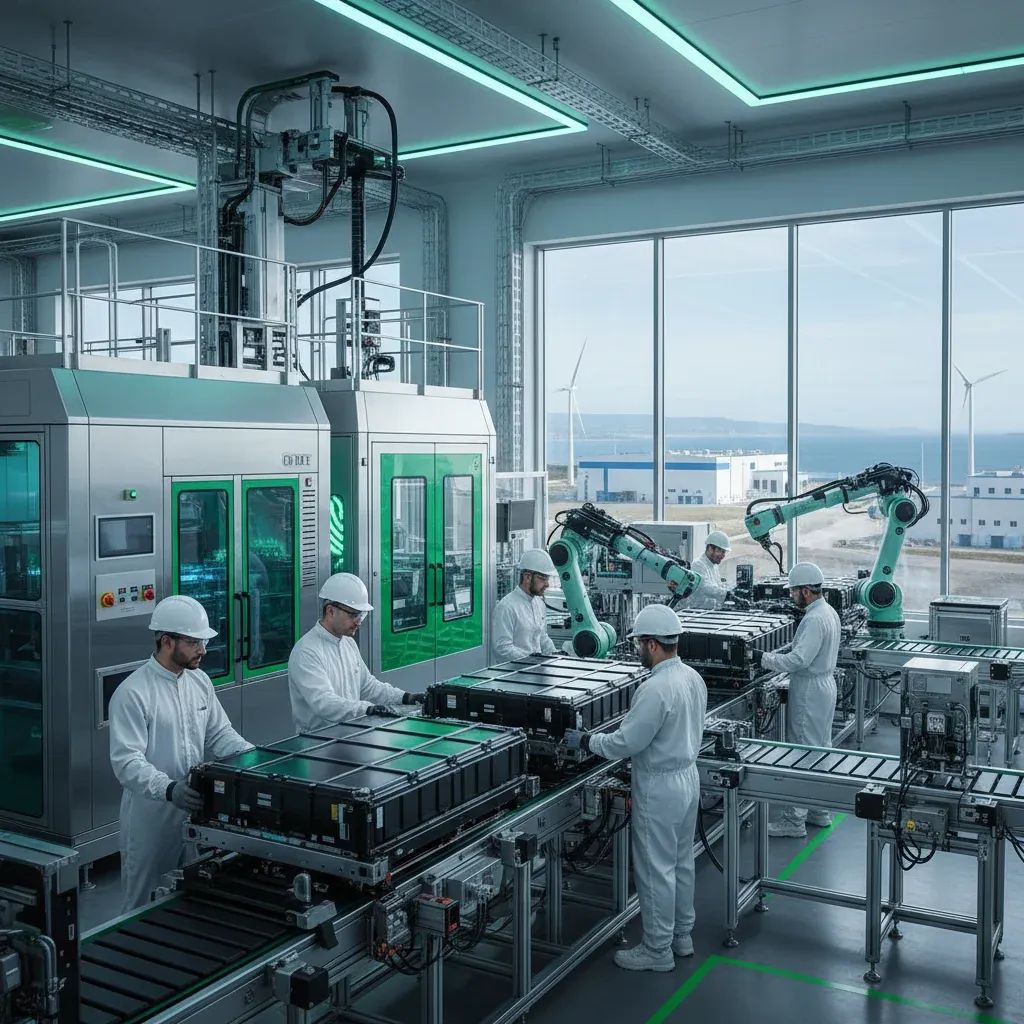
• Battery investment reshaping energy infrastructure: The CALB gigafactory in Sines (€2.06 billion) begins full operations this year, potentially creating hundreds of regional jobs and positioning Portugal as Europe's EV supply hub.
• Consumer choice expanding rapidly: Chinese marques now represent 8+ brands sold through established Portuguese dealership networks, with pricing and technology competitive against traditional European rivals.
Portugal's automotive ecosystem faces a turning point. Chinese manufacturers are no longer content selling imported vehicles through independent dealers—they're embedding themselves into the supply chain and exploring local assembly. For consumers, workers, and investors watching Portugal's industrial trajectory, understanding what this transformation means requires moving beyond the diplomatic speeches about "perfect combinations" and examining the concrete reshaping of the sector occurring across 2025 and 2026.
The Strategic Pivot: From Exports to Local Investment
The Portugal Ministry of Economy and Chinese officials have quietly shifted the conversation from trade rhetoric to infrastructure investment. Chinese automakers control roughly 34 million vehicles annually—more than one-third of all vehicles produced globally—and over the past five years they've pioneered battery technology that undercuts Western competitors on cost while maintaining acceptable range and charging speed. For a country like Portugal with limited domestic automotive assembly capacity, this presents both opportunity and competitive pressure.
Ambassador Yang Yirui's March 2026 remarks at the ARAN conference outlined the complementary strengths that negotiators on both sides had already identified in closed sessions. Portugal contributes high-value components and engineering services; China brings manufacturing scale and battery expertise. The framing as a "perfect combination" was less diplomatic flourish than practical roadmap. What makes this pairing credible is not sentiment but Portugal's actual industrial architecture: the country has cultivated a 96% to 98% export orientation in automotive manufacturing, meaning it already thinks and operates in continental terms rather than domestic consumption terms.
Volkswagen Autoeuropa in Palmela and Stellantis in Mangualde produce passenger vehicles for European distribution, but the real competitive advantage lies in the supply chain. Bosch, Continental Engineering, Volkswagen Digital Solutions, and other tier-one suppliers operate advanced R&D centers in Portuguese cities, attracting engineering talent and keeping intellectual property close to major customer bases. This ecosystem didn't develop by accident—it reflects years of strategic positioning by government and industry to occupy a specific market niche: the skilled-labor, technology-adjacent space where Europe maintains advantages over Asian competitors seeking to expand beyond low-cost manufacturing.
Chinese investors recognize this positioning. Rather than replicate entire production pipelines, they prefer to acquire access to existing engineering talent, regulatory compliance infrastructure, and logistics networks already oriented toward European distribution. The CALB battery investment exemplifies this logic: the company isn't building in Portugal to serve the Portuguese market (which consumes roughly 150,000 vehicles annually, a fraction of what a 45 GWh battery plant could produce). It's building there to export across the EU while remaining insulated from tariff classifications and regulatory disputes surrounding Chinese manufacturing.
Reshaping the Supply Chain: Who Wins, Who Adjusts
The entry of Chinese competitors into Portugal's automotive sector has triggered a visible reorganization of dealer networks and distribution rights. Traditional European brands still dominate by volume, but market share movements in specific categories are striking. BYD, the world's largest EV manufacturer by volume, captured 645 units of Portuguese registrations in November 2025—a 119.4% year-over-year increase—and now ranks among the leading EV sellers in the country. This surge reflects not a flash of curiosity but sustained dealer investment and marketing spending.
Grupo Salvador Caetano, one of Portugal's largest automotive distribution groups, has spent two years locking in exclusive representation for multiple Chinese brands. Since 2023, the company has secured BYD, Dongfeng, Voyah, M-Hero, and Xpeng—five separate import agreements covering the Iberian Peninsula. This concentration in a single distributor's hands is strategic: it allows faster market penetration and unified after-sales service infrastructure, reducing the friction that typically frustrates early-stage Chinese EV entrants in European markets.
Parallel agreements by Grupo JAP (representing Aion and Firefly), ASTARA (handling Aiways and Maxus commercial vehicles), and the century-old Grupo Auto-Industrial (importing Forthing through its Solmotor subsidiary) indicate that Chinese manufacturers have abandoned the patchwork approach. Instead, they're partnering with established Portuguese distributors who understand local regulations, customer expectations, and service networks. This professionalization of market entry matters because it signals confidence: Chinese automakers aren't testing Portugal as a throwaway market for inventory they can't sell elsewhere.
The public transportation and commercial vehicle segment adds texture to this picture. Mário Ferreira and Carlos Martins, via their venture Energia Fundamental, have negotiated contracts to supply Zhongtong electric buses to STCP (Porto's public transport operator) and won multiple tender awards in the commercial EV category. This isn't passenger car sales—it's infrastructure investment in which Portuguese entrepreneurs secure capital and technology from Chinese manufacturers, deploying it domestically. For communities dependent on aging diesel bus fleets, Chinese electric alternatives present genuine improvement in air quality and operating costs, even as European competitors struggle to match Chinese pricing.
What This Means for Residents
For individuals living in Portugal, the influx of Chinese automotive investment translates into four immediate effects:
Consumer pricing and choice will intensify as Chinese brands mature their European operations. The market for compact SUVs and affordable EVs, historically dominated by European and Korean manufacturers, now includes serious Chinese competitors. The Leapmotor C10 REEV Hybrid's recognition as "Plug-in Hybrid of the Year" in March 2026 wasn't an upset—it reflected independent automotive journalists evaluating technology, design, reliability forecasts, and cost-of-ownership. Portuguese buyers researching EV purchases now encounter models from BYD, Xpeng, Aion, and Aiways alongside Volkswagen, Renault, and BMW options.
Regional employment dynamics will shift as battery production commences at Sines. The CALB facility is projected to create approximately 300 to 500 direct manufacturing jobs, with several hundred more in logistics, quality assurance, and management. Sines, a smaller coastal city with limited industrial diversification, will see payroll injection and infrastructure investment. Workers in the region should expect both recruitment and wage pressure as skilled technicians become scarcer. The company has indicated employment preferences for local hiring with on-the-job training, though this remains unconfirmed.
After-sales service networks in cities outside Lisbon and Porto will remain uneven for several years. Chinese automakers have established basic warranty and repair infrastructure in the capital and northern hubs, but rural regions and smaller municipalities lack dedicated service centers. This creates a real friction for consumers: purchasing a BYD or Xpeng in a secondary market means either traveling to Lisbon for warranty work or relying on non-franchised mechanics for repairs outside warranty periods. This gap will eventually narrow as Chinese brands gain installed bases, but the transition period poses a genuine ownership risk.
Engineer and technology professional mobility may increase. As Chinese manufacturers establish R&D centers to meet EU regulatory requirements and adapt vehicles to European tastes, they'll recruit engineers, software developers, and compliance specialists. Portuguese universities produce competent graduates in mechanical engineering, electronics, and software, and labor costs remain below northern European levels. Professionals with relevant experience may encounter direct recruitment pitches from Chinese firms or subsidiaries.
The Consolidation Question
Chinese automakers are themselves consolidating. Industry analysts predict that only 8 to 12 major players will survive in China's domestic market by 2028, a radical reduction from today's landscape where over 150 brands compete for local sales. This matters for Portugal because it means only the strongest, best-capitalized Chinese firms will pursue European expansion. The companies already in the Portuguese market—BYD, Geely-Volvo, Xpeng, GAC-Aion, and Dongfeng—are among those expected to endure consolidation. Weaker competitors that failed to build early European presence may withdraw, leaving the field to proven winners. This reduces the risk of market instability but also concentrates bargaining power among fewer partners.
The EU-China trade agreement reached in January 2026, which permits minimum price commitments to replace tariffs under certain conditions, has accelerated Chinese assembly ambitions. If tariff structures remain punitive, Chinese brands can't profitably import semi-finished vehicles for final assembly at scale. If tariffs become negotiable or tradeable through EU-approved mechanisms, the calculus shifts. BYD and at least five other manufacturers have disclosed that Portugal ranks among their priorities for assembly facility locations, according to prior statements by Ambassador Zhao Bentang (Yang Yirui's predecessor). An assembly plant in Portugal would require 200 to 500 hectares of industrial land, several hundred million euros of capex, and commitments of 1,500 to 3,000 jobs. Such investment remains hypothetical, contingent on EU regulatory clarity and Portuguese government incentive packages still under negotiation.
Portugal's Defensive and Offensive Strategies
The Portugal government has not signaled opposition to Chinese investment, but equally has not granted preferential treatment beyond what EU law permits. The approach reflects pragmatism: attracting advanced manufacturing (battery production) while maintaining selective oversight of assembly ambitions. Officials recognize that China controls critical battery technology and that access to EV supply chains will increasingly determine competitiveness in European automotive markets over the next decade.
Portugal's actual competitive advantage lies not in scale but in specialization. The nation cannot out-produce China in vehicles. What it can do is deepen its role in high-value components, renewable energy integration for EV manufacturing, and engineering services. The pairing of Bosch, Continental, and Volkswagen's digital solutions teams with Portuguese engineers and Portuguese-based R&D suggests a sustainable model: Europe's tier-one suppliers establish centers in Portugal to reduce cost and maintain intellectual property proximity, while Portuguese firms grow as specialized subcontractors rather than mass-market assemblers.
Chinese investment can reinforce this model if managed carefully. The CALB battery facility brings advanced manufacturing to a region with limited industrial alternatives, adding export value without requiring Portugal to compete on volume. Potential assembly plants would similarly represent value-add rather than displacement—Portugal would gain manufacturing employment and technology transfer while Chinese firms secure EU market access. The risk emerges only if Portugal becomes a destination for low-value assembly operations that could relocate as Chinese domestic labor costs rise, leaving redundant infrastructure and displaced workers.
Diplomatic Bedrock and Market Reality
Portugal and China maintain the longest continuous diplomatic relationship between Europe and Beijing—stretching back to the 16th century when Portuguese traders arrived in Macau. This historical relationship is real but instrumentally limited. Market forces and tariff structures drive investment decisions far more than centuries of diplomatic precedent. The current enthusiasm for Portuguese partnership reflects only that China perceives Portugal as a favorable regulatory environment and European gateway. Should Brussels tighten Chinese EV tariffs or require majority-European ownership of assembly plants, these advantages evaporate quickly.
Ambassador Yang Yirui's characterization of the relationship as a "perfect combination" will prove accurate only if both sides execute disciplined strategy. For China, that means accepting transparency requirements on subsidies and supply chains; for Portugal, it means resisting pressure to compromise environmental standards or labor protections in exchange for investment. The infrastructure investment is substantial enough to matter—€2.06 billion in battery production plus prospective assembly plant capex could reach €4 to 6 billion over the next five years. But such capital commitments do not require Portugal to surrender regulatory sovereignty.
Residents and investors should approach this transition with clear-eyed realism. Portuguese automotive advantage will survive and potentially strengthen through specialization in components, engineering, and renewable energy integration—not through competition with China on vehicle production volume. Chinese investment can deepen this niche or dilute it, depending on policy choices made over the next 12 to 24 months. The "perfect combination" is strategically plausible but operationally demanding. Its success will depend less on diplomatic goodwill than on Portugal's ability to extract maximum value while protecting existing industrial and technological advantages.


