
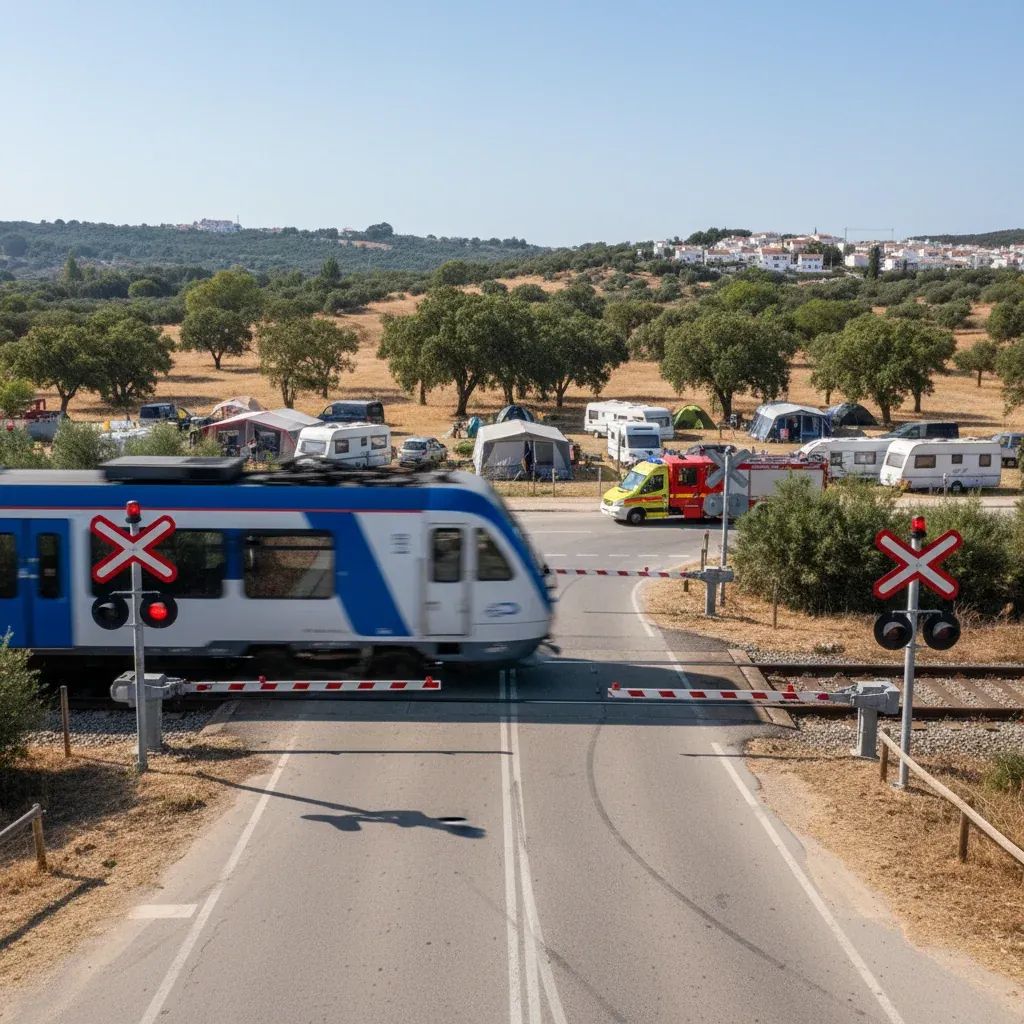
The Portugal rail authority reopened the Linha do Norte main line near Coimbra on Thursday, May 8, 2026, following a fatal collision that killed a pilgrim traveling on foot to Fátima. The incident suspended service for 90 minutes during the peak afternoon travel window, triggering fresh scrutiny of pedestrian safety along one of Europe's busiest rail corridors.
Why This Matters:
• Transport disruption: The line was blocked from 14:15 to 15:46, causing cascading delays for intercity passengers.
• Safety record: The Linha do Norte saw 6 pedestrian deaths in just the first 9 months of 2023 on one segment alone.
• Pilgrim vulnerability: The victim was part of a 60-person group walking to the Fátima shrine, highlighting exposure on rural routes.
The Incident: Alfa Pendular Strikes Pilgrim at Grade Crossing
Acácio Campos, a 66-year-old resident of Vila do Conde traveling in a pilgrimage convoy, was struck and killed by an Alfa Pendular high-speed train at approximately 14:15 on Thursday, May 8, 2026, at the Loreto level crossing on the outskirts of Coimbra. The crossing, located adjacent to the Plural industrial facility, is a known pinch point for foot traffic mixing with express rail service.
According to testimony from fellow pilgrims, the group—numbering around 60 individuals from northern Portugal—had paused for a meal and was preparing to resume their journey south toward the Fátima sanctuary when the accident occurred. Multiple witnesses reported shouting warnings to Campos as the train approached, but he did not react in time. The Portugal Emergency and Civil Protection Command (CSREPC) for the Coimbra region confirmed the death at the scene, with 9 emergency personnel from the Coimbra Volunteer and Professional Fire Brigade, Portugal Public Security Police (PSP), and National Institute of Medical Emergency (INEM) deployed. No other injuries were recorded.
The Comboios de Portugal (CP) national rail operator suspended all traffic on the Linha do Norte through Coimbra while the PSP and Portugal Infrastructure Authority (IP) conducted an on-site investigation. Service resumed at 15:46, though delays rippled through the afternoon schedule.
What This Means for Travelers and Pilgrims
For anyone traveling by rail or on foot along the Linha do Norte, this incident underscores a persistent and deadly hazard. Portugal's railway network recorded 21 fatalities in 2023—nearly double the 12 deaths in 2022—with 97% of those deaths occurring at level crossings or from pedestrian intrusion onto tracks. The Linha do Norte, which carries both high-speed Alfa Pendular services and regional trains, is among the most dangerous corridors in the country.
Pilgrims walking to Fátima, a journey undertaken by tens of thousands annually, often cross rural and semi-urban areas where rail infrastructure intersects with footpaths. The Loreto crossing is one of several grade-level points that the IP has earmarked for elimination or upgrade. Under a €316M national plan running through 2030, the IP intends to remove 135 high-risk crossings and automate or reclassify another 237. In Coimbra specifically, five new pedestrian overpasses and underpasses are planned for the Espanadeira, Loreto Sul, Ameal, Casais, and Taveiro stations, all designed to separate foot traffic from trains entirely.
Yet construction timelines remain unclear, and in the interim, pilgrims and other pedestrians must navigate active crossings with varying levels of protection. As of early 2025, 471 of Portugal's 785 level crossings had active protection—lights, bells, and barriers—but many rural crossings relied solely on passive signage and user vigilance.
The Human Factor: Why Warnings and Infrastructure Are Not Enough
Even crossings equipped with automatic barriers fail to prevent all accidents. The IP's own safety campaigns emphasize that distraction, impatience, and overconfidence are the leading causes of level-crossing deaths. Mobile phones and headphones are specifically cited as high-risk distractions, and there have been documented cases of tourists stopping on crossings to take photographs.
Local residents near crossings can develop a dangerous familiarity, treating the infrastructure as routine rather than hazardous. Drivers and pedestrians sometimes ignore flashing lights, break through lowered barriers, or misjudge the speed and stopping distance of an approaching train. The Alfa Pendular, which operates at speeds up to 220 km/h, requires over a kilometer to come to a full stop—far beyond the visual range of many crossings.
In the case of Campos, fellow pilgrims reported calling out to him, but it remains unclear whether he was distracted, fatigued, or simply did not hear the warnings in time. The PSP is investigating whether the crossing barriers were functioning and whether the group had received any safety briefing before departing.
A National Problem with No Quick Fix
The Loreto death is part of a broader pattern. Between 2016 and 2020, pedestrian intrusions and level-crossing violations accounted for nearly all rail fatalities in Portugal. The Vila Franca de Xira-Santarém segment of the Linha do Norte alone recorded 6 pedestrian deaths in the first 9 months of 2023, exceeding the 5 deaths for all of 2022 in that stretch.
The IP has launched repeated public awareness campaigns under the banner "Nas Passagens de Nível Não Arrisque a Sua Vida" (Don't Risk Your Life at Level Crossings), urging users to stop at the "STOP" sign, never cross when lights are flashing, and avoid entering if the exit is blocked. The authority is also extending video surveillance to detect and penalize rule violations.
But infrastructure lags behind demand. Eliminating all dangerous crossings at once is financially and logistically impossible, and in the meantime, pedestrians—pilgrims included—remain the most vulnerable users of the rail corridor. The IP's 2030 timeline means that high-risk crossings like Loreto will remain in use for several more years, even as traffic volumes and train speeds continue to rise.
Practical Advice for Pilgrims and Pedestrians
Anyone planning to walk long-distance routes that intersect with rail lines—whether to Fátima, along the Caminho Português, or through rural areas near Coimbra—should take the following precautions:
• Never wear headphones or use a mobile phone near rail crossings.
• Stop and look both directions even at automated crossings. A train can obscure another train approaching from the opposite direction.
• Obey all signals. If lights are flashing or barriers are down, do not cross under any circumstances.
• Stay alert in groups. Fatigue and conversation can reduce awareness. Designate a member to watch for trains at each crossing.
• Plan routes in advance. Use maps that identify level crossings and, where possible, choose pedestrian overpasses or underpasses.
For those traveling by car, the same rules apply: impatience and distraction are the primary killers. The PSP and IP both stress that a few seconds of delay is never worth the risk.
Broader Implications for Rail Safety Policy
The Campos death will likely fuel renewed debate over the pace of level-crossing elimination in Portugal. Advocacy groups have long argued that the €316M budget is insufficient given the scale of the problem, and that the 2030 deadline is too distant. Others point to enforcement gaps: even with video surveillance, penalties for crossing violations remain rare and often too small to deter repeat offenders.
The tragedy also raises questions about coordination between the IP, local municipalities, and religious organizations that sponsor large-scale pilgrimages. Should pilgrim routes be formally mapped and integrated with rail safety planning? Should groups receive mandatory safety briefings before departure?
For now, the Linha do Norte remains open, and pilgrims continue to walk. But the Loreto crossing—and dozens like it—stand as a stark reminder that Portugal's rail network, for all its modernization, still includes dozens of at-grade crossings where pedestrians and trains intersect with often-fatal consequences.


