

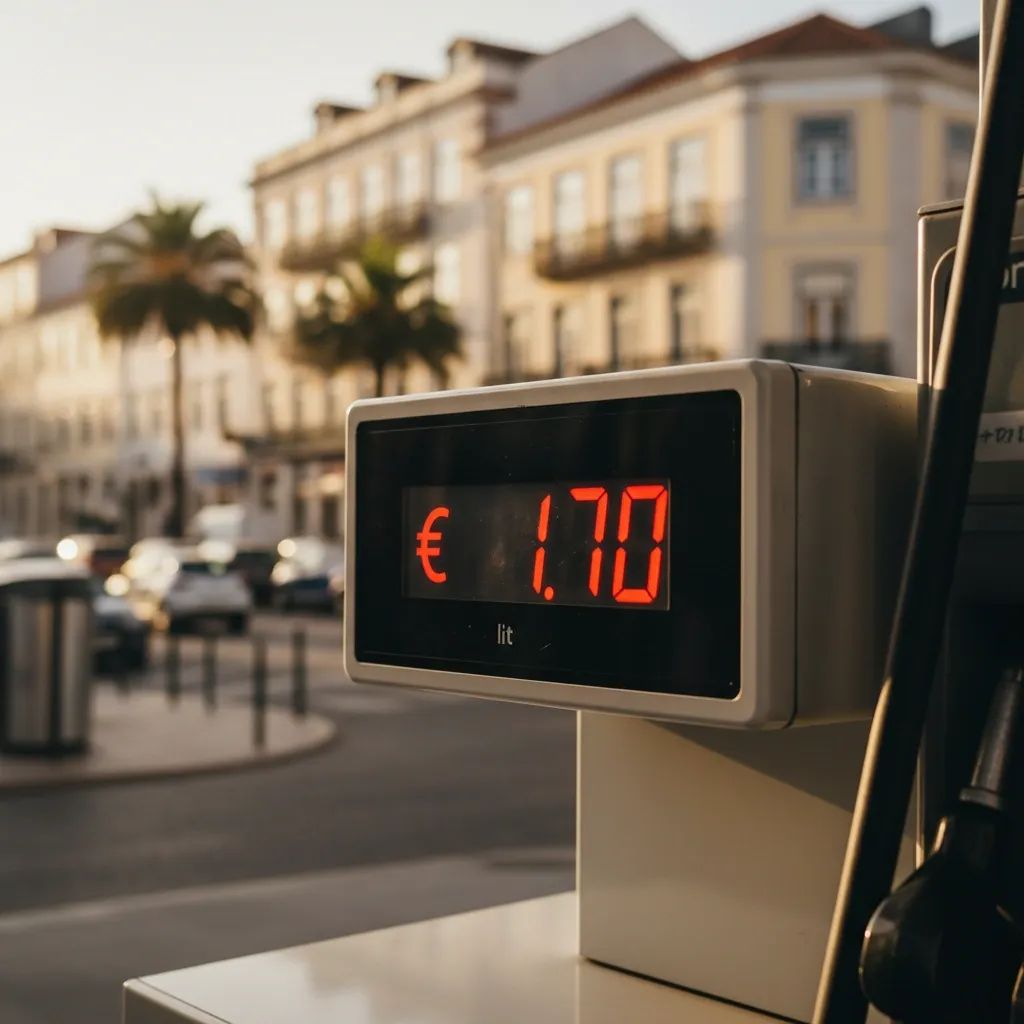
The Portugal Energy and Geology Directorate has confirmed that fuel prices are set to spike dramatically next week, with diesel climbing 16 cents per liter to an average of €2.09 and gasoline rising 9 cents to €1.95. The surge, driven by the escalating Middle East conflict and the blockade of the Strait of Ormuz, marks one of the steepest weekly increases in recent memory—affecting everything from grocery delivery costs to agricultural operations across the country.
Why This Matters
• Diesel breaches €2.10 threshold: Many stations are already pricing above the national average, with some exceeding €2.20 per liter.
• Transport and agriculture hit hardest: Freight companies without fuel-indexed contracts face immediate margin erosion; according to the National Confederation of Agriculture (CNA), farmers have reported 30% cost increases in agricultural diesel within three weeks.
• Government triggers emergency discounts: The Portugal Cabinet approved extraordinary reductions in the Petroleum Products Tax (ISP) and introduced a professional diesel rebate scheme worth 10 cents per liter.
• Energy crisis mechanisms now active: New legislation allows price caps on electricity below cost if retail rates exceed €180/MWh—a threshold that could trigger within days.
The Geopolitical Trigger
The Strait of Ormuz, through which roughly 20% of global oil and gas trade flows, has become a chokepoint as tensions between the United States, Israel, and Iran intensify. According to international market reports, Brent crude reached $115 per barrel in mid-March 2026, with the European Central Bank modeling worst-case scenarios at $145. Attacks on liquefied natural gas facilities in Qatar are expected to reduce production capacity for three to five years, compounding supply anxiety across European markets.
Portugal imports nearly all its fossil fuels, making it acutely vulnerable to external shocks. The Energy and Geology Directorate recorded diesel at €1.84 per liter and gasoline at €1.78 on March 13—less than a week before the confirmed jumps. The rapidity of the escalation has caught both industry and policymakers off guard.
What the Portugal Government Is Doing
Prime Minister Luís Montenegro announced a three-month support package targeting professional diesel users, including freight operators, passenger transport companies, firefighters, and taxi drivers. The scheme provides a 10-cent-per-liter rebate on up to 15,000 liters per vehicle, delivered as a post-purchase reimbursement. This comes on top of the existing 6-cent ISP discount applied to all consumers.
Additionally, the Portugal Council of Ministers approved three legislative packages designed to shield households and small businesses from energy price volatility:
• Electricity price caps in crisis: If retail electricity exceeds €180/MWh or rises 70% above baseline, the government can mandate below-cost pricing by suppliers. The state absorbs the differential and recoups it later.
• Mandatory fixed-rate contracts: Energy retailers in urban areas with populations above 200,000 must offer one-year fixed-price contracts.
• Consumption reduction requirements: Households receiving subsidized electricity must cut usage to 80% of the prior year's consumption; businesses must hit 70%. Non-compliance voids the discount.
• Payment plan extensions: Retailers must accept installment plans tailored to household income, with reduced power capacity (1.5 kVA) replacing outright disconnections for non-payment.
The Portugal Finance Ministry also announced a €25 subsidy for the solidarity gas bottle, a lifeline for low-income families reliant on bottled gas for cooking and heating.
Industry Pushback and Economic Ripple Effects
The Portuguese Taxi Federation, led by Carlos Silva, dismissed the measures as "clearly insufficient," warning that fixed tariffs and soaring operational costs are pushing the sector toward collapse. The federation is calling for a permanent professional fuel regime rather than temporary relief, arguing that the current support model fails to address structural imbalances.
The National Association of Portuguese Hauliers (ANTP) echoed similar concerns, noting that freight companies without fuel price indexation clauses in their contracts will absorb the full cost increase—potentially forcing service reductions or insolvencies. Road passenger transport operators have warned of potential service suspensions if prices continue unchecked.
Agriculture faces an equally severe crunch. The National Confederation of Agriculture (CNA) reported that diesel for farm machinery has surged 30% in under three weeks, making soil preparation and planting prohibitively expensive during peak season. Fertilizer costs—linked to natural gas prices—are also climbing, raising the specter of a food supply shock later in the year.
How Portugal Compares to European Neighbors
While Portugal has deployed ISP reductions and targeted rebates, neighboring countries took more aggressive fiscal action as of mid-March 2026. Italy slashed excise duties by 25 cents per liter (equivalent to 30 cents including VAT) via emergency decree, effective for 20 days with the possibility of extension. The Italian government also introduced an anti-speculation mechanism tying pump prices to actual crude costs and offering tax credits for truckers.
Spain cut the VAT rate on fuels, gas, and electricity from 21% to 10% starting March 20, supplemented by the planned suspension of the hydrocarbons excise tax—expected to lower prices by 30 to 40 cents per liter. Madrid also committed to releasing 11.5 million barrels from strategic reserves in coordination with the International Energy Agency (IEA).
France opted against tax cuts due to budget constraints, instead launching 500 fuel station inspections—six months' worth of enforcement compressed into weeks—to combat price gouging. TotalEnergies voluntarily capped prices at €1.99 for gasoline and €2.09 for diesel. France's long-term strategy pivots on nuclear energy expansion to reduce fossil fuel dependence.
Impact on Residents and Businesses
For Portuguese households, the immediate pain is felt at the pump and indirectly through higher costs for goods and services. A typical 60-liter diesel fill now costs approximately €125, up from €110 a week ago. For families in rural areas or those reliant on personal vehicles for work, the increase represents a significant erosion of disposable income.
Small and medium enterprises—particularly in logistics, construction, and agriculture—face margin compression or the difficult choice of passing costs to customers. The construction sector, already grappling with elevated material prices, is likely to see project delays or cost overruns as fuel and transport expenses escalate.
The Portugal Tax Authority has pledged that rising fuel prices will not inflate state revenue, with Secretary of State for Tax Affairs Cláudia Reis Duarte confirming that additional VAT collected due to higher prices is being "returned entirely through ISP reductions." However, opposition parties in the Assembly of the Republic have questioned the transparency of this mechanism, with the Socialist Party arguing that the government has made "no real fiscal effort" and the Liberal Initiative demanding an end to the "double taxation" created by charging VAT on top of ISP.
What Happens Next
The Portugal Energy Ministry is monitoring global price trends daily, with Minister Leitão Amaro indicating that further interventions—including the formal declaration of an energy crisis—remain on the table if Brent crude sustains levels above $120 per barrel. Such a declaration would unlock the electricity price cap mechanism and additional consumer protections, but would also impose mandatory consumption reductions and potentially strain public finances.
Portugal's strategic bet on renewable energy offers some insulation. The country generated its highest monthly renewable electricity output since April 2025 in January, reducing reliance on gas-fired generation. New interconnections with central Europe and a planned hydrogen corridor position Portugal as a potential clean energy exporter, though these projects remain years from full realization.
For now, residents and businesses must brace for continued volatility. The duration of the Middle East conflict remains uncertain, and markets remain jittery. The government's ability to sustain subsidy programs without triggering fiscal overruns—or requiring future tax increases—will depend on how long crude prices remain elevated and whether European coordination through the IEA can stabilize supply chains.
The Taxation Controversy
The debate over "double taxation"—applying VAT to fuel prices that already include ISP—has resurfaced in parliamentary sessions. The Liberal Initiative proposed reducing VAT on gas bottles to 6% and cutting levies on solar panels to encourage energy independence. The Communist Party called for eliminating the carbon tax and ending ISP-VAT overlap. The Bloco de Esquerda urged the government to close the Lajes Air Base to U.S. forces as a geopolitical lever, while the People-Animals-Nature Party (PAN) demanded VAT removal from the essential food basket.
The Portugal Finance Ministry has resisted broad tax cuts, citing budget constraints and arguing that targeted support is more efficient than blanket reductions that disproportionately benefit higher-income households with larger vehicles and fuel consumption.


