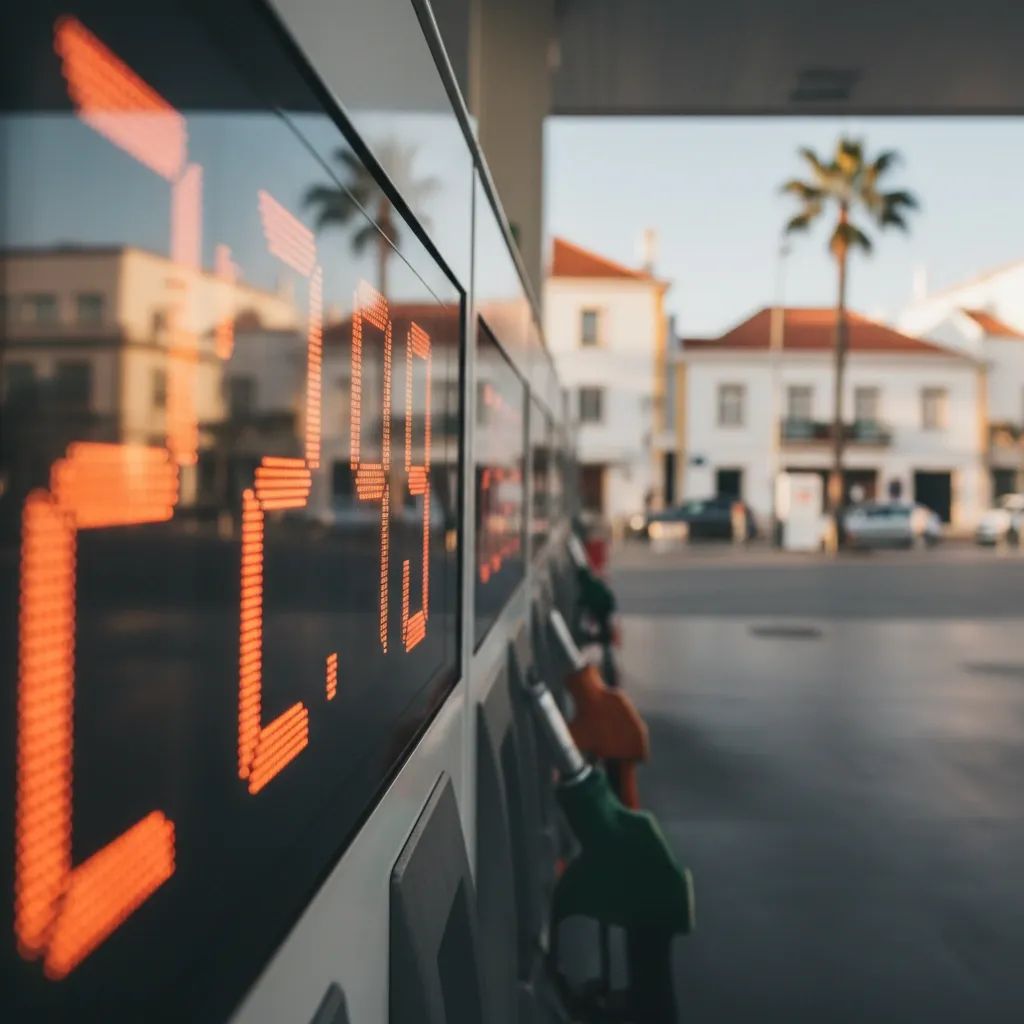
The Portuguese government has adjusted its temporary fuel tax discount just as pump prices were set to drop significantly starting Monday, June 2, a move that will shrink the savings motorists and businesses would have enjoyed from falling global oil prices.
Why This Matters
• Smaller savings at the pump: Though wholesale prices suggest a €0.12/liter drop, the government's ISP discount reduction means drivers will pocket less.
• Gasoline 95 expected at €1.904/liter, diesel at €1.837/liter starting Monday, June 2, according to Anarec forecasts.
• Strategic timing: The adjustment allows the state to capture more tax revenue exactly when international oil markets ease.
• Your tank cost: A 50-liter fill-up would still save roughly €6, but could have saved more without the government's intervention.
The Double-Edged Discount Mechanism
Portugal has operated a temporary and extraordinary ISP (Imposto sobre Produtos Petrolíferos - Petroleum Products Tax) discount system since the Ukraine crisis erupted in 2022, later extended to counter Middle East geopolitical tensions that spiked crude prices earlier this year. The mechanism works as a fiscal shock absorber: when international fuel prices surge beyond €0.10/liter compared to the reference week of March 2 to 6, the government reduces the petroleum tax to cushion the blow for households and enterprises.
But the system cuts both ways. When global prices retreat—as they are now, driven by optimism around a potential US-Iran diplomatic breakthrough—Portugal's Finance Ministry dials back the discount, effectively limiting how much of the international price drop reaches consumers. This week's portaria published in Diário da República confirmed the new discount rates: €43.80 per 1,000 liters for road diesel (down €1.90 from the previous week) and €42.18 per 1,000 liters for unleaded gasoline (down €1.80).
The official justification cites the extraordinary price increase stemming from "the impact of the geopolitical and military crisis in the Middle East on oil and derivative prices," alongside persistent uncertainty affecting families and businesses. In practice, the government reclaims a portion of the additional VAT revenue it would otherwise forego, converting what would be a sharper price drop into a more modest one while stabilizing public finances.
What This Means for Residents
For the average Portuguese household, the upcoming price adjustment translates into tangible but constrained relief. The National Association of Fuel Retailers (Anarec) forecasted a €0.12/liter decrease for both gasoline 95 and diesel based on Thursday's market close and current data from the Directorate-General for Energy and Geology (DGEG). At those rates, filling a standard 50-liter tank would cost about €95.20 for gasoline or €91.85 for diesel—a drop of roughly €6 per fill-up.
Yet that figure is approximately €1.90 smaller for diesel and €1.80 smaller for gasoline than it would have been had the government maintained the prior week's ISP discount. Over a month, for a driver who refuels twice weekly, the difference accumulates to around €15–20 in foregone savings. For families already stretched by a €0.36/liter diesel increase and €0.34/liter gasoline increase since late February, every centime counts.
Commercial operators feel the pinch even more acutely. Haulage firms, taxi drivers, and agricultural producers—sectors deeply reliant on diesel—will see operating costs ease modestly but not as dramatically as the international price drop would suggest. The government has maintained a separate €0.10/liter professional diesel subsidy capped at 15,000 liters per vehicle, valid through June 30, for freight and passenger transport, agriculture, forestry, fisheries, and aquaculture. Humanitarian firefighting associations and social solidarity institutions also received lump-sum vehicle subsidies in March, yet these one-off measures do not fully offset the structural volatility.
Portugal Among Europe's Costliest Fuel Markets
Even after Monday's anticipated drop, Portugal remains positioned in the upper tier of European pump prices. On May 25, Portuguese gasoline averaged €2.023/liter and diesel €1.958/liter, compared to the EU average of €1.851/liter for gasoline and €1.870/liter for diesel. Only Denmark, the Netherlands, Finland, France, and Switzerland posted higher gasoline prices; at the opposite end, Malta sold gasoline for €1.34/liter and diesel for €1.21/liter, while neighboring Spain offered gasoline around €1.57/liter.
Portugal's elevated pricing stems from a combination of factors: high baseline fuel taxes, the geographic premium for distribution, and the limited refining capacity that makes the country heavily import-dependent. Even with the temporary ISP discount mechanism in place, Portugal's total tax burden on fuel—including VAT and carbon levies—ensures pump prices hover well above the European median.
The carbon tax component is set to rise further this year, adding approximately €0.024/liter to gasoline and €0.026/liter to diesel. Meanwhile, the European Commission has been pressing Lisbon to phase out the emergency fuel subsidies altogether, arguing they distort the single market and contradict climate goals under the "Fit for 55" package. Brussels views these discounts as temporary pandemic-and-war-era exceptions that should not become permanent fixtures.
The Fiscal Tightrope and Future Outlook
Portugal's Finance Ministry walks a delicate line: protect consumers and businesses from energy price shocks without blowing a hole in the state budget or running afoul of EU fiscal rules. The Center for Public Finance Studies (CFP) estimated that maintaining the ISP discounts through 2026 could deliver net tax savings of €777 M to economic agents, a substantial buffer against inflation. Yet every week the government reduces the discount when prices fall, it claws back revenue, effectively turning the mechanism into a fiscal stabilizer that smooths both upward and downward price swings.
Looking ahead, analysts expect renewed upward pressure on fuel prices in the second half of 2026. International crude benchmarks are forecast to oscillate between $75 and $90 per barrel amid lingering Middle East tensions and the risk of supply disruptions around the Strait of Hormuz. If diplomatic efforts between Washington and Tehran falter, or if OPEC+ production cuts deepen, the recent relief at the pump could evaporate quickly.
Moreover, Portugal's commitment to EU energy taxation reforms means that baseline fuel taxes will trend higher over the medium term, independent of the temporary discount system. The carbon levy adjustment alone guarantees a structural increase, and the eventual unwinding of the ISP discount—under pressure from Brussels—will expose consumers to the full weight of international price movements once again.
Navigating the New Normal
For residents and businesses in Portugal, the message is clear: fuel price volatility is the new baseline, and government interventions will moderate but not eliminate the swings. Monday's €0.12/liter drop offers a brief respite, but the state's simultaneous reduction of the ISP discount underscores the limits of fiscal cushioning.
To maximize your savings, consider these practical steps: refuel at Continente or Carrefour fuel stations, which consistently offer lower prices through their retail loyalty programs; explore fuel cards such as Repsol Premium or BP Plus for frequent discounts; if you live within 30 kilometers of the Spanish border (Guarda, Castelo Branco, or Portalegre districts), cross-border refueling in Spain can yield savings of €0.15–€0.25 per liter. For fleet operators and businesses, the professional diesel subsidy program remains available through June 30—contact your regional Chamber of Commerce to confirm eligibility and application procedures. Accelerating the transition to electric and hybrid vehicles is increasingly competitive: Portugal's EV purchase incentive program offers grants up to €5,000 for qualifying electric cars, and the network of public charging stations has expanded to over 1,800 locations nationwide through the Mobi.E initiative, making the total cost of ownership increasingly favorable for high-mileage users.