

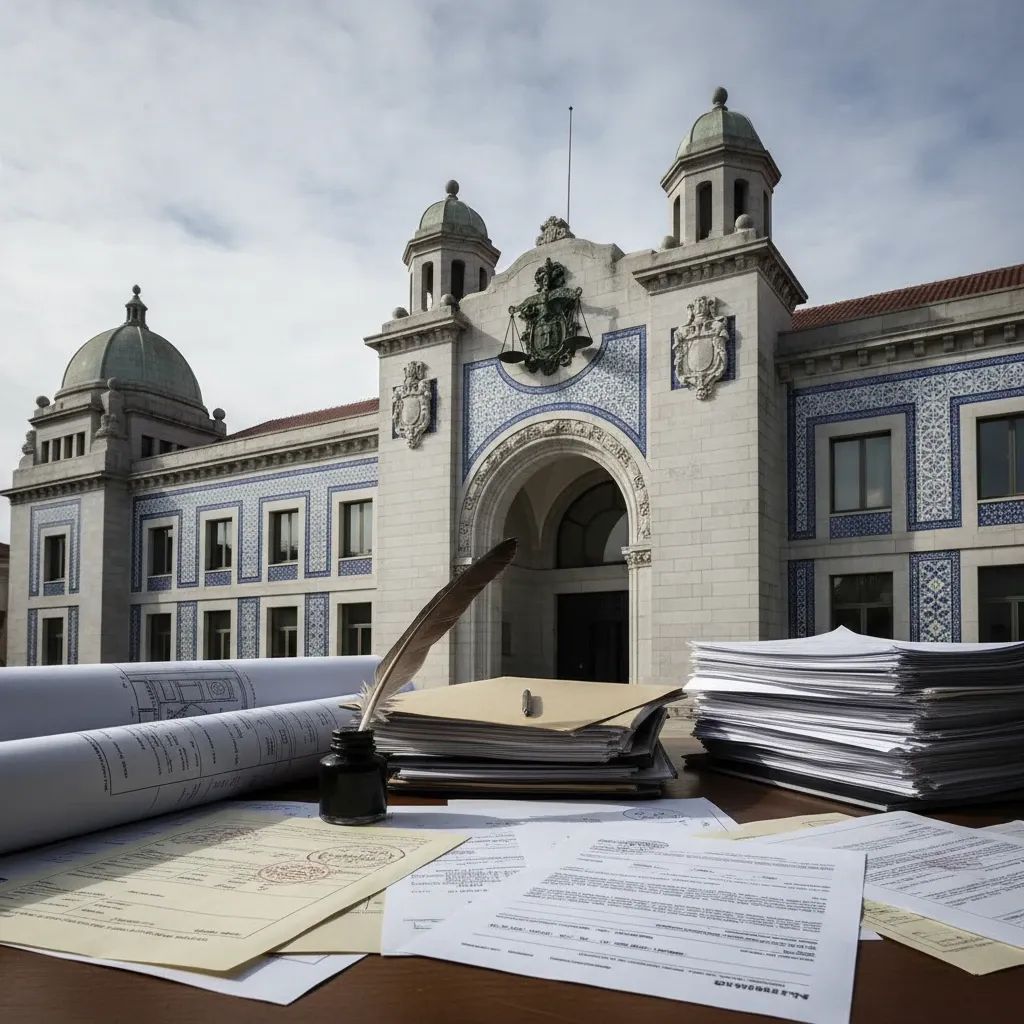
The Corruption Behind Gaia's Skyline: What the Verdict Means for Your City
A Porto District Court has convicted Patrocínio Azevedo, the former deputy mayor of Vila Nova de Gaia, of orchestrating a decade-long corruption scheme that fundamentally altered the northern city's urban development landscape. The outcome is clear: €300M in real estate projects received expedited municipal approvals in exchange for cash payments, luxury watches, and privileged information—and now the municipality faces questions about the legality of those approvals.
Why This Matters
• Licenses under review: The municipality has declared the Skyline public-private partnership "absurdly constructed from a legal and urban standpoint," lacking competitive public tender and violating the city's Master Development Plan. An ongoing audit may assess similar issues with other major projects approved during Azevedo's tenure.
• Your property rights may be affected: Anyone holding contracts for apartments or commercial units in affected projects should consult a lawyer to understand their contractual position, particularly if the municipality challenges the legality of underlying approvals.
• New municipal oversight: The municipality is implementing stricter internal controls and documentation requirements for future development decisions.
• Eight-year public ban: Azevedo cannot hold elected or appointed office until 2034, a legal barrier intended to prevent his return to influence.
How a City's Growth Machine Became Corrupted
Between 2020 and 2021, a single municipal official wielded enormous power over Vila Nova de Gaia's transformation. As deputy mayor overseeing urban planning, Patrocínio Azevedo controlled which projects received licenses, how quickly they moved through bureaucracy, and whether zoning regulations would be modified to accommodate developer ambitions. During that 18-month window, the Judicial Police (PJ) later documented, Azevedo channeled that authority into a direct profit-sharing arrangement with real estate entrepreneurs Paulo Malafaia and Elad Dror, founder of the Fortera Group, an Israel-backed developer operating across Portuguese cities.
The mechanics were straightforward but calculated. Dror and Malafaia offered three separate cash deliveries—two confirmed at €25,000 each, one amount undisclosed—plus four luxury watches worth thousands of euros combined. In return, Azevedo expedited licensing for their major projects, modified planning regulations to increase construction density, and provided advance notice of competing applications. A lawyer named João Lopes served as the courier, arranging meetings in semi-public locations. One handover occurred in a bathroom at NorteShopping, a commercial center 15 minutes from downtown Gaia, underscoring the deliberate avoidance of official channels.
By late 2021, according to court records, the relationship had escalated. The developers stopped requesting Azevedo's cooperation and began demanding it, confident they had compromised his independence entirely. The Porto Court's presiding judge stated in her ruling that Azevedo's authority as a decision-maker had become "conditioned and captured" by the developers, who received systematic preferential treatment unavailable to other investors.
Gaia's Flagship Tower at the Center of the Scandal
The Skyline/Centro Cultural e de Congressos project embodied Azevedo's ambitions and became the scandal's centerpiece. Designed by Souto Moura, a Pritzker Prize-winning architect, the 28-story mixed-use tower would have been Portugal's tallest building north of Lisbon—a symbol of urban prestige and municipal accomplishment. The development included luxury apartments, a five-star hotel, conference facilities, and an estimated value exceeding €150M.
Court documents reveal that Azevedo personally championed Moura's involvement, effectively imposing the renowned architect on the developers rather than allowing them creative control over the design. The judge interpreted this as evidence of Azevedo's aspiration to realize a landmark work that would deliver political significance. A completed architectural masterpiece would have solidified his legacy and strengthened any electoral bid.
To make the project financially viable, Azevedo supported a regulatory modification that increased the allowable construction density on the site. Without this zoning change, the tower would have been substantially smaller and less profitable. The developer benefited significantly from this single administrative act.
Today, the municipality under Social Democrat Luís Filipe Menezes has declared the public-private partnership underlying Skyline "absurdly constructed from a legal and urban standpoint." Officials noted that the arrangement lacked a competitive public tender, violated the city's foundational Master Development Plan (PDM), and appeared designed to benefit a single developer rather than serve public interest. An ongoing audit may result in license revocation or compulsory project modifications that would delay construction or force a redesign.
Riverside: Where Money Changed Hands in a Shopping Mall Bathroom
The Riverside residential development at Quinta de Santo António received similarly favorable treatment, but with more direct financial motivation. Azevedo received all three documented cash payments and all four luxury watches in connection with this project alone, according to court findings. The rewards were compensation for "privileged information and favorable decisions" that advanced the developers' agenda.
Azevedo provided the developers with advance knowledge of municipal planning intentions, giving them competitive advantage in structuring proposals and securing approvals before alternatives could be submitted. The court determined that the money and watches constituted a "form of recompensing" Azevedo's actions—a euphemism for direct bribery. In one instance, Lopes delivered cash in a bathroom stall at NorteShopping, suggesting both parties understood the transaction's illegality and sought to avoid detection.
Unlike the Skyline project, Riverside involves direct residential housing. Purchasers who have already signed contracts or occupied units now face potential contractual disputes if the municipality revokes or substantially modifies the license. Developers will likely argue they paid for regulatory approval and cannot be held responsible for official malfeasance—a legal position that Portuguese courts have treated inconsistently in past cases.
The Court's Decision and Its Four-Part Verdict
The Porto District Court announced its verdict on May 8, 2026, issuing separate prison sentences reflecting each defendant's role:
Patrocínio Azevedo received 8.5 years in prison, plus an 8-year prohibition on any public office, for aggravated passive corruption, abuse of authority (prevaricação), improper involvement in private business, and unlawful receipt of benefit. The punishment represents the harshest sentence among the four convictions.
João Lopes, the lawyer-intermediary, was sentenced to 7 years and 9 months, plus a fine exceeding €500,000. His role was facilitating communication and executing physical handovers of money and valuables between developers and the official.
Paulo Malafaia, the real estate entrepreneur, received 7 years in prison. His conviction reflects active participation in the bribery scheme and design of projects that exploited Azevedo's authority.
Elad Dror, founder of Fortera Group, was sentenced to 6 years in prison and ordered to pay a fine exceeding €3M. Despite receiving the shortest custodial sentence, Dror faced the largest financial penalty, reflecting the prosecution's argument that his enterprise benefited most from Azevedo's regulatory favoritism.
The court acquitted two other defendants: Luísa Aparício, the former head of Urban Planning and Environment, and Jordi Busquets, an economist. The judges found no criminal complicity on their part, suggesting that corruption was concentrated in Azevedo's office rather than systemic across the planning department.
Azevedo's Defense: Denial and Rhetorical Maneuvering
Within hours of the verdict, Azevedo spoke to journalists outside the courthouse, rejecting the court's findings and maintaining he had been victimized by overreach. He did not accept the conviction passively.
On the Skyline project, he asserted that all documentation was legally correct and that no prevaricação (abuse of authority) had occurred. He argued that a €200M investment could not materialize without dialogue between developers and municipal officials. The court explicitly rejected this reasoning, finding instead that the evidence demonstrated systematic favoritism designed to enrich Azevedo personally.
Regarding Riverside and the cash payments, Azevedo offered a different defense: he claimed to be a "victim of a charlatan, someone who used my name to move money." He appeared to reference either Malafaia or Dror but remained deliberately vague, providing no explanation of how someone could route cash payments in his name without his knowledge or active participation. This statement contradicted his earlier testimony.
Azevedo also challenged the court's logical construction of the payment scheme. One allegation involved a conditional promise of favorable decisions in exchange for municipal funding related to São João festivities, a June cultural celebration. Azevedo questioned the prosecution's theory: if the developers paid him to decide against their interests, why would they have made the payments at all? The court addressed this reasoning in its verdict, finding that the payments compensated Azevedo for decisions already made in the developers' favor.
He emphasized that his two-year pre-trial detention was significant, and suggested a "campaign of persecution" had affected his associates and relatives. He cited instances where family members were summoned by the Judicial Police (PJ) to testify. When pressed to name those responsible for coordination, he deferred. His legal team has filed notice of appeal, with 30 additional days granted beyond the standard 60-day window to prepare the brief.
What Happens to Your Apartment, Your Investment, Your Permits
The verdict creates immediate practical consequences for residents and investors across Gaia:
If you hold a contract for a Skyline or Riverside unit, the municipality's audit is underway. Construction timelines may be affected depending on audit findings. If the audit uncovers license violations, the municipality may seek to revoke or substantially modify the approvals. Developers will likely resist, and the outcome of any legal disputes remains uncertain. Consult a real estate attorney to understand your contractual position and any exit rights.
If you are applying for building permits or variances in Gaia, the municipality is implementing new documentation requirements and internal review procedures. Application processing may take longer than before as staff implement stricter controls.
If you are considering investing in major real estate in Gaia, current regulatory circumstances involve ongoing audits and appellate proceedings. The regulatory environment remains in flux, which may affect investor decisions until audit conclusions become public.
If you reside near any of the affected projects, monitor municipal announcements for construction updates, potential embargoes, or project modifications. Large residential projects often trigger traffic, noise, and parking impacts. Changes to project timelines or scope may alter those impacts.
Broader Implications: How Local Governance Faces Questions
The Operação Babel investigation exposed vulnerabilities in Portuguese municipal governance. Urban planning authority is frequently concentrated in the hands of a small number of elected or appointed officials, with minimal internal oversight or external regional review. Similar corruption cases have emerged in Lisbon, Cascais, and Braga, indicating this is not an isolated incident.
The typical pattern mirrors what occurred in Gaia: a developer offers financial or material inducements to an official with licensing power; the official accelerates approvals, modifies regulations favorably, or provides advance competitive intelligence; the corruption operates for 2–4 years before investigation begins. The Portuguese legal system eventually prosecutes the culprits, but public resources and private investments have already been affected during that period.
Legal scholars and legislators have proposed structural remedies: mandatory competitive tenders for significant public-private partnerships; rotation of officials with licensing authority; clearer conflict-of-interest rules; and strengthened oversight by regional environmental and planning agencies independent of municipal authority. Whether this conviction provides momentum for such reforms remains to be seen.
The Appeal Process and Next Steps
All four defendants have indicated intent to appeal. Given the case's complexity, the appellate process could extend 12–18 months or longer. Azevedo's defense team is expected to file within 30 days, utilizing the court-granted extension to strengthen arguments challenging the trial court's factual findings and legal reasoning.
Simultaneously, Gaia Municipality is advancing its audit of the Skyline partnership and related projects. If auditors confirm license violations or PDM infractions, officials may petition for an order to revoke development permits or compel substantial redesigns. Riverside, Garden Place/Hills, and Urban 68—another project approved during Azevedo's tenure—face similar scrutiny. The Public Prosecutor's Office (Ministério Público) has not ruled out pursuing additional charges or launching new investigations into other municipal decisions made during that period.
Transparency and Municipal Decision-Making
The Gaia corruption scandal underscores why transparent procurement, documented decision-making, and independent oversight matter in municipal governance. Azevedo's authority was concentrated enough that he could reshape zoning regulations, expedite licenses, and provide competitive intelligence—all without systematic review or public documentation of his reasoning. That concentration of power created the opportunity for corruption.
The municipality's current audit reflects an acknowledgment that many decisions made during Azevedo's tenure require reexamination. This represents administrative effort, but also a necessary review. Whether Gaia emerges with durable reforms—strengthened internal controls, mandatory public disclosure of municipal decisions, external regional oversight—or returns to previous practices remains an open question.
For residents and investors in Gaia, the immediate reality is administrative review and ongoing legal proceedings. The city's planning apparatus is recalibrating, audits are underway, and projects worth hundreds of millions of euros are under legal examination. Monitoring municipal announcements and seeking professional legal advice are practical steps for those directly affected.


