

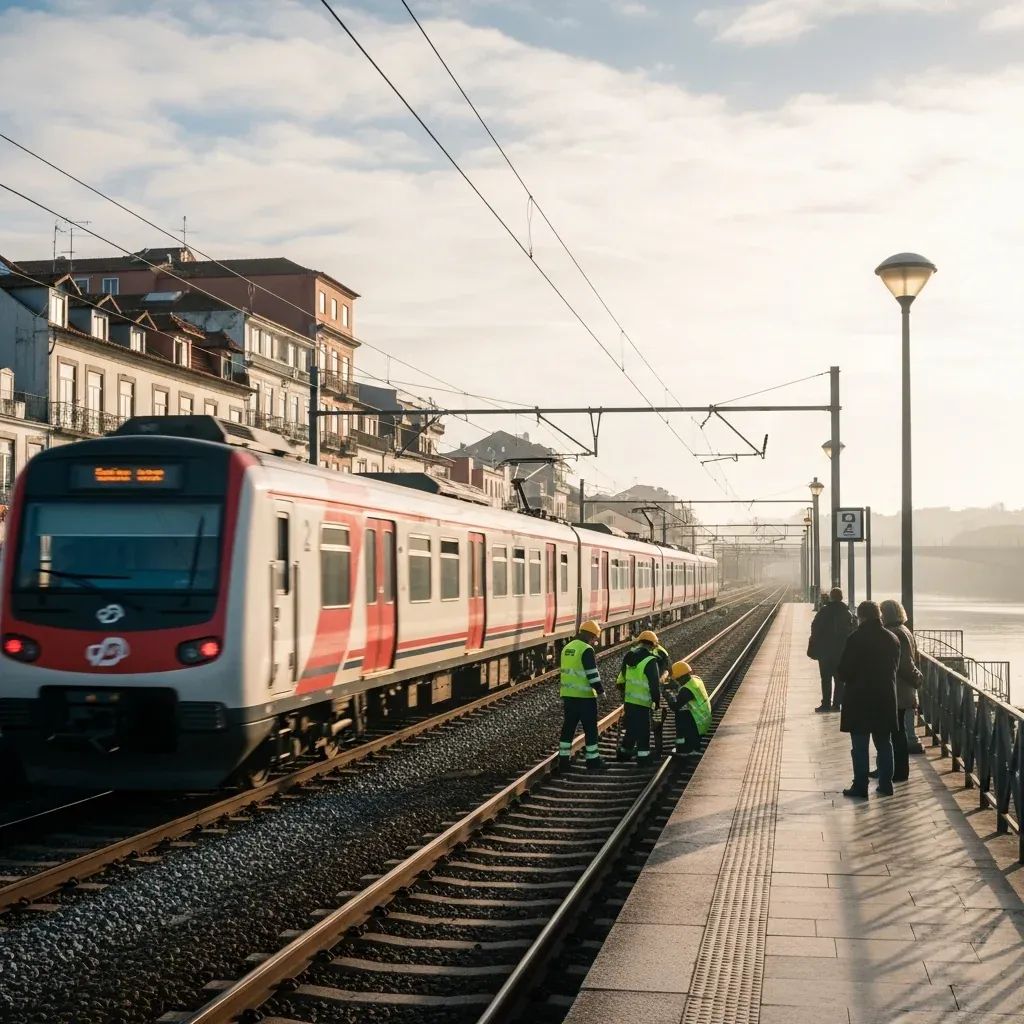
The Fertagus rail operator will receive its first two of five desperately needed carriages in the first half of 2027, a timeline confirmed by the company's administration chair Cristina Dourado at a public transport conference in Lisbon. The announcement offers a glimmer of relief for tens of thousands of daily commuters enduring what has become a notorious cross-Tejo bottleneck—but it also means at least another year of crush-hour conditions that triggered a formal complaint to the European Commission.
Why This Matters
• Capacity boost delayed until mid-2027: Each of the five incoming carriages holds 350 passengers, but only the first two will enter service by H1 2027.
• Safety complaints escalate: In March, the Fertagus Users' Commission filed a complaint with Brussels alleging "sub-European standard" conditions and daily security risks.
• Infrastructure cracks persist: Beyond rolling stock shortages, underlying rail network problems—managed by Infraestruturas de Portugal (IP)—cause speed restrictions and service delays with no published remediation schedule.
Anatomy of a Commuter Crisis
The Fertagus corridor—spanning the 25 de Abril Bridge between Lisbon and Setúbal—has spiraled into chronic overcrowding since fare reductions sent ridership soaring. Dourado describes the surge as "exponential," a demand spike the operator cannot match with its aging fleet. The company acknowledged to Parliament in April that it operates at maximum capacity, shifting responsibility for additional rolling stock to government procurement.
Each morning and evening, platforms transform into pressure zones. The Users' Commission spokesperson, Aristides Teixeira, painted a stark picture in March: commuters jamming onto platforms, shoving, verbal and physical altercations breaking out, adults and children compressed in carriages where breathable air becomes scarce. Medical emergencies requiring train stoppages for paramedics have become routine, not exceptional.
Where the New Carriages Stand
The incoming units—sourced from Spain's RENFE—represent a phased intervention rather than an immediate fix. While the first pair should arrive by mid-2027, the delivery schedule for the remaining three carriages remains unspecified. Given that integrating new carriages into existing four- or eight-car configurations requires significant adaptation work, full deployment will stretch well into 2028.
RENFE has faced operational pressures typical of major European rail operators managing aging fleets and maintenance demands. Spain has allocated financing for RENFE's rolling stock acquisition as part of broader fleet renewal efforts—funds that underpin agreements like the Fertagus supply contract. These commitments reflect the broader challenge European transit systems face in modernizing infrastructure while managing current demand.
What This Means for Residents
For anyone commuting across the Tejo or considering housing in the Setúbal peninsula, the timeline is sobering. Expect no meaningful relief until at least early 2027, and full capacity restoration only after 2028. If your employer requires fixed office hours in central Lisbon, budget extra travel time and brace for continued discomfort during peak periods.
The European Commission complaint could accelerate political pressure, but Brussels procedures move slowly; practical improvements depend entirely on carriage deliveries and infrastructure repairs by IP. Families with young children or individuals with mobility constraints should weigh alternative routes—ferries, express buses, or carpooling—where feasible.
The Infrastructure Blind Spot
Fertagus executives consistently point to structural failures beyond their control. Broken rails between Entrecampos and Sete Rios (January 2026), malfunctioning track switches at Roma-Areeiro (also January), and recurring speed restrictions caused by track defects have compounded the rolling-stock shortage. All these assets fall under IP management, yet no comprehensive renovation timetable has been published.
Even after the new carriages arrive, chronic infrastructure bottlenecks will continue to throttle service frequency and reliability. The concessionary extension through March 2031, announced in late 2024, included vague commitments to increase train frequency, but without IP investing in signaling upgrades and track renewals, additional carriages alone cannot unlock the corridor's full potential.
European Approaches to Capacity Pressure
Across the continent, rail operators confronting similar crowding pressures have deployed solutions Portugal has barely explored. Many systems now offer real-time crowding data through apps and platform displays, allowing commuters to choose less-packed cars. Staggered work schedules, off-peak fare incentives, and employer coordination also help distribute passenger load throughout the day—measures not yet visible in Fertagus or Portuguese transport authority planning.
These strategies reflect a reality facing major transit networks: adding carriages alone is insufficient without operational flexibility, passenger information systems, and coordinated demand management. Portugal's approach remains focused primarily on rolling stock procurement, leaving other proven tools unexploited.
The Cost of Inaction
The Users' Commission complaint to Brussels frames the situation not as inconvenience but as a public health hazard. Prolonged exposure to crush conditions elevates injury risk, aggravates respiratory issues, and undermines the modal shift policies Portugal nominally champions. When commuters view trains as punishment rather than convenience, car dependency hardens—particularly among those who can afford the switch.
Economically, the Setúbal peninsula serves hundreds of thousands of daily commuters and links significant population centers to Lisbon's employment hubs. Persistent transport dysfunction deters investment in southern housing markets and discourages firms from locating offices south of the river, perpetuating a lopsided regional development pattern.
Political Accountability Gap
Secretary of State for Mobility Cristina Pinto Dias acknowledged capacity limitations in March and pledged reinforcement starting in 2027, with the Ministry of Infrastructure and Finance scouring European markets for the five additional carriages. Yet the decision to source units from RENFE—an operator itself managing fleet renewal demands—suggests limited alternatives existed.
Parliamentary testimony by Fertagus management in April effectively threw the ball into government hands, noting that private concession terms cap the operator's capital expenditure and leave fleet expansion to state procurement. This split responsibility creates an accountability void: Fertagus blames IP and the state for insufficient assets; IP points to budget constraints; the Finance Ministry argues procurement timelines cannot be rushed. Commuters, meanwhile, absorb the consequences.
Navigating the Interim
Until the cavalry arrives in 2027, practical coping strategies matter. Monitor the LiveTagus platform for real-time delay estimates and train tracking; Transit app offers schedule and live departure data. Travel outside the 7:30–9:00 and 17:30–19:30 windows when possible. If remote or hybrid work is an option, negotiate days at home to sidestep peak congestion.
Consider the ferry services from Cacilhas or Seixal as backup routes, though their frequency and capacity also face strain. Carpooling arrangements with neighbors can split fuel costs and reduce per-person stress. For those house-hunting, proximity to Fertagus stations no longer carries the premium it once did—factor in the grinding commute reality before signing a lease or mortgage in Corroios, Fogueteiro, or Palmela.
The 2027 delivery is a start, not a solution. Without parallel investment in track, signaling, and operational flexibility, the Tejo crossing will remain a chokepoint long after the new carriages roll in. For now, patience and a good podcast library are the commuter's best allies.


