

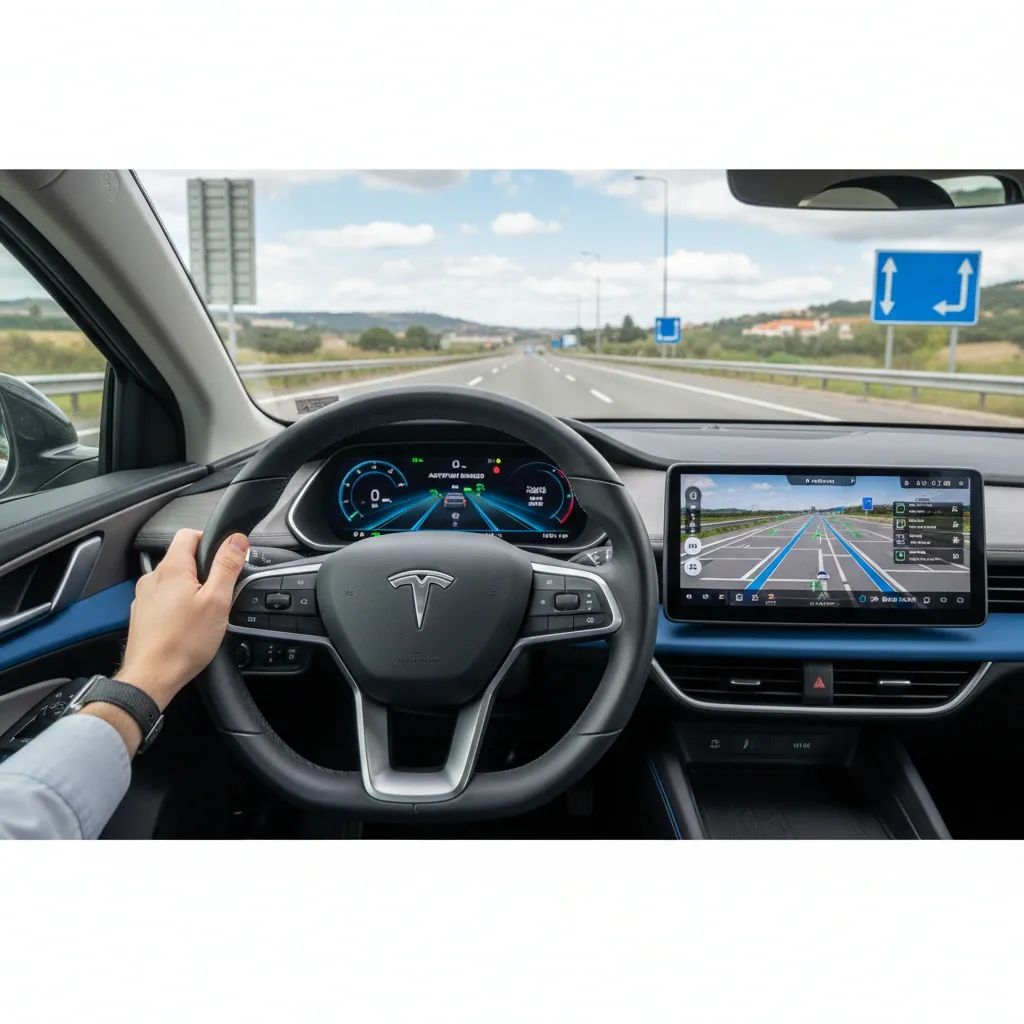
The Portugal automotive regulator has yet to greenlight Tesla's Full Self-Driving (FSD) technology, even as neighboring European nations and China rapidly expand access to the controversial system—a development that leaves Portuguese Tesla owners and prospective buyers in limbo while the rest of the continent moves ahead.
Why This Matters:
• Tesla's supervised self-driving has now reached 10 countries worldwide, including the Netherlands and Lithuania in the EU, but Portugal remains off the list despite growing pressure from local owners.
• China officially launched FSD Supervised on May 21, unlocking a massive market of 1.4 billion potential users after years of regulatory delays.
• European approval remains fragmented, with each member state deciding independently rather than through a unified EU-wide certification, prolonging the wait for Portuguese drivers.
The European Approval Maze
Tesla's push to deploy its advanced driver-assistance system across Europe has turned into a protracted regulatory marathon. The Netherlands became the first EU member to approve FSD Supervised in April after an 18-month testing period by the Dutch vehicle authority (RDW). Lithuania followed on May 20, becoming the second European nation to recognize the Dutch certification through mutual regulatory acknowledgment.
The piecemeal approach stems from a fundamental clash between Tesla's AI-driven learning system and Europe's rule-based regulatory framework, particularly the UN R-171 and UNECE R157 standards. To bypass the glacial pace of EU-wide regulatory reform, Tesla has exploited Article 39 of EU vehicle regulations, which permits national exemptions for technologies not yet fully covered by pan-European law.
Belgium is expected to be next within weeks, with the Flemish region already conducting on-road testing, while Greece's Ministry of Transport is drafting legislation to grant similar approval. Larger markets including Germany, France, and Italy reportedly held advanced discussions in March, though no concrete timelines have emerged.
What This Means for Portuguese Drivers
For now, Portuguese Tesla owners cannot access FSD Supervised, even though the feature is technically embedded in their vehicles' software. The system remains locked behind regulatory approval, which Portugal's transport authorities have not yet pursued or granted.
The delay carries financial implications. In most global markets, Tesla offers FSD as a subscription service. However, in China, the company still provides a one-time purchase option for ¥64,000 (approximately €8,300), making it a potentially significant revenue stream. Portuguese buyers who might consider purchasing a Tesla with FSD enabled face uncertainty about when—or if—the feature will become available domestically.
The European Commission's Technical Committee for Motor Vehicles (TCMV) is reviewing the Dutch technical evidence for a potential EU-wide approval, a process expected to take 4 to 8 months and requiring votes from all member states. However, Scandinavian regulators have expressed skepticism about FSD's performance in challenging conditions such as icy roads or excessive speed scenarios. No vote has been scheduled, with the next TCMV meetings slated for July and October, making Tesla's goal of summer 2026 availability across the EU appear overly optimistic.
China Breaks Through After Years of Gridlock
Tesla's breakthrough in China—its second-largest market—came after prolonged negotiations over data security, mapping licenses, and privacy standards. The May 21 launch of FSD Supervised places China among just 10 territories worldwide where the system operates, alongside the US, Canada, Mexico, Puerto Rico, Australia, New Zealand, South Korea, the Netherlands, and Lithuania.
The approval followed a high-profile visit to Beijing by Tesla CEO Elon Musk as part of a US business delegation accompanying President Donald Trump on a state visit to meet Chinese President Xi Jinping. That diplomatic backdrop likely smoothed regulatory resistance that had stalled the technology for years.
To satisfy Chinese authorities, Tesla established a local AI data center in Shanghai and partnered with tech giant Baidu for navigation and mapping data—both critical to complying with China's stringent data localization laws. Under the Cybersecurity Law, Data Security Law, and Personal Information Protection Law, all vehicle-generated data classified as "important" must remain stored within China, and cross-border data transfers require security assessments.
Chinese regulations also mandate that autonomous vehicles install data storage systems akin to black boxes, a rule that took effect in January under the national standard for "Autonomous Driving Data Recording Systems." These devices provide forensic evidence to determine liability in accidents involving Level 3 or higher autonomy.
Despite the launch, the current rollout is limited. Tesla aims for broader regulatory clearance by Q3 2026 to enable the full FSD version across all eligible vehicles. The company has been actively recruiting test drivers and ADAS operators in nine major Chinese cities to gather localized training data, as traffic patterns in China differ markedly from North America.
The Wuhan Incident and Its Regulatory Fallout
Tesla's entry into the Chinese market comes amid heightened scrutiny following a dramatic incident in late March. More than 100 robotaxis operated by Baidu's Apollo Go service abruptly halted on the streets of Wuhan, causing traffic chaos and minor collisions. Preliminary investigations blamed network failures and system malfunctions, prompting Chinese authorities to suspend the issuance of new licenses for Level 4 autonomous vehicles indefinitely.
The moratorium prevents companies from expanding their robotaxi fleets or entering new cities, marking a regulatory pivot from rapid expansion to prioritizing safety and stability. The Ministry of Industry and Information Technology (MIIT) summoned robotaxi operators and municipal authorities for comprehensive self-assessments and stricter safety monitoring.
While Tesla's FSD Supervised still requires constant human oversight and does not qualify as a Level 4 system like Apollo Go's robotaxis, the Wuhan incident has cast a shadow over all autonomous technologies in China. New mandatory safety requirements for Level 3 and Level 4 systems, set to take effect in July 2027, will impose stricter obligations, including the ability to execute "minimum-risk maneuvers" if a driver fails to respond to intervention requests.
Intensifying Competition in the EV Sector
Tesla's push to deploy FSD in China is also a strategic response to fierce competition from domestic manufacturers. BYD overtook Tesla as the world's largest electric vehicle producer, while rivals such as Xpeng, Nio, Xiaomi, and Huawei have developed their own advanced driver-assistance systems and robotaxi operations. China has also legalized Level 3 autonomous driving, allowing hands-free operation under certain conditions—a step ahead of most Western markets.
Tesla's sales in China climbed 36% year-over-year in April, according to the China Passenger Car Association, a positive sign as the company battles a brutal price war that has squeezed margins across the sector. The ability to offer FSD as a premium feature could help differentiate Tesla's vehicles in an increasingly crowded marketplace.
The Road Ahead for Portugal
Portuguese regulators face a choice: wait for a unified EU approval that may not materialize until late 2026 or beyond, or follow the Dutch and Lithuanian example by granting national authorization. Given that Belgium and Greece are already moving independently, Portugal's inaction risks leaving its drivers at a competitive disadvantage, particularly as the technology becomes a key differentiator in the premium EV segment.
The broader question is whether Portugal's transport authorities view the technology as sufficiently tested and safe for local road conditions, which include narrow urban streets, mountainous terrain, and a mix of modern and aging infrastructure. The Portuguese Institute of Mobility and Transport (IMT) has not publicly commented on Tesla's FSD or outlined a timeline for review.
For now, Portuguese Tesla enthusiasts will continue to watch as drivers in Amsterdam, Vilnius, and soon Brussels gain access to a feature that remains tantalizingly out of reach. Whether that changes in the coming months will depend on how aggressively Portugal chooses to engage with the regulatory challenge—or whether it waits for Brussels to act on its behalf.


