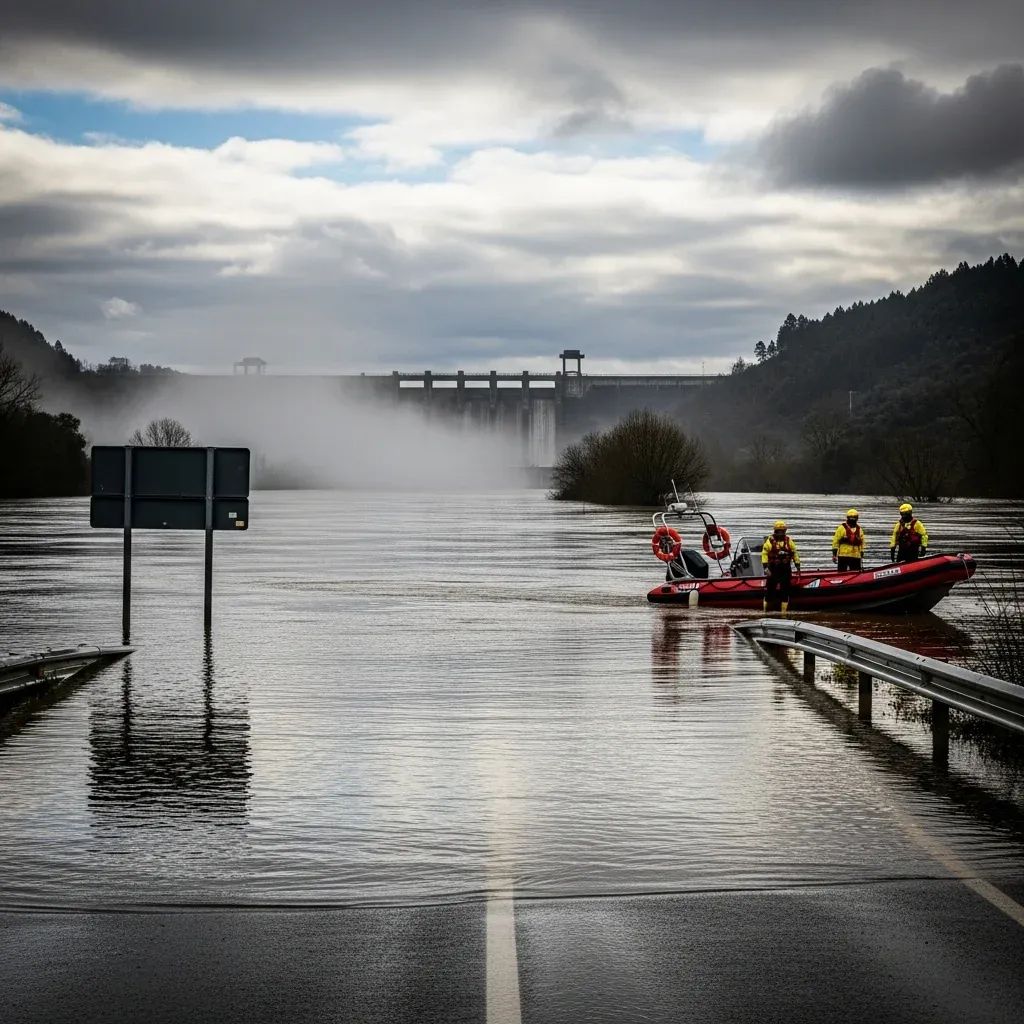

The Portugal Environment Ministry has expanded emergency forest clean-up funding to 26 municipalities in the Centro region, offering landowners up to €1,500 per hectare to clear terrain devastated by Storm Kristin—a move designed to slash wildfire risk and inject cash directly into rural hands with minimal red tape.
Why This Matters:
• Direct payments: Landowners get €1,000–€1,500 per hectare for clearing storm-damaged forest, no invoices or receipts required—just photographic proof.
• Deadline: Candidacies close June 29, 2026 at 6 PM; work must be completed between January 28, 2026 and November 30, 2026.
• Scale: The €40M scheme covers an estimated 60,000 hectares across the Centro region, targeting areas where millions of fallen trees have created a tinderbox.
• New zones: Four councils—Ansião, Figueiró dos Vinhos, Lousã, and Mação—just joined the original 22, broadening eligibility across Leiria, Coimbra, and Santarém districts.
The Storm's Toll: €6 Billion and 8 Million Trees
Storm Kristin made landfall in the early hours of January 28, 2026, registering a national wind-speed record of 208.8 km/h in Soure. The cyclone-bomb left more than eight million trees felled across the Centro region, wiping out roughly two million cubic meters of pine—equivalent to half the annual supply for Portugal's timber industry. Total damages in the region exceeded €6 billion, reportedly making it one of the costliest natural disasters in modern Portuguese history. Leiria district alone absorbed €2 billion in losses—roughly 30% of its regional economy—while Pombal recorded over €80M in business damages and Sertã saw €30M disappear overnight.
The ecological fallout has been equally severe. Vast swathes of biomass now blanket hillsides, creating ideal conditions for summer wildfires and phytosanitary crises. Insurers logged more than 140,000 claims nationwide, with over 60,000 from Leiria district alone.
How the Funding Works
Under the Environmental Fund initiative, financed entirely by the Recovery and Resilience Plan (PRR)—EU-funded COVID recovery money redirected to disaster relief—councils receive a 100% allocation tailored to their damaged hectarage. Municipalities then disburse payments proportionally to landowners or forest managers. Environment and Energy Minister Maria da Graça Carvalho emphasized the streamlined approach: "It's not necessary to have bureaucracy, not even an invoice or receipt for the €1,500 per hectare—just very simple proof that the land has been cleaned."
That proof? Geo-referenced before-and-after photographs with date, time, and GPS coordinates, plus a brief intervention report. Councils validate applications and wire funds directly, bypassing contractors and middlemen who, according to forest-owner advocates, have been scooping up fallen timber at zero cost while landowners shoulder clean-up expenses.
Luís Damas, president of the National Federation of Forest Owner Associations (FNAPF), welcomed the no-fuss model: "If the process is easy, we agree there should be no bureaucracy, and that money should go to the owners—not get stuck in the chain of contractors and all those people." He lamented that in many recovery operations, "the ones winning are the timber merchants, who are collecting wood at zero price."
Municipal Allocations and Eligible Operations
The €40M pot is distributed unevenly, reflecting both area and damage intensity. Leiria commands the lion's share at €13.17M, followed by Pombal (€6.79M), Alcobaça (€3.83M), Ourém (€3.66M), and Marinha Grande (€2.79M). At the lower end, Miranda do Corvo gets €208,000, Batalha €189,000, and Porto de Mós €155,000.
Eligible activities include:
• Cutting and processing affected trees
• Removing woody material and managing residual biomass
• Establishing or expanding temporary storage yards
• Emergency phytosanitary control to prevent pest outbreaks
• Restoring forest-road circulation (municipal responsibility)
Applicants must also demonstrate that interventions protect biodiversity, prevent soil and water pollution, and do not cause significant environmental harm. Where private land is involved, councils must secure express owner consent or, if contact proves impossible, publish civil-protection edicts in line with fire-defense statutes.
What This Means for Residents
For the thousands of smallholders and forest producers across the Centro region, the scheme offers immediate liquidity at a moment when fire-insurance payouts remain delayed and timber prices have collapsed under market glut. The per-hectare subsidy effectively covers basic chainsaw work, transport, and stump clearance—operations that would otherwise fall entirely on owner budgets.
Crucially, the lack of invoice requirements removes a chronic friction point in Portuguese rural bureaucracy. Elderly or part-time landowners who lack formal contractor relationships can now perform or commission clean-up work without navigating VAT receipts and certified quotes. The trade-off is transparency: geo-tagged photos and GPS metadata provide an audit trail that discourages double-dipping while keeping paperwork minimal.
Yet the clock is ticking. With candidacies closing June 29, 2026 and work windows ending November 30, 2026, landowners face a compressed timeline coinciding with the driest, most fire-prone months. Any delay in municipal validation or payment could leave properties uncleared as summer heat peaks.
The Broader Policy Context
The expansion to Ansião, Figueiró dos Vinhos, Lousã, and Mação follows sustained pressure from local mayors and forest associations, who argued that storm damage respected no administrative boundaries. The original 22 councils were designated under Integrated Landscape Management Areas (AIGP) in April, a zoning framework designed to coordinate fire prevention across municipal lines. Adding the four new councils extends the safety net to contiguous forestland that suffered similar devastation but fell outside initial AIGP borders.
The Recovery and Resilience Plan funding means Brussels ultimately underwrites the clean-up. Portugal's capacity to drawdown PRR allocations has been sluggish in other sectors—energy retrofits and digital-skills training have lagged targets—but wildfire mitigation enjoys broad EU support, given the continent-wide spike in mega-fires and the link to climate adaptation. Expect Brussels auditors to scrutinize the photo archives and GPS logs closely; any whiff of fraud could jeopardize future tranches.
Risks and Criticisms
Forest-owner representatives remain wary of contractor capture. In past disaster-relief schemes, intermediaries have inserted themselves between councils and landowners, skimming margins or negotiating bulk deals that favor large operators over individual plots. The FNAPF's emphasis on "money going to owners, not contractors" reflects long-standing tensions over who profits from calamity.
There is also the question of phytosanitary follow-through. Clearing fallen timber is only step one; without active reforestation or pest-monitoring programs, cleared land can revert to scrubland or become colonized by invasive species. The scheme's focus on immediate debris removal may inadvertently defer harder conversations about long-term forest resilience and climate-adapted species selection.
Finally, the November 30, 2026 deadline for completed works sits uncomfortably close to the traditional fire season. If summer arrives early or drought persists, landowners may face the Catch-22 of clearing brush during total-fire-ban periods, when even mechanical equipment is restricted.
How to Apply
Candidacies are submitted via the Environmental Fund portal or directly at municipal offices in the 26 eligible councils. Some municipalities have integrated registration through the Nature and Forest Conservation Institute (ICNF) platform. Applicants need:
• Proof of ownership or management rights
• Tax-registration details
• A brief intervention plan
Payment requests submitted after work completion require the geo-referenced photo set and an activity summary. Councils validate claims and transfer funds within administrative timelines that vary by municipality—check with your local Gabinete Técnico Florestal (Municipal Forestry Technical Office) for processing estimates.
The initiative represents a calculated gamble: trade bureaucratic rigor for speed, empower councils to act as paymasters, and bet that direct cash will mobilize a fragmented, aging rural landowner base faster than top-down contractor tenders. Whether it succeeds may hinge less on policy design than on whether Portugal's summer stays cool and wet—or ignites.