

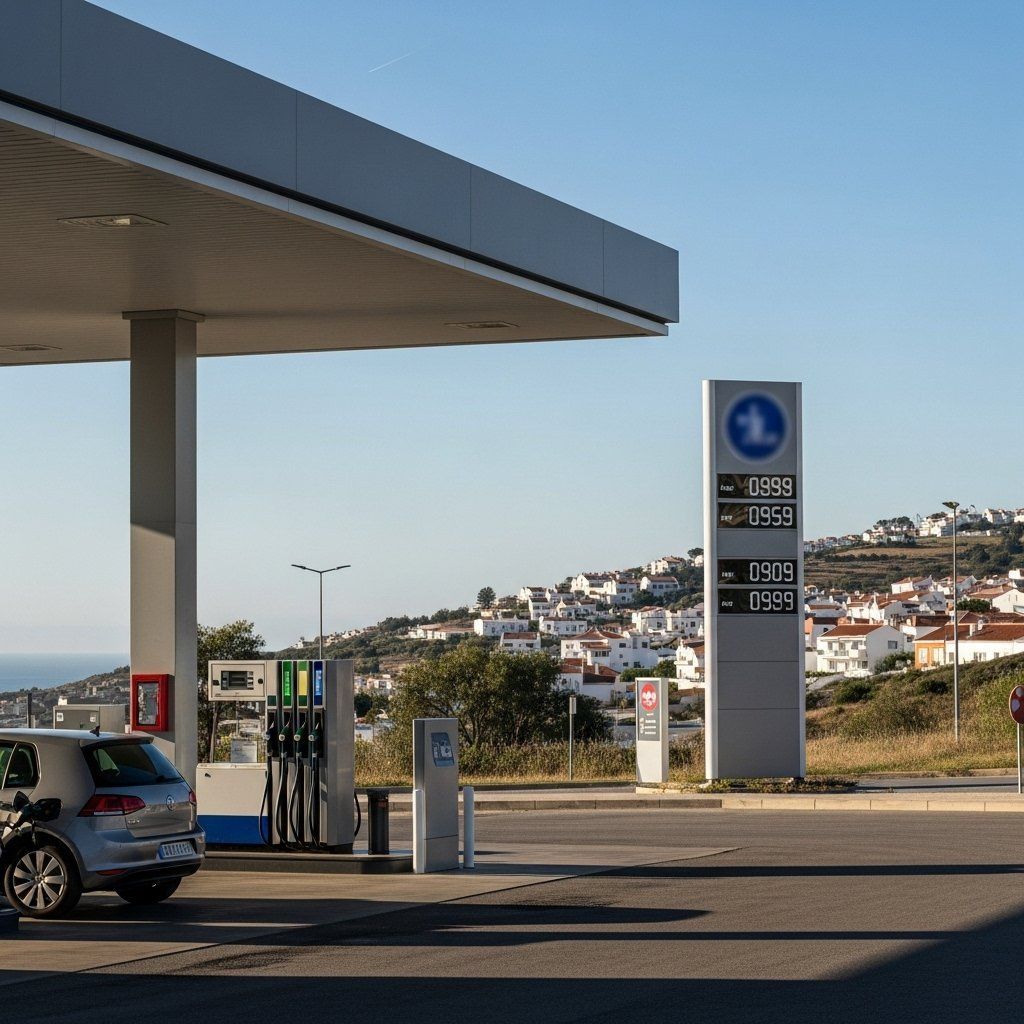
Global oil crisis threatens energy security for import-dependent economies as OPEC oil production has collapsed by a staggering 34% since late February, threatening to prolong inflation and increase transportation and heating costs for households across Europe and beyond. The cartel's output has plunged by 9.67 million barrels per day (M bpd) following the outbreak of conflict in Iran, according to figures released in OPEC's latest monthly report—a drop exceeding even the historic voluntary cuts implemented during the COVID-19 pandemic six years ago.
Why This Matters
• Fuel prices remain elevated: The Brent crude benchmark continues trading above €100 per barrel, directly impacting petrol and diesel costs at pumps across Europe, including Portugal.
• Inflation pressure persists: Global economic forecasts now predict 4.4% inflation in a prolonged conflict scenario, eroding purchasing power for residents worldwide.
• Supply uncertainty through year-end: Transit through the Strait of Ormuz—which handles 20% of global oil trade—remains severely disrupted, with no clear timeline for normalization.
Dramatic Gulf Production Declines
Saudi Arabia's extraction has been hit particularly hard. The kingdom's output fell by almost 1 M barrels daily between March and April alone, settling at 6.77 M bpd in April—down 33% from the 10.11 M bpd recorded in February. Kuwait and Iraq suffered proportionally steeper losses, with production slashed by 77% and 67% respectively. Kuwait's daily output dropped from 2.58 M bpd to just 0.6 M bpd, while Iraq tumbled from 4.18 M bpd to 1.38 M bpd.
Iranian production has also continued its downward slide, totaling 2.85 M bpd last month compared to 3.24 M bpd before the conflict began. The United Arab Emirates, which officially exited OPEC on May 1, posted a modest recovery of 0.13 M bpd in April (reaching 2.02 M bpd), yet remains more than 40% below pre-war levels of 3.4 M bpd.
Marginal gains from other cartel members—Libya (up 0.55 M bpd), Venezuela (up 0.46 M bpd), Nigeria (up 0.13 M bpd), and Algeria (up 0.09 M bpd)—fall far short of offsetting the Gulf states' unprecedented extraction collapse.
OPEC+ Alliance Unable to Meet Production Targets
When factoring in the 10 non-OPEC partner nations, the broader OPEC+ alliance extracted 33.19 M bpd in April, nearly 10% below February's baseline. Russia, which leads the independent producer bloc, saw its own supplies decline by 0.1 M bpd in April—possibly due to Ukrainian strikes on Russian oil infrastructure—though Kazakhstan's 0.11 M bpd increase marginally balanced the shortfall.
Under current conditions, the group appears unable to implement the production increases of 0.20 M bpd agreed for April and May, nor the additional 0.18 M bpd hike scheduled for June. Any meaningful expansion remains contingent on the resumption of safe shipping through the Strait of Ormuz, the narrow waterway between Iran and Oman that typically channels 20% of globally traded crude.
Latin America Steps Into Supply Gap
Production outside the OPEC+ framework is forecast to reach 54.83 M bpd in 2026 and 55.45 M bpd in 2027, representing gains of 0.63 M bpd and 0.62 M bpd respectively. OPEC's report identifies Latin America as the primary growth engine, projecting regional supply increases of approximately 560,000 bpd driven by multiple offshore project launches in key producer nations and additional shale oil output in Argentina.
Brazil, in particular, is expected to boost liquid fuels production by 270,000 bpd this year, averaging 4.7 M bpd. For import-dependent European economies like Portugal—which rely entirely on imported energy—these alternative supply sources offer some hedge against Gulf volatility, though experts caution that Latin American volumes remain insufficient to fully replace lost Middle Eastern capacity.
What This Means for European Households
Import-dependent European economies face acute vulnerability to global price swings. The prolonged conflict has already pushed the Brent benchmark to peaks of €126 per barrel in March, with knock-on effects rippling through transportation, logistics, and consumer goods sectors across the continent.
Higher diesel and petrol costs translate directly to elevated prices for groceries, public transport, and home heating. Central banks and finance ministries across Europe are closely monitoring inflation trajectories, with officials warning that sustained energy price increases could complicate efforts to maintain economic growth targets. European households should brace for continued pressure at the pump and in utility bills, particularly if Strait of Ormuz transit disruptions extend beyond the summer months.
Demand Forecasts Diverge Sharply
OPEC has revised downward its 2026 global oil demand growth forecast to 1.17 M bpd—some 230,000 bpd below last month's projection of 1.4 M bpd. The organization now anticipates average world consumption of 106.33 M bpd this year, rising to 107.87 M bpd in 2027. These calculations rest on assumptions that the global economy will expand 3.1% in 2026 and 3.2% in 2027.
The International Energy Agency (IEA) paints a far bleaker picture. In its latest assessment, the Paris-based watchdog projects an outright contraction in oil consumption of 420,000 bpd relative to 2025, totaling 104 M bpd—a downward revision of 1.3 M bpd from March estimates. The IEA attributes the deterioration to the combined economic impact of the Iran conflict and the effective closure of Ormuz.
This stark divergence in outlook underscores the uncertainty clouding energy markets. The IEA's more pessimistic view reflects concerns that a prolonged crisis could tip major economies into recession, with the International Monetary Fund (IMF) warning that global growth could slip to as low as 2% in an adverse scenario—levels comparable to the 2008 financial crisis or the 2020 pandemic shock.
Infrastructure Alternatives Remain Limited
While some Gulf producers maintain bypass routes that avoid the Strait of Ormuz, their combined capacity falls woefully short of normal traffic volumes. Saudi Arabia's East-West (Petroline) pipeline can handle up to 5 M bpd (potentially expandable to 7 M bpd) and transports crude to the Red Sea port of Yanbu. The UAE's Habshan-Fujairah (ADCOP) pipeline offers 1.8 M bpd capacity to the Gulf of Oman.
Yet countries including Kuwait, Qatar, and Bahrain possess virtually no alternative export infrastructure, leaving them almost entirely dependent on Ormuz. Iran's Goreh-Jask pipeline to the Gulf of Oman has an effective throughput of only 300,000 bpd and remains largely inoperative. The aggregate capacity of alternative routes tops out around 3.5 M to 5.5 M bpd—a fraction of the 20 M bpd that typically traverses the strait.
Long-Term Outlook for Energy Security
Energy security for import-dependent economies remains a critical concern as the global oil crisis unfolds. Nations without domestic fossil fuel production face sustained vulnerability to supply shocks emanating from Middle Eastern conflicts and chokepoint disruptions.
Energy analysts recommend that both governments and consumers prioritize efficiency measures and accelerate the transition to renewable sources where feasible. International bodies including the IEA have indicated that reducing reliance on imported oil through renewable energy investments—solar, wind, and green hydrogen projects—remains a top policy objective for energy-importing nations. In the near term, however, households and businesses must navigate an environment of elevated fuel costs and persistent supply uncertainty.
Should Strait of Ormuz disruptions extend into the second half of 2026, economists warn that import-dependent economies could face GDP growth downgrades and heightened risk of stagflation—a toxic combination of stagnant output and rising prices. Policymakers in Europe and beyond face difficult trade-offs between supporting consumer purchasing power and maintaining fiscal discipline amid rising import costs.
Investment and Market Implications
For investors globally, the current crisis underscores the importance of portfolio resilience. Energy sector volatility is rippling through equities, with transportation and logistics stocks particularly vulnerable. Conversely, renewable energy and efficiency technology companies may see sustained tailwinds as both public and private actors accelerate diversification away from fossil fuels.
Global crude inventories have already fallen by nearly 200 M barrels—equivalent to a daily drawdown of 6.6 M bpd—even as higher prices dampen demand. If OPEC+ members remain unable to restore production and alternative suppliers cannot bridge the gap, analysts warn that the Brent benchmark could retest €150 per barrel territory, with severe implications for inflation-sensitive assets and fixed-income portfolios.
Financial markets across Europe have experienced heightened volatility in energy-intensive sectors, and financial advisers are counseling clients to review exposure to commodities, transport, and consumer discretionary names. Meanwhile, pension fund regulators and other financial authorities are monitoring the potential impact of sustained energy inflation on retirement savings and cost-of-living adjustments.


