The Portuguese Navy intervened on Friday, May 8 off the coast of Huelva to airlift wounded Spanish Guardia Civil agents following a fatal collision between patrol vessels during a high-speed chase targeting drug traffickers. The incident killed two officers and injured several others, underscoring the escalating dangers along the Iberian maritime frontier where narcotics trafficking has intensified dramatically.
Why This Matters
• Cross-border cooperation in action: The NRP Setúbal was operating nearby under existing Portugal-Spain maritime security protocols, allowing rapid medical response.
• Regional security context: Huelva province now accounts for 10% of all drug seizures in Spain despite representing just 2% of national territory, making the area a focal point for organized crime.
• Diplomatic significance: This marks the second major joint operation between Portuguese Navy and Guardia Civil assets this year, reflecting deepening security integration.
The Collision and Immediate Response
Two Guardia Civil patrol craft collided approximately 74 nautical miles—roughly 137 km—south of Huelva on Friday, May 8 around 9:50 AM local time. The crash occurred in contested waters near the Spain-Morocco maritime boundary, an area notorious for fast-boat drug smuggling operations known locally as "narcolanchas."
One vessel involved was the Río Antas, a rigid patrol boat, which reportedly struck a semi-rigid inflatable also operated by the Guardia Civil during the pursuit of a suspect vessel laden with narcotics. Nine officers were aboard the two craft at the time.
A veteran officer, 55 years old with three decades of maritime service in Huelva, died at the scene. The operation's captain initially survived but succumbed to injuries after evacuation to hospital. Among the nine officers aboard, at least two sustained serious injuries, and one suffered minor wounds.
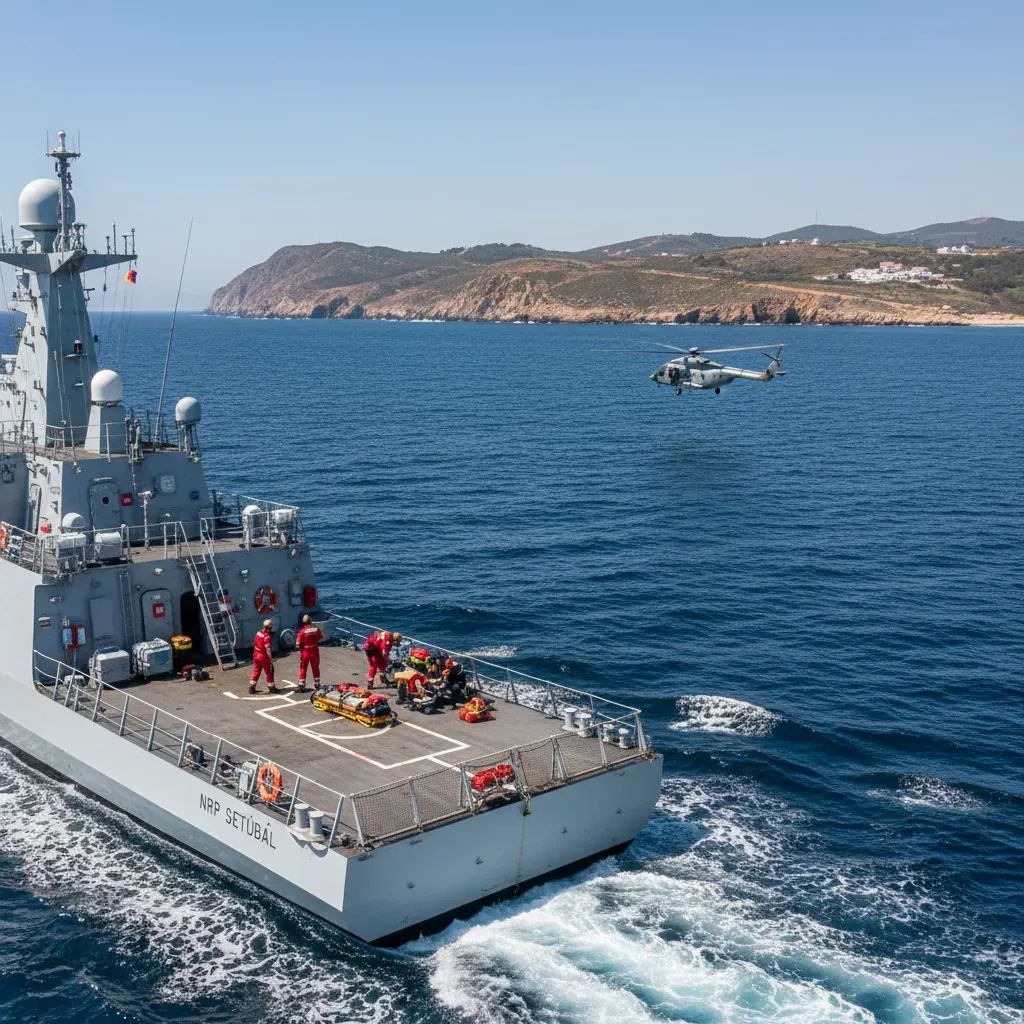
The Portuguese Navy confirmed that the NRP Setúbal, a patrol ship on a routine mission in adjacent waters, diverted immediately after coordination between the National Maritime Rescue Coordination Centre in Madrid (MRCC Madrid) and the Maritime Search and Rescue Coordination Centre in Lisbon (MRCC Lisboa). Medical teams aboard the Portuguese vessel treated multiple casualties and transferred several injured personnel to the ship's facilities.
"One of the injured Guardia Civil officers was transported by helicopter from the NRP Setúbal, ensuring greater safety in this operation," the Portuguese Navy stated in an official communiqué. After delivering all necessary assistance, the Portuguese vessel withdrew from the area.
What This Means for Cross-Border Security
The intervention illustrates the practical application of bilateral maritime cooperation protocols established between Portugal and Spain over the past two decades. Key among these is the 2015 Agreement on Defense Cooperation, which explicitly covers maritime security collaboration between the Portuguese Navy, the Spanish Navy (Armada), and security forces including Portugal's Guarda Nacional Republicana (GNR) and Spain's Guardia Civil.
A more specific 2010 Technical Agreement on Maritime Security Cooperation governs intelligence sharing and operational coordination between the two nations' armed forces. The proximity of the NRP Setúbal to the incident site was no coincidence—Portuguese and Spanish naval assets routinely patrol overlapping zones under these frameworks, particularly in areas where trafficking activity spikes.
The Portugal-Spain border region has become a critical theater in European narcotics interdiction. In April 2026 alone, the multinational Operation ALPHA LIMA involved Portuguese and Spanish forces alongside other European agencies, resulting in 54 arrests and the seizure of approximately 11 tons of cocaine and 8.5 tons of hashish across Atlantic waters and multiple Spanish provinces, including Huelva.
Portuguese authorities have a vested interest in these operations because trafficking routes through Huelva frequently extend northward into Portugal's Algarve and Alentejo coastal zones. In December 2025, Operation Diana, a joint effort between the GNR and Guardia Civil, led to 15 arrests and confiscated 1,509 kg of hashish in Huelva and adjacent Portuguese border areas.
The Escalating Narcotic Threat
Huelva province has transformed into one of Europe's most critical drug entry points. Despite constituting only 2% of Spanish territory and housing just 1.1% of the national population, the region accounts for a disproportionate share of national drug seizures. Drug trafficking cases in the province surged 76.9% in the first quarter of 2025 compared to the same period in 2024, jumping from 26 to 46 recorded incidents.
The volume of narcotics passing through the area has prompted thousands of annual interdiction operations. In 2024, the Spanish Customs Surveillance Service alone conducted 12,000 interventions against drug trafficking in the Strait of Gibraltar area, representing a 40% increase over the previous year. Huelva's coastal waters, situated between the strait and the open Atlantic, serve as an alternative corridor when enforcement tightens further south.
Major seizures have become routine. In March 2026, Spanish police confiscated approximately 5 tons of cocaine in Huelva, allegedly sourced from Morocco and stored near Gibraleón. The following month brought the province's largest single cocaine interception: roughly 6 tons captured off the coast. Another April operation dismantled a criminal organization with Huelva connections, arresting 17 individuals and seizing over 3,500 kg of drugs.
Impact on Law Enforcement and Policy
The Unified Association of Civil Guards (AUGC) emphasized that officers "fight against extremely dangerous criminal organizations" under "operationally complex conditions." The union has intensified calls for additional resources, upgraded equipment, and formal recognition of maritime patrol duty as a high-risk profession.
Friday's deaths prompted the Andalusian regional government to declare an official day of mourning for Saturday, May 9. Political parties across the spectrum canceled campaign events scheduled for the weekend in respect for the fallen officers.
"This tragedy once again highlights the harshness and enormous risk assumed by many Guardia Civil units in their daily work," the AUGC stated, urging lawmakers to address operational shortcomings that leave patrol crews vulnerable during high-speed pursuits in open water.
For residents of Portugal's southern coastal communities, the incident serves as a reminder that the narcotic trade remains a shared security challenge with tangible cross-border implications. Portuguese naval and law enforcement assets are deeply embedded in the regional response architecture, participating in routine patrols, intelligence fusion, and—as demonstrated on Friday—emergency medical assistance.
The investigation into the precise circumstances of the collision continues, with Spanish authorities examining whether equipment failure, communication breakdown, or tactical errors contributed to the tragedy. Preliminary reports suggest poor visibility and the chaotic nature of the high-speed pursuit may have been factors, though no official conclusions have been released.
The Portuguese Navy has not disclosed whether the NRP Setúbal will remain on station in the area or return to regular patrol duties. Maritime security analysts expect no immediate changes to the operational tempo or bilateral cooperation protocols, given the strategic importance both nations place on countering organized crime in shared waters.