

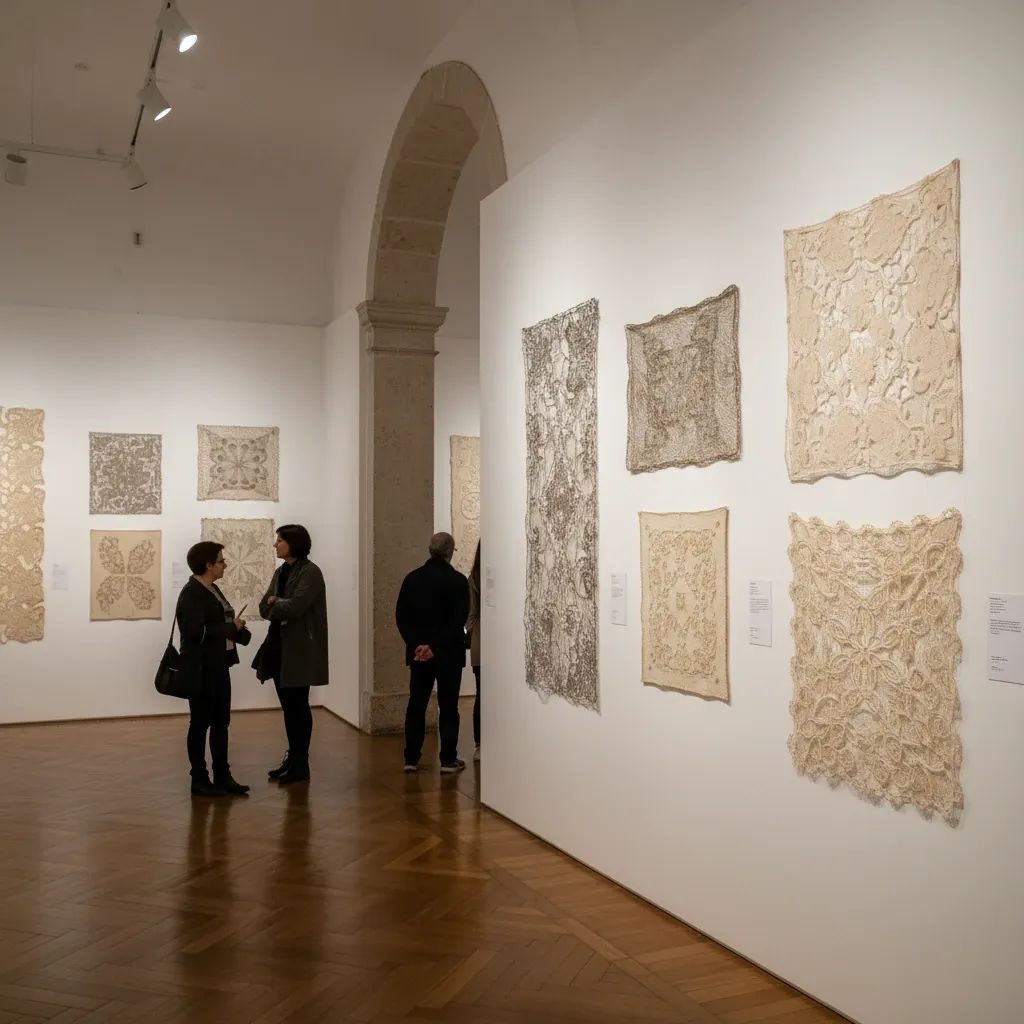
Portugal-born contemporary artist Joana Vasconcelos launches a major solo exhibition at the Museo Picasso Málaga on May 29, 2025, marking a career-defining moment that places her textile-based, feminist-inflected sculptures in direct spatial conversation with the Spanish master's works. The show, titled "Transfiguração," runs through September 27, 2026—over 16 months—and represents nearly two years of collaborative planning between Vasconcelos and the Málaga institution.
Why This Matters
• Cultural diplomacy milestone: A landmark Portuguese artist brings this scale of intervention to Picasso's birthplace museum, reinforcing Portugal's contemporary art footprint in Iberia.
• Visibility for Portuguese artistic heritage: The exhibition integrates traditional Portuguese craft techniques—azulejos, crochet, ceramics—into monumental contemporary installations, showcasing Portugal's cultural identity on an international stage.
• Accessible to Portuguese residents: Málaga is a 1-hour flight from Lisbon; the exhibition offers an affordable cultural excursion for those living in Portugal seeking high-profile European art events.
A Spatial Intervention, Not Just a Loan Exhibition
Unlike conventional museum loans, "Transfiguração" functions as what curator Miguel López-Remiro calls "a kind of friendly invasion of Picasso's house." The 13 works—many monumental in scale—occupy two floors, the courtyard, and both balconies of the museum, interspersed with Picasso's permanent collection. Visitors exiting galleries of Picasso drawings and paintings step directly into Vasconcelos's immersive installations, creating an unbroken aesthetic dialogue across a century of artistic evolution.
Vasconcelos, speaking to Portuguese press agency Lusa during the preview, described the arrangement as a career milestone. "People visit the museum and leave a room with paintings and drawings by Picasso, then enter my rooms on these two floors," she explained. The setup challenges traditional exhibition hierarchies, positioning a living Portuguese artist as an equal interlocutor with one of the 20th century's titans.
The exhibition spans nearly three decades of output, from "Flores do meu desejo" (1996), on loan from Fundação EDP, to a site-specific version of "Floresta Encantada" (2024), created specifically for the Málaga space. López-Remiro noted that Vasconcelos "transfigures everything she touches—us and the space."
The Picasso Parallel: Transfiguration as Shared DNA
Vasconcelos anchors the exhibition's conceptual framework in the notion of transfiguração—transformation—a quality she identifies as central to both her practice and Picasso's. "Picasso had a very long career that transfigured itself, that changed, that had several periods, several epochs," she told Lusa. "He was an artist who managed to adapt to the times and always maintained a very contemporary and clear vision of the moment he was living in."
The parallels extend beyond career longevity. Both artists moved fluidly between two-dimensional and three-dimensional media, between abstraction and figuration. Both appropriated everyday objects—Picasso with newspaper clippings in his Cubist collages, Vasconcelos with cooking pots, tampons, and plastic cutlery transformed into baroque assemblages. Both drew deeply from national cultural traditions: Picasso from Spanish bullfighting and Iberian sculpture, Vasconcelos from Portuguese azulejos and female-dominated craft practices like crochet and embroidery.
The critical distinction lies in thematic focus. While Picasso's oeuvre explored formal innovation and the destruction of visual representation, Vasconcelos uses her transfigurations to interrogate gender roles, consumer culture, and the devaluation of "women's work." Her monumental chandeliers made from tampons ("A Noiva," 2005) or her towering sculptures wrapped in hand-crocheted textiles elevate domestic labor into high art, a feminist gesture absent from Picasso's largely male-centered modernism.
What's on Display: From Feminist Icons to Immersive Forests
The exhibition assembles works from major European collections, including the Louis Vuitton Foundation (Paris), the Museum of Contemporary Art of Castile and León (MUSAC), the Extremadura and Ibero-American Museum of Contemporary Art (MEIAC), and Vasconcelos's own studio. Among the highlights:
• "Vista Interior" (2000): An early work that established her practice of embedding domestic objects in unexpected contexts.
• "Carmen" (2001): A nod to both the operatic archetype and Spanish-Portuguese cultural crossover.
• "www.fatimashop" (2002): A provocative commentary on religious kitsch and Portuguese Catholic identity.
• "Coração Independente Preto" (2006): A black heart sculpture that plays on Portuguese symbolism and pop iconography.
• "Valkyrie Marina Rinaldi" (2014): A monumental textile sculpture blending Norse mythology with fashion branding.
• "Loft" (2010-2017): A multi-year installation project.
• "J'Adore Miss Dior (PA/AP)" (2017): A commentary on luxury branding and female desire.
• "Betty Boop (PA/AP)" (2020): A pop-culture appropriation typical of Vasconcelos's ironic sensibility.
• "Floresta Encantada" (2024): The exhibition's centerpiece, a room-scale immersive installation first shown in Hong Kong but reworked for Málaga with what Vasconcelos described as "a rigor and quality we've never achieved before."
What This Means for Portuguese Cultural Influence
For Portugal's art world, the Málaga exhibition represents a strategic cultural export. Vasconcelos, born in 1971, has built a significant international presence through museum exhibitions in major European institutions. Her work has gained recognition across the continent, with presentations at prominent venues and growing institutional support.
Her success has coincided with a strategic use of Portuguese cultural signifiers. Unlike artists who abandon national identity for global abstraction, Vasconcelos doubles down on it, incorporating Portuguese tiles, textiles, and folk motifs into works that interrogate contemporary issues. This approach has made her a de facto ambassador for Portuguese contemporary culture, a role amplified by the Joana Vasconcelos Foundation (established 2012), which funds scholarships and social causes.
The Málaga exhibition extends this cultural diplomacy into Spain's artistic heartland. Picasso's birthplace carries symbolic weight; staging a major intervention there positions Portuguese contemporary art as both heir to and critic of Iberian modernism's male-dominated legacy.
Practical Information for Visitors
"Transfiguração" opens on May 29, 2025, at the Museo Picasso Málaga (Calle San Agustín, 8, Málaga, Spain) and runs through September 27, 2026. This 16-month exhibition offers an extended opportunity for Portuguese residents to plan a visit. The museum is open Tuesday through Sunday, with extended summer hours. Standard admission covers both the permanent collection and the Vasconcelos intervention.
For Portugal residents, Málaga is reachable via direct flights from Lisbon (approximately 1 hour) and Porto (1.5 hours), with budget carriers offering frequent service. The exhibition's integration into the permanent collection means visitors experience Vasconcelos's work as part of a broader art-historical narrative, rather than in isolation.
Vasconcelos's work demands physical presence—her installations are immersive, tactile, and monumental in ways that resist digital reproduction. The site-specific version of "Floresta Encantada" alone, occupying an entire gallery, represents a unique iteration unlikely to be replicated elsewhere.
A Career Built on Recontextualization
Vasconcelos's practice hinges on what art historians call "recontextualization"—taking objects coded as feminine, domestic, or low-status and repositioning them in spaces traditionally reserved for high art. Her breakthrough came at the 2005 Venice Biennale, where she unveiled "A Noiva" (The Bride), a monumental chandelier constructed from 25,000 tampons. The work's provocation lay not in shock value but in its formal beauty: from a distance, the chandelier read as elegant and baroque, only revealing its subversive materiality upon closer inspection.
This strategy recurs throughout her career. Cooking pots become armor ("Valkyrie" series). Plastic cutlery and crocheted textiles form towering sculptures. Everyday ceramics and tiles transform into architectural interventions. The effect is simultaneously playful and pointed, critiquing the gendered hierarchies that devalue "women's work" while celebrating the aesthetic and technical mastery those practices require.
Her 2000 Prémio Novos Artistas Fundação EDP win—the first artist to receive the award—marked the beginning of institutional recognition within Portugal. International projection followed in the 2005 Venice Biennale, and her work has achieved growing museum-scale visibility over subsequent years.
The Málaga exhibition consolidates this trajectory, offering what the museum describes as "a comprehensive view of the work of one of the most singular European artists on the contemporary scene." For Portuguese audiences, it's both a validation of homegrown talent and an opportunity to see decades of work assembled in a single, coherent narrative—something rarely achieved even in major retrospectives.


