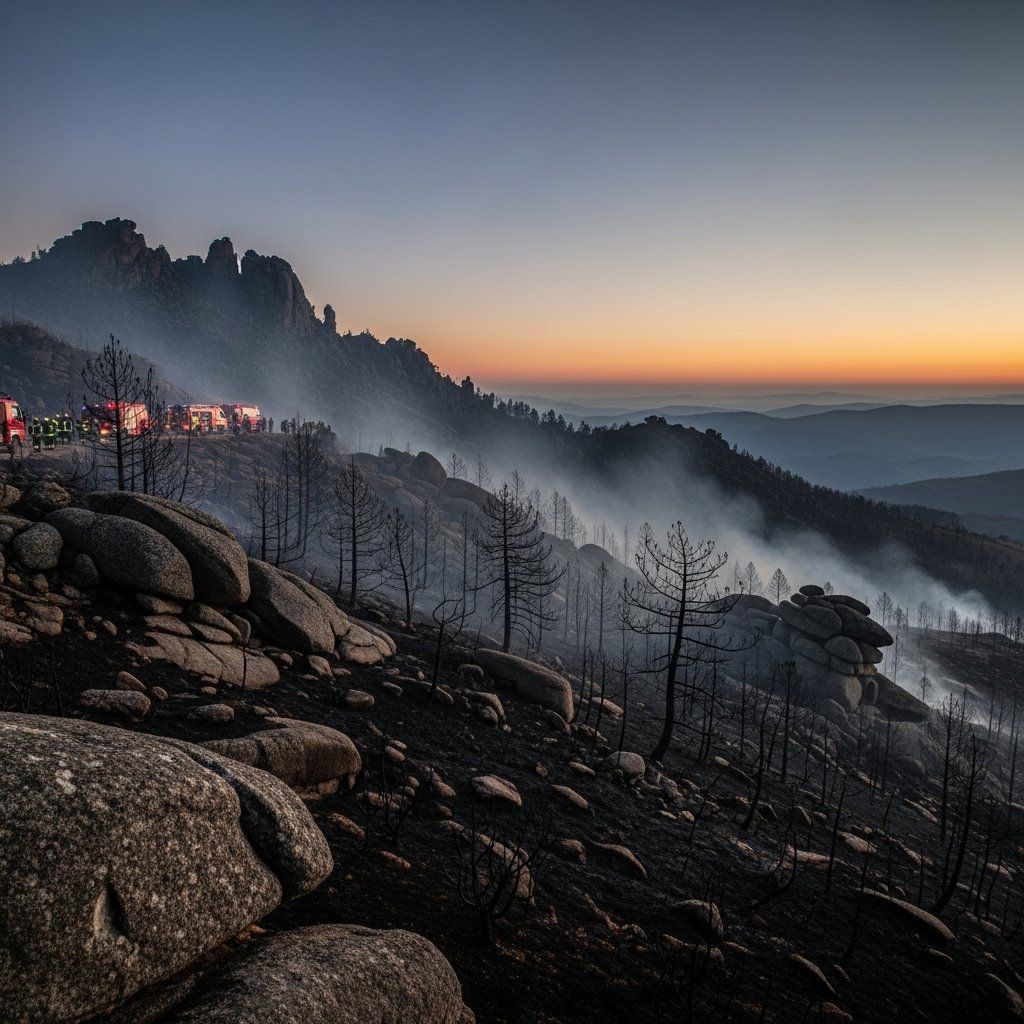
Portugal's wildfire season through August has burned 73.5% less territory than the same period last year, a dramatic reduction that spared 187,046 hectares despite a 6.7% increase in total fire incidents. The discrepancy between more fires and far less damage points to a critical shift in how the country responds to rural blazes.
Why This Matters
• Lives and property: The fires consumed roughly €10 million in state emergency aid for the hardest-hit communities in Vouzela and Valpaços alone.
• Safety restrictions: July's emergency alerts banned access to forest areas, suspended slash burning, and prohibited machinery use during high-risk periods.
• Legal consequences: Portugal's prison system currently holds 58 convicted arsonists with another 41 suspects in custody as of August.
• Geographic focus: The inland North bore the brunt, with Vila Real, Bragança, and Viseu districts accounting for 57% of all burned area.
A Tale of Two Metrics: Frequency Versus Destruction
The Institute for Nature Conservation and Forests (ICNF) has released its preliminary assessment for 2025, covering 1 January through 31 August, and the numbers reveal an unusual pattern. Firefighters battled 6,910 rural blazes, which is 434 more incidents than during the same eight months of 2024. Yet the total scorched earth reached only 67,130 hectares, a fraction of the devastation seen in recent years.
To put that figure in perspective, the average annual burned area over the preceding decade was roughly 25% higher. This year, the destruction splits almost evenly between forest stands (30,123 hectares) and scrubland (30,682 hectares), with agricultural land making up a far smaller portion (6,325 hectares).
The reduction owes something to weather. August brought significant rainfall, and meteorologists have described the summer as "relatively calm" compared to the searing temperatures of 2024. But authorities are quick to note that preparation played an equally vital role.
The Response Machine: Portugal's Largest-Ever Firefighting Deployment
The National Authority for Emergency and Civil Protection (ANEPC) activated what officials called the largest Special Rural Firefighting Device (DECIR) in the country's history. At the peak of the critical phase in July, the operation mobilized 15,149 personnel, 3,463 vehicles, and 50 aerial assets.
One tactical change proved particularly effective. Aerial units began intervention earlier in the day, often by 08:00, rather than the typical 09:00 or 09:30 start. This adjustment aimed to strike small ignitions before they could spread, aligning with the broader strategic principle of rapid initial attack that prioritizes containment over extended suppression.
The government also rolled out the "Portugal Chama" (Portugal Calls) awareness campaign, urging residents to avoid risky behaviors, report controlled burns, and maintain cleared buffers around properties. Patrol intensity increased in high-danger zones, focusing on early detection and deterring negligent fire use.
The Human Factor: What Caused the Fires?
ICNF investigators looked into 6,024 of the 6,910 recorded incidents, and their findings paint a clear picture of preventable causes.
Controlled burns and agricultural clearing — the category known locally as queimas e queimadas — accounted for roughly one-third of investigated fires. Negligence, rather than malice, led the list. Arson ranked second at 19% of cases, a notable drop from the 33% recorded in 2024, when deliberate ignition was the leading cause. Re-ignitions, where poorly extinguished embers flare back up, represented 9% of the total, slightly below the ten-year average.
Law enforcement has kept pace. Portugal's judiciary detained a record number of suspects over the past two years, and as of August, 329 alleged arsonists remain under judicial supervision, including those in custody, under house arrest, or released pending trial.
Security analysts note there is no single profile. Research divides offenders into three groups: those with serious mental illness, those with developmental disorders, and those with no psychiatric diagnosis at all. Many display social isolation, alcohol dependency, or a pattern of repeat offending — so-called "serial arsonists." Investigators have even recovered sophisticated timing devices used to delay ignition and give perpetrators time to flee.
Where the Flames Hit Hardest
The geography of loss followed familiar lines. The districts of Porto (1,088), Braga (668), and Vila Real (630) logged the most fire starts, but most remained small, burning less than one hectare each. The difference lies in what happens when a fire escapes containment.
In terms of total area destroyed, Vila Real led the nation with 16,794 hectares — a quarter of all burned territory nationwide. Bragança followed with 13,084 hectares (19% of the total), and Viseu recorded 8,526 hectares (13%). Together, these three northern districts account for nearly six-tenths of Portugal's fire damage in 2025.
July was the cruelest month. More than half of the season's total burned area — 37,119 hectares — erupted in that thirty-day window, concentrated primarily in two catastrophic events.
The Two Giants: Vouzela and Valpaços
The fire season's worst moments came in July. On 2 July, a blaze ignited near Tourelhe in the municipality of Vouzela, Viseu district. It would become the year's largest fire, charring more than 15,000 hectares before firefighters brought it under control. Flames jumped municipal boundaries, spreading to Tondela, Oliveira de Frades, and parts of Aveiro district.
Late in the month, another major fire erupted near Cabelo, Ervões, in Valpaços, Vila Real district. That blaze consumed 11,619 hectares, extending into Mirandela, Vinhais, and Macedo de Cavaleiros in Bragança before being declared dominated on 1 August.
Together, these two incidents alone account for over a third of all territory burned in 2025. The 68 large fires (defined as blazes exceeding 100 hectares) were responsible for 82% of the total damage, underscoring how a handful of runaway incidents drive the national statistics.
Government Response: €10 Million in Emergency Aid
The scale of destruction in Vouzela and Valpaços prompted swift political action. On 3 September, the Cabinet approved a €10 million relief package for affected residents and producers. The funds, disbursed as non-reimbursable grants, aim to restore agricultural and forestry potential.
The government also triggered nationwide alert declarations between 3 and 6 July, later extending restrictions through 9 July in high-risk districts including Viseu and Vila Real. The orders prohibited access to forest areas, banned all slash burning, and restricted machinery operation in rural zones.
These measures followed a series of policy refinements throughout the year. In April, the government created the Integrated Prevention and Operations Command (CIPO) to strengthen planning and risk control. In May, officials approved the National Qualifications Plan for the Integrated Rural Fire Management System and tightened rules on tree cutting and enforcement penalties. The Vila Real-hosted "Phoenix Exercise 2025" in May had tested operational readiness months before fire season peaked.
What This Means for Residents and Landowners
For anyone living in Portugal's inland north or central regions, the 2025 data carries two practical messages.
First, vigilance remains essential even in quieter years. The number of fires rose, even if total damage fell. The leading causes — controlled burns and negligence — are entirely within human control. If you manage land, follow clearing obligations and report any planned fire use to local authorities before ignition.
Second, the legal and financial stakes have risen. Authorities are prosecuting arson more aggressively, and the prison population for wildfire crimes has climbed steadily over the past decade. For landowners affected by declared natural disasters like the Vouzela and Valpaços fires, state aid is available but typically requires documentation of losses and compliance with prior land management regulations.
Finally, stay informed about alert declarations during the critical season, typically July through September. When authorities issue an alert, forest access bans carry legal weight, and violations can result in fines or criminal charges.
Portugal's fire season is not over. But through August, the combination of favorable weather and a reinforced response infrastructure has kept the damage far below recent memory.