

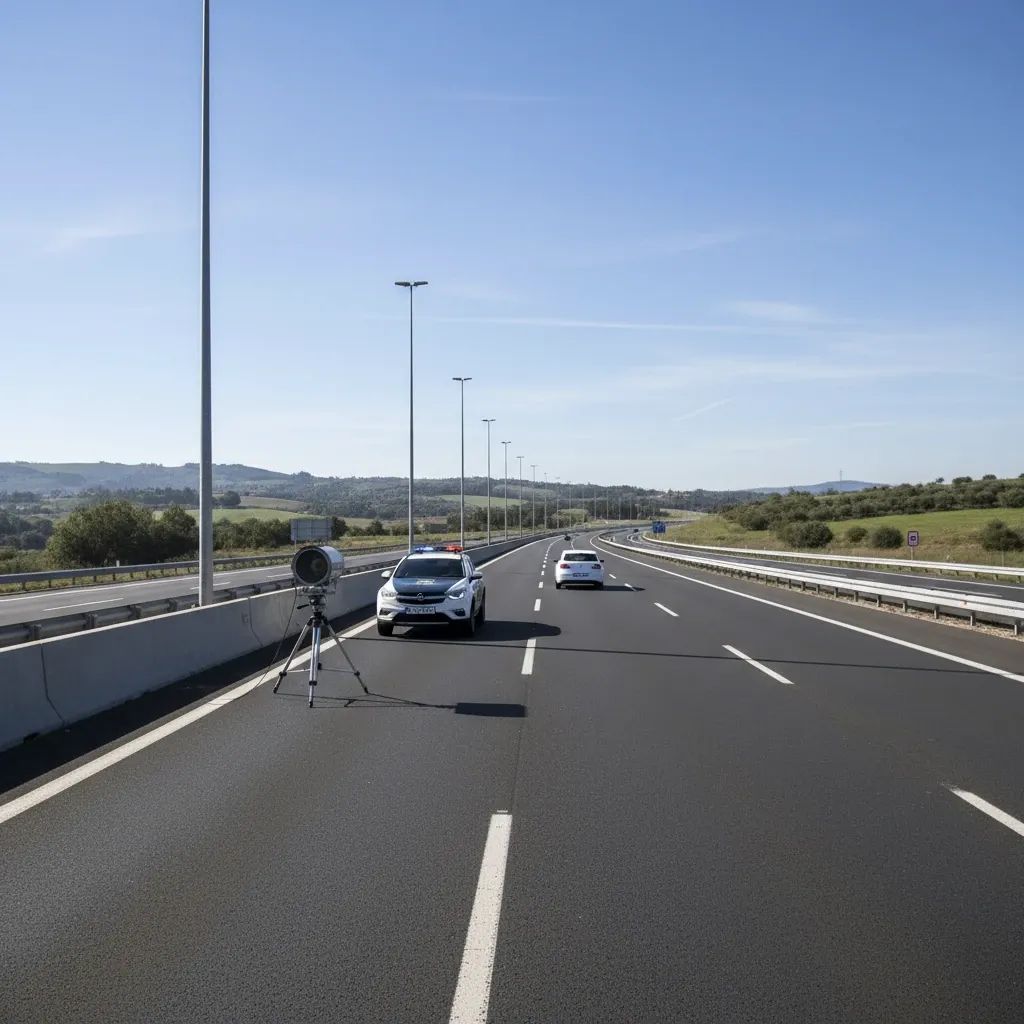
The Portugal Cabinet has officially approved the National Road Safety Strategy — Vision Zero 2030, a framework that aims to cut road deaths and serious injuries in half by the end of the decade and eliminate them entirely by 2050. The document, pending since 2021, now enters public consultation—a critical step before implementation begins through biennial action plans.
Why This Matters
• Ambitious targets: Portugal commits to reducing fatalities and serious injuries by 50% within four years, addressing a death toll that currently sits 22% above the EU average.
• 40 concrete measures will tackle high-risk zones including urban centers, schools, rural roads, and alcohol- and drug-impaired driving.
• Reactivation of the GNR Traffic Brigade in April 2026 marks the return of specialized highway enforcement units, extinct since 2007.
• Shared responsibility model: Local governments, private firms, and individual road users will all be held accountable under the new governance structure.
A Strategy Two Decades in the Making
According to the Portugal Ministry of Internal Administration (MAI), this strategy represents one of the government's flagship safety commitments, aligning domestic policy with the European Union's road safety framework, the UN Decade of Action for Road Safety 2021-2030, and the Stockholm Declaration. Minister Luís Neves highlighted that the strategy rests on five pillars: safe users, safe infrastructure, safe vehicles, safe speeds, and post-crash response.
Unlike past efforts, this strategy puts human life—not traffic flow—first. Multiple ministries will now coordinate: transport handles infrastructure, health manages post-crash response, education runs awareness campaigns, and justice enforces penalties. Previously, traffic police worked alone. This means measurable benchmarks will be monitored continuously by an interministerial governance structure, rather than leaving road safety solely to traffic police.
Private sector involvement is already underway. Highway operator Ascendi signed the Vision Zero Commitment, pledging infrastructure upgrades and investment in safety technology. The strategy document references technical and scientific studies conducted over the past two years, though the detailed action plan containing all 40 measures has not yet been made publicly available. That information is expected during the public consultation phase.
What This Means for Residents
Looking back at 2025, Portugal's road safety record lagged behind most of Western Europe. In that year, the country recorded 55 deaths per million inhabitants—roughly 565 total deaths—compared to the EU average of 45. While that represented a 5% improvement over 2024, the gap remained troubling.
But 2026 has been worse. Provisional data from the National Road Safety Authority (ANSR) show 210 fatalities between January 1 and early June, an increase of 54 deaths compared to the same period in 2025. Total accidents climbed to 63,493, up by 5,612 incidents year-on-year. The New Year period alone (December 27, 2025, to January 4, 2026) saw 26 deaths, an 86% surge over the previous year. The Easter operation added another 20 fatalities.
For residents, the strategy translates into more frequent traffic stops, expanded speed camera networks, and harsher penalties for drunk driving. The government announced that random enforcement operations will no longer be publicized in advance, a shift designed to deter risky behavior through unpredictability. The revised Road Code—also approved in recent months—broadens the criteria for license suspension and accelerates the digitization of traffic fines to prevent expiration of minor infractions, meaning penalties are less likely to be overlooked in the bureaucratic process.
Minister of the Presidency António Leitão Amaro emphasized during the post-Cabinet press conference that the strategy seeks "a significant reduction in serious accidents and deeply regrettable fatal crashes." The focus extends beyond highways: urban zones, school perimeters, and rural roads—where 40% of serious accidents occur—will receive targeted interventions. Factors such as alcohol, psychotropic substances, driver distraction, and fatigue are explicitly named as priority enforcement areas.
The Return of the Traffic Brigade
One of the most visible changes arriving this year is the reactivation of the GNR Traffic Brigade, nearly 20 years after its dissolution. Announced in April 2026, the brigade will deploy specialized officers dedicated exclusively to highway patrol and major route monitoring. GNR Commander-General Rui Veloso stated the brigade will assume full control of main itineraries and motorways, increasing both visibility and enforcement capacity.
While termed a "reactivation," the brigade functions more as a reorganization of existing traffic personnel under centralized national command. This structure aims to standardize procedures and optimize resource allocation across Portugal's varied geography. Given the recent approval, no impact data exists yet, but traffic safety advocates, including the National Association of Guard Officers (ANOG) and Portuguese Road Prevention (PRP), welcomed the move with caution. They stress that enforcement alone cannot solve the problem without complementary education campaigns and infrastructure investment.
Skepticism lingers. A similar brigade reactivation was announced in 2013 but never materialized. This time, the measure forms part of a broader legislative package—including the revised Road Code and the Vision Zero strategy—suggesting stronger political commitment.
Challenges Ahead
Portugal faces a difficult trajectory. The EU's 2026 interim report on road safety policy confirmed that current reduction rates across the bloc are insufficient to meet 2030 targets. Portugal's spike in early-2026 fatalities underscores the urgency.
The strategy positions road safety as a shared responsibility, demanding action not just from the state but from municipalities, private entities, and everyday road users. Drivers, motorcyclists, cyclists, and pedestrians will all face heightened scrutiny and enforcement. Local governments must align infrastructure projects—crosswalks, signage, speed bumps—with national safety standards, while companies operating fleets or public transport will be expected to adopt vehicle safety technologies and driver training programs.
Critics argue that enforcement-heavy approaches risk alienating the public without addressing systemic issues such as poorly maintained rural roads, inadequate public transport alternatives, and urban sprawl that forces long commutes. The strategy's success will depend on whether the biennial action plans balance penalties with genuine infrastructure improvements and behavioral change campaigns.
Timeline and Next Steps
The public consultation opens immediately, allowing citizens, municipal authorities, transport operators, and advocacy groups to comment on the strategy before final adoption. The first biennial action plan is expected by late 2026, outlining specific interventions, budget allocations, and performance indicators. The MAI and partner ministries will publish progress reports every six months, tracking fatalities, serious injuries, and intermediate benchmarks such as seatbelt usage rates, average speeds, and enforcement activity.
Reaching zero deaths by 2050 remains an aspirational goal, one shared by several EU member states. Achieving the interim 50% reduction by 2030 will require reversing the current upward trend within four years—a steep challenge given the 2026 data. The reactivated Traffic Brigade, revised penalties, and coordinated governance model represent the most comprehensive road safety overhaul in over a decade. Whether it proves sufficient will become clear as enforcement ramps up and the first action plans take effect across Portugal's highways, cities, and rural networks.


