

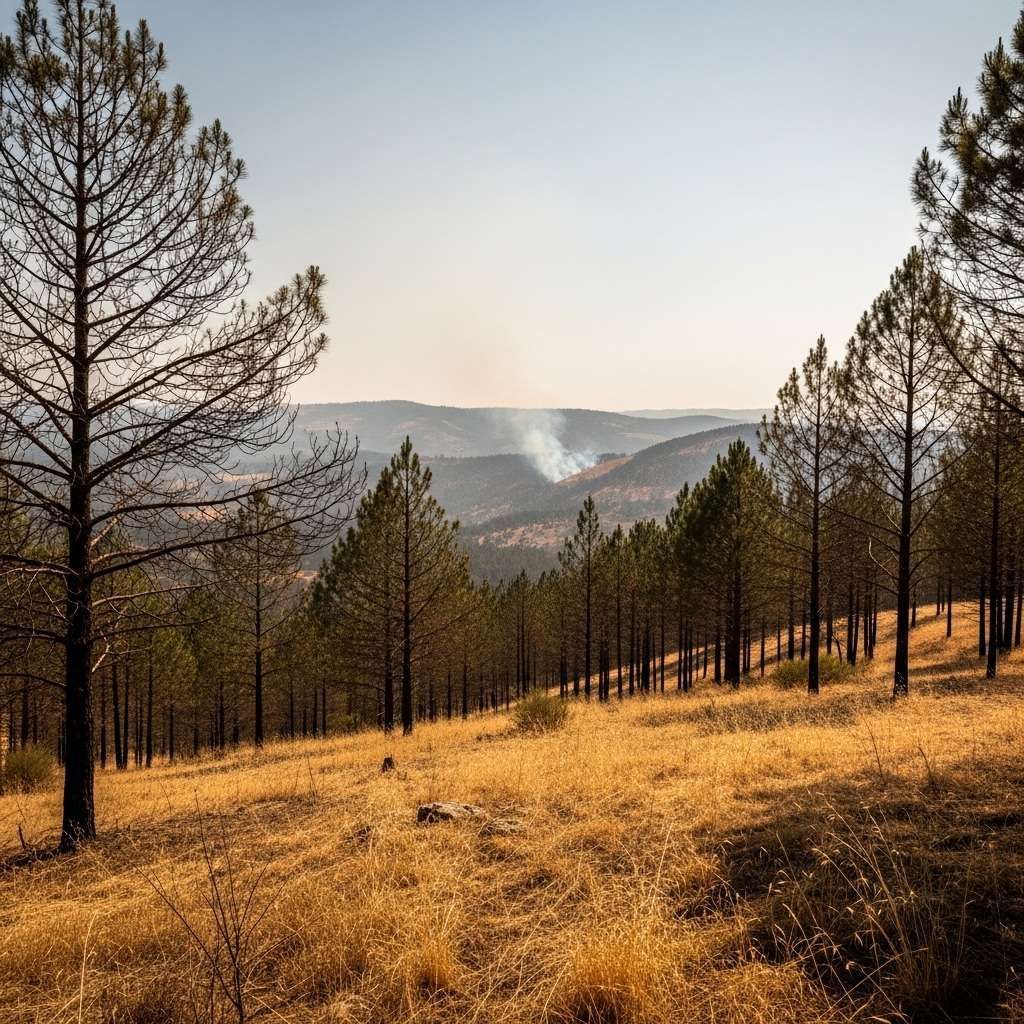
Portugal's Civil Protection Agency mobilized more than 245 firefighters and 9 aircraft to battle a wildfire that erupted in Murça, Vila Real district, marking the first major test of the country's newly reinforced firefighting apparatus as the nation enters its most critical wildfire season with area burned already double that of last year.
What This Means for Residents—Immediate Safety Information
Portugal enters the most dangerous phase of wildfire season under extraordinary pressure. Maximum fire risk now covers 60 inland municipalities, with an additional 40 under high risk across districts from Viana do Castelo to Faro, according to the Portuguese Institute for Sea and Atmosphere (IPMA).
Critical actions for residents in high-risk areas:
• Check your municipality's fire risk level immediately at IPMA.pt or through your local Civil Protection authority
• Fire prevention regulations during Delta phase: No outdoor burning or agricultural fires; no machinery use in forests or agricultural areas between 9:00 AM and 7:00 PM; BBQ use restricted to designated areas away from vegetation; clear vegetation at least 10 meters from your property
• Keep emergency numbers saved: 112 for emergencies, local Civil Protection hotlines for evacuation alerts
• Prepare an evacuation bag with documents, medications, and essentials—keep it accessible at all times
• Sign up for municipal emergency alerts if available in your area
Current conditions: Heat warnings escalated today, with Castelo Branco, Portalegre, Évora, and Beja under orange alert (the second-highest severity). That warning expands to the entire country by Friday. Temperatures reached 40°C in Castelo Branco today, and IPMA forecasts highs of 40–43°C in the Tagus Valley and Alentejo through the week. Minimum overnight temperatures offer little relief, remaining between 16°C on the coast and 25°C inland—tropical night conditions that prevent fuel moisture recovery.
Why This Matters
• Immediate impact: Maximum fire danger declared in 60 inland municipalities; orange heat warnings cover much of the country through Friday.
• Seasonal outlook: Portugal's firefighting force enters its highest readiness level (Delta) with 15,149 personnel and 81 aircraft active through September 30—the largest deployment in a decade.
• Troubling trend: Over 14,000 hectares have burned in 2026 through today, the worst figure since 2017 and twice the destruction recorded during the same period in 2025.
• Regional exposure: The North region accounts for 68% of all burned area this year, with 9,643 hectares consumed.
Murça Fire Brought Under Control After Nine-Hour Battle
The wildfire that ignited shortly before 1:00 p.m. in the Noura e Palheiros parish of Murça entered the resolution phase at 9:40 p.m., according to Portugal's National Emergency and Civil Protection Authority (ANEPC). By 10:30 p.m., 231 firefighters and 72 vehicles remained on site conducting mop-up operations.
José Requeijo, deputy regional commander for Civil Protection Douro, described the incident as a successful containment despite challenging terrain and weather. "The fire maintained two active fronts throughout the afternoon, but the combined ground and aerial effort allowed us to bring it under control," he told reporters. While several villages fell within the fire perimeter, no evacuations proved necessary.
The blaze burned through a mixed landscape of scrubland, pine forest, and agricultural plots in an area with notoriously difficult access. Firefighters confronted not only rough terrain but also intense heat and wind, though Requeijo noted wind speeds remained generally weak except for localized gusts created by the fire itself.
Aerial resources—including up to 9 aircraft—departed the scene between 8:30 and 8:40 p.m. as sunset ended flight operations. The rapid deployment of firefighting assets immediately after the alert represented a tactical priority: contain the fire before nightfall reduced operational capacity.
The Heat Crisis Deepens
The combination of prolonged heat, low humidity, and accumulated dry vegetation creates what officials describe as a "perfect storm" scenario. Rui Rocha, Secretary of State for Civil Protection, acknowledged the timing: "We're entering Delta phase during a heatwave, with very hot days, tropical nights, and low humidity—always a cause for concern."
The fire danger index, calculated from air temperature, humidity, wind speed, and recent precipitation, will remain at maximum or very high levels across nearly the entire mainland through at least July 8.
Firefighting Arsenal Reaches Peak Strength
Portugal activated its maximum firefighting deployment today, maintaining it through September 30. The Special Rural Fire Combat Device (DECIR) for 2026 represents the largest mobilization in a decade, with a €50 M budget—€6 M more than 2025.
The 81-aircraft fleet includes several strategic additions:
• Two Black Hawk helicopters from the Portuguese Air Force, making their operational debut in wildfire suppression.
• Three helicopters from AFOCELCA, the private forest protection company specialized in rural firefighting.
• Expanded use of chemical fire retardant at five aircraft centers, up from just one in 2025—a technology that delays flame spread and improves containment odds.
Ground forces comprise 15,149 personnel from volunteer fire brigades, the Special Civil Protection Force, National Republican Guard (GNR) military units, and forest rangers from the Institute for Nature Conservation and Forests (ICNF). They operate 3,463 vehicles organized into 2,596 teams—a slight increase over last year.
The Leiria region received targeted reinforcement following February's Storm Kristin, which toppled thousands of trees and created massive fuel loads. An Integrated Command for Prevention and Operations (CIPO) coordinates debris removal, critical area clearance, and access road improvements in that zone.
"Our feeling is one of confidence and preparation," Rocha said at the inauguration of a new municipal coordination center in Almodôvar. "We've made improvements to the 2026 apparatus to address issues we identified last year."
Sobering Statistics Frame the Challenge
Provisional data from the Integrated Rural Fire Management System (SGIFR) paint a stark picture: through today, Portugal recorded 7,173 wildfires that burned 14,173 hectares—double both the incident count and burned area compared to the same period in 2025. This year's destruction marks the worst January-to-July performance since 2017.
The North region bears the heaviest burden, with 2,131 fires consuming 9,643 hectares—68% of the national total. Interior Ministry officials have repeatedly characterized 2026 as likely to be "very hard" and "very complicated" for wildfire risk.
A Greenpeace Portugal report released June 30 highlighted structural vulnerabilities: despite a 20-year decline in ignition events, the country remains exposed due to inadequate landscape management. The analysis noted that 2003, 2005, 2017, and 2025 were exceptional years for burned area and casualties, and Portugal continues ranking among Europe's most fire-affected nations.
Labor Dispute Shadows Emergency Response
A strike by emergency telecommunications operators at Civil Protection ran from June 29 through today, coinciding with the Delta phase activation. The Independent Union of Forest, Environment and Civil Protection Workers (SinFAP) called the action to demand creation of a dedicated career path for the operators and reorganization of ANEPC. Secretary of State Rocha assured that minimum services remain fully guaranteed and "at no location has the quality of emergency response to the population been compromised."
Outlook and Historical Context
IPMA warned at the start of this week that Portugal faces "a long period of hot, dry weather," with dangerous conditions extending into the second week of July. The typical peak wildfire season in Portugal begins in late June and lasts approximately 12 weeks.
Fire danger assessments incorporate multiple variables—air temperature, relative humidity, wind velocity, and precipitation in the preceding 24 hours—to produce a five-level risk scale from reduced to maximum. The current forecast places virtually the entire mainland in the top two categories through at least mid-July.
Authorities maintain that despite challenging circumstances—doubled burned area, extreme heat, difficult terrain, and labor tensions—the response infrastructure represents Portugal's most robust wildfire defense capability in modern history. Whether that proves sufficient will depend largely on variables beyond official control: the severity and duration of the heatwave, ignition sources, and wind behavior during critical fire runs.
For residents in high-risk zones, the message remains clear: the next three months demand heightened vigilance, adherence to fire prevention regulations, and readiness to respond quickly to evacuation orders should conditions deteriorate. Stay informed through official channels, follow local guidance, and prioritize your family's safety above all else.


