

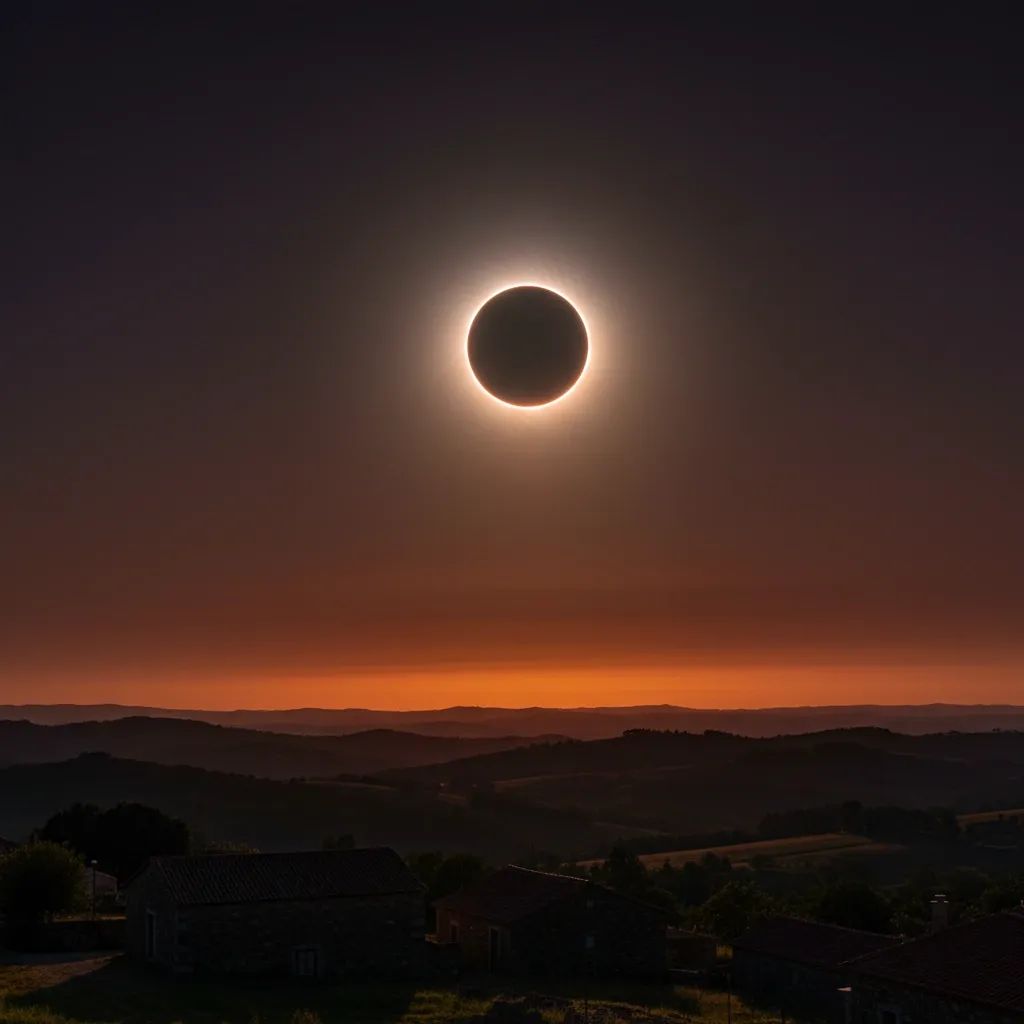
The European electricity grid faces a rare technical challenge on Wednesday, August 12, 2026, when a solar eclipse will temporarily slash photovoltaic output across the continent—a stress test for an energy system increasingly reliant on renewables. In Portugal, grid operator Redes Energéticas Nacionais (REN) is preparing contingency measures for the eclipse window. Backup hydroelectric and thermal plants will be standing by to fill any generation gaps during this period.
Why This Matters
• Timing is crucial: The eclipse will occur during late afternoon and early evening hours, when people return home and businesses wind down, coinciding with increased electricity demand.
• No blackouts expected: Authorities have confirmed security of supply is not at risk, but coordinated reserve activation across the EU is essential for the 2026 event.
• Rare celestial event: The last total solar eclipse visible in Portugal was in 1912; the next won't occur until 2144, making the August 2026 eclipse a once-in-several-lifetimes phenomenon.
• Totality in Bragança: The eclipse will be total only in a narrow strip near Parque Natural de Montesinho, while the rest of mainland Portugal will see 92% to 99% obscuration. The Azores and Madeira will experience 74% to 77% coverage.
Grid Operators Mobilize Reserves Across the Peninsula
Spain's Red Eléctrica estimates the Iberian Peninsula will lose around 5 GW of solar capacity during the August 2026 eclipse—approximately 13% of typical peak demand on an August Wednesday. For context, that's enough power to supply roughly 2 million households simultaneously. Despite the seemingly large figure, grid managers describe the impact as "limited and temporary" because the eclipse occurs late in the day, when solar generation naturally tapers off and does not coincide with the midday demand surge.
Portugal's REN is coordinating advance preparations for the 2026 event, planning to deploy hydroelectric reservoirs and gas-fired thermal stations, which can ramp up quickly to stabilize frequency and voltage. The operator has been running simulations to prepare, coordinating with counterparts in Spain, France, and other interconnected markets to ensure seamless balancing of cross-border electricity flows.
Europe-Wide Coordination Through ENTSO-E
The European Network of Transmission System Operators for Electricity (ENTSO-E), representing 40 grid operators in 36 countries, activated a dedicated task force to prepare for the August 2026 eclipse. The group has held coordination meetings to finalize contingency protocols and share real-time data models. Anna-Kaisa Itkonen, spokesperson for the European Commission's Climate and Energy Directorate, confirmed the institution is monitoring preparations "from all angles" but emphasized the impact should not be "very significant" given the late-afternoon timing.
In optimal weather conditions, Europe-wide photovoltaic output could drop by a significant amount during the eclipse. Germany and Spain—home to the continent's largest solar fleets—will face the steepest absolute losses. However, grid operators have integrated eclipse-specific algorithms into their forecasting systems, allowing control rooms to anticipate generation changes throughout the event and adjust dispatch schedules accordingly.
What This Means for Residents
For most people in Portugal, the August 2026 eclipse will be entirely transparent from a practical standpoint. Lights will stay on, appliances will run, and electricity prices on the wholesale market may see only modest volatility. The real work happens behind the scenes, where engineers balance supply and demand in real time by calling up dispatchable generation and, if necessary, requesting large industrial consumers—such as steel mills or data centers—to temporarily reduce load.
Renewable energy investors and solar farm operators should note that Portugal's solar capacity has grown dramatically in recent years, making the grid more sensitive to weather-driven fluctuations. The August 2026 eclipse serves as a reminder that energy storage and grid flexibility remain critical investments as the country pursues its carbon neutrality goals for 2050. Battery storage systems, which can discharge power within milliseconds, are increasingly seen as a hedge against both eclipses and sudden cloud cover.
Homeowners with rooftop solar panels will notice their systems produce little or no power during the eclipse window in 2026, though this won't affect grid-connected households, who will draw electricity from the network as usual. Off-grid properties relying solely on solar plus batteries should ensure their storage systems are fully charged beforehand.
A Once-in-a-Lifetime Spectacle
Beyond the technical logistics, the August 12, 2026 eclipse offers a rare astronomical spectacle. The path of totality—where the Sun is completely obscured—cuts across Greenland, Iceland, the North Atlantic, and northern Spain, with totality occurring over Parque Natural de Montesinho near Bragança. Observers in that narrow corridor will witness the Sun's corona glowing around the lunar silhouette, a phenomenon last seen in Portugal more than a century ago.
The rest of the country will experience a deep partial eclipse, with near-total obscuration in the north and progressively less coverage toward the south. Lisbon and the Algarve will still see well over 90% of the Sun blocked, producing an eerie twilight effect and noticeable temperature drop. The Azores and Madeira, farther from the eclipse's central path, will see a more modest three-quarters obscuration.
Astronomers and educators have been promoting safe viewing practices, emphasizing the need for ISO-certified eclipse glasses to prevent eye damage. Local municipalities across northern Portugal are beginning to organize public viewing events for the 2026 eclipse, and tourism operators in the Bragança region are already anticipating increased interest.
Lessons from the 2015 Eclipse
European grid operators have confronted this challenge before. The March 20, 2015 solar eclipse was dubbed an "unprecedented test" because solar energy had grown from 0.1% of the continent's generation mix in 1999 to 10.5% by 2015. That event caused no blackouts, but it forced operators to refine their coordination protocols and reserve management strategies.
Since then, solar capacity has more than doubled in many EU countries, including Portugal, which ranked 9th in Europe for solar electricity generation in 2022. The upcoming August 2026 eclipse benefits from those earlier lessons: enhanced cross-border coordination, pre-positioned reserves, minute-by-minute forecasting, and direct communication with market participants. Operators have also improved their ability to integrate behavioral models for intermittent renewables, making the grid more resilient to rapid fluctuations.
No Supply Concerns, But Vigilance Remains
The European Commission and national regulators have repeatedly assured the public that energy security is not at risk during the August 2026 eclipse. Portugal's grid is interconnected with Spain via multiple high-voltage transmission lines, allowing surplus power to flow in from neighboring markets if needed. The country's hydroelectric dams, which provide significant storage capacity, offer a flexible backstop, and natural gas plants can ramp up within minutes.
The eclipse underscores a broader strategic question: as Portugal accelerates its renewable energy transition—with ambitious targets for solar, wind, and green hydrogen—the need for grid flexibility, storage infrastructure, and cross-border interconnections becomes more urgent. The August 2026 event is both a technical challenge and a proof-of-concept for managing a future in which variable renewables dominate the energy mix.
For now, Portuguese consumers can mark their calendars for an extraordinary celestial show in 2026, confident that the lights will stay on even as the Sun briefly disappears.


