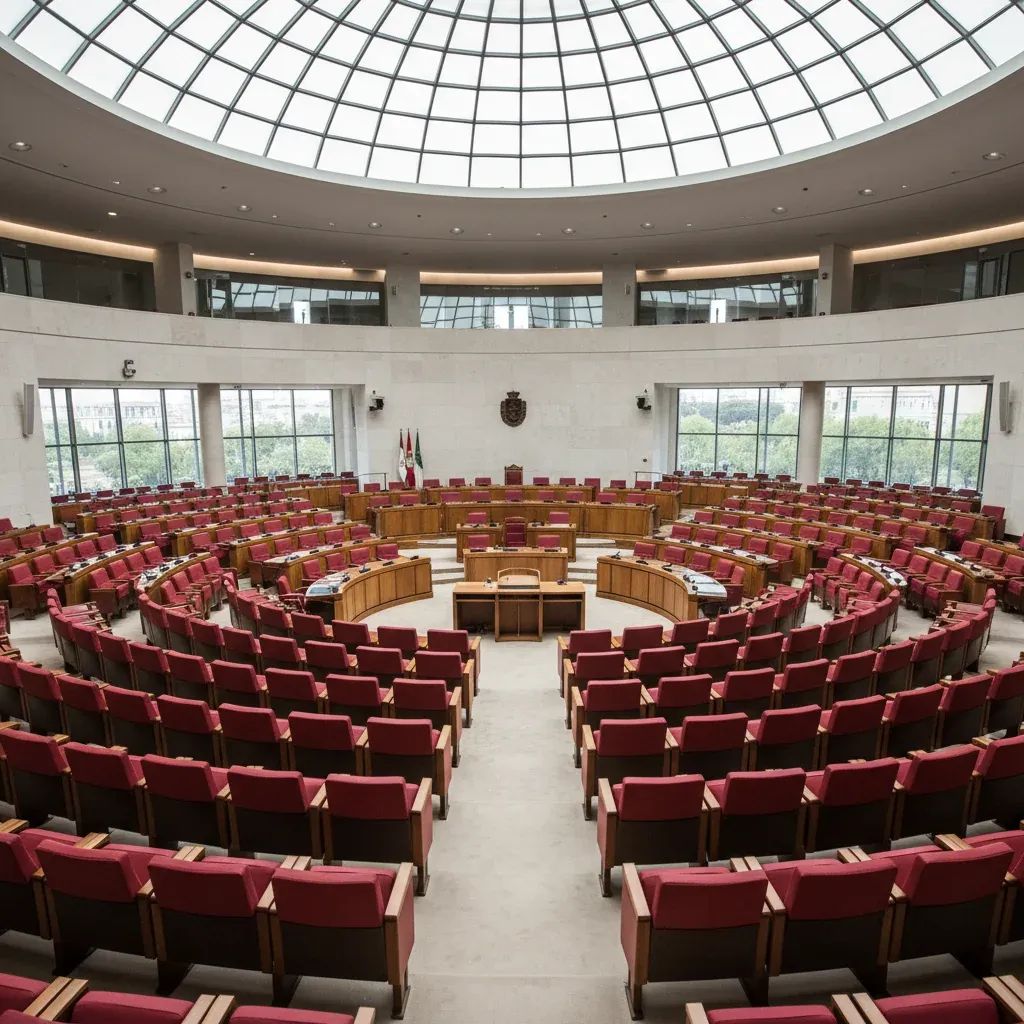
The President of Portugal's Assembly of the Republic, José Pedro Aguiar-Branco, has issued a pointed call to political parties to adapt to a fragmented parliamentary reality, warning that institutional function depends on negotiating with "the parliament that exists, not the one each party wishes it had." His remarks, delivered during a swearing-in ceremony for external parliamentary body members on May 5, come as Portugal's minority government struggles to secure qualified majorities for appointments and legislation.
Why This Matters
• Parliamentary gridlock is real: Successive delays in appointing members to constitutional oversight bodies reveal how difficult consensus has become in a legislature where no single bloc commands control.
• Strike rights for police on the table: A communist proposal to grant PSP officers the right to strike has been admitted for review despite constitutional concerns, signaling a shift in labor rights debates for security personnel.
• Fragmentation is the new normal: The rise of Chega to second-largest party status has shattered decades-old political geometry, forcing centrist parties into uncomfortable alliances.
A Fragmented Chamber Demands New Rules
Aguiar-Branco's speech marked a rare public acknowledgment of the friction inside Portugal's Palácio de São Bento. For years, the appointment of representatives to external bodies—the Economic and Social Council, the National Data Protection Commission, the Integrated Criminal Information System Oversight Council, and others—passed almost as administrative formalities. This cycle, however, saw repeated postponements, tense bargaining, and public hearings that sometimes rejected consensus nominees outright.
"We were used to faster, more discreet processes, sometimes treated almost as a bureaucratic formality," Aguiar-Branco said. "This time it was very different. For many years, we grew accustomed to a certain parliamentary geometry. Today that geometry has changed—it is more fragmented, more plural, and therefore more demanding."
The Assembly chief, re-elected in June 2025, pinned the delays on a simple fact: no party or coalition holds an absolute majority. The PSD-led minority government must secure opposition support not just for the annual budget—a failure that historically triggers snap elections—but also for two-thirds majorities required to fill key institutional posts. The selection of members to constitutional oversight bodies has become increasingly contentious, with the fragmented parliament requiring complex multi-party negotiations even for traditionally routine appointments. Such delays underline how difficult consensus building has become in the current Assembly.
"Populist Simplifications" vs. Democratic Negotiation
Aguiar-Branco took aim at critics who frame parliamentary consensus as "back-room dealing" or dialogue as "betrayal of principles." He defended the system's design: winning legislative elections or forming a government does not grant unilateral power. Instead, parties must negotiate, build cross-party support, and submit nominees to public hearings and secret ballots.
"And worse," he said, "there are those who speak of electing administrative officials as if it were merely a scheme to distribute positions. As if this process were not also part of Parliament's mission—and a legitimate expression of popular sovereignty."
He noted that even after achieving consensus candidate lists, each name must be publicly announced, scrutinized by deputies without any guarantee of election, and ultimately validated by secret vote. In some cases, two-thirds qualified majorities are required, a threshold that can only be met through multi-party coalitions.
Aguiar-Branco cited the recent swearing-in of Luís Pais Antunes as president of the Economic and Social Council as proof the system can work, even if the path is slower and messier than before.
What This Means for Institutional Stability
For residents and businesses in Portugal, the implications of this parliamentary stalemate extend beyond Lisbon intrigue. Delays in appointing members to regulatory and oversight bodies can slow administrative decisions, from data protection rulings to criminal justice system reforms. The Economic and Social Council, for instance, advises the government on labor law, minimum wage negotiations, and economic policy—areas that directly affect employment contracts and cost of living.
Aguiar-Branco warned that external parliamentary bodies serve as "arms that help understand, update, and apply constitutional principles" at a time when technological innovation, bioethics, labor market transformation, and privacy concerns are testing the limits of existing law. Without timely appointments, these bodies risk becoming understaffed or politically imbalanced, undermining their credibility.
The Assembly President also stressed that constitutional rights and guarantees are under unprecedented stress. "The world is changing," he said, pointing to challenges in security, privacy, ethics, and the economy. "We must ensure these institutions have the legitimacy and breadth to respond."
Police Strike Rights: A Constitutional Minefield
On the same day, Aguiar-Branco admitted a Portuguese Communist Party (PCP) legislative proposal that would grant PSP (Polícia de Segurança Pública) officers the right to strike, but only after flagging serious constitutional reservations. The initiative has been forwarded to the Constitutional Affairs, Rights, Freedoms and Guarantees Committee with instructions to examine whether the proposal adequately balances worker rights with the PSP's constitutional mission to safeguard internal security, public order, and citizens' freedoms.
Under current law, PSP personnel with police functions are prohibited from striking, a restriction rooted in the belief that security forces must remain operational at all times. The PCP proposal would repeal that ban and also narrow the prohibition on political engagement, restricting it only to partisan activities rather than all political gatherings.
Aguiar-Branco acknowledged that Article 270 of the Portuguese Constitution does not explicitly impose an absolute strike ban on security forces. However, he argued that simply deleting the prohibition without crafting a detailed regulatory framework could jeopardize public safety and violate the PSP's constitutional mandate.
"The constitutional problem is not only whether the Constitution prohibits, in absolute terms, the recognition of the right to strike for PSP professionals—a conclusion that does not seem to result unequivocally from the constitutional text—but also whether the simple elimination of the prohibitory norm, unaccompanied by specific regulation of how that right is exercised, ensures a constitutionally adequate outcome," he wrote in his decision.
Aguiar-Branco stressed that any strike law for police would need to specify minimum service requirements, operational continuity guarantees, and protections for third-party rights. He cited the 2024 shutdown of the women-only ride app Pinker, which was ordered to cease operations for violating Article 7 of Law 45/2018 on equal access to transport services, as an example of how constitutional rights can collide in unexpected ways.
European Context: Where Do Other Countries Stand?
Across Europe, the right to strike for security forces remains highly restricted. Germany, Cyprus, Austria, and Armenia prohibit strikes by military and police personnel outright, citing sovereignty and public safety. In Ireland, military associations can join national union federations but are barred from striking or making political statements. Canada's Supreme Court, however, has ruled that blanket bans on public sector strikes can be unconstitutional if they eliminate all meaningful collective bargaining.
Portugal's current debate mirrors tensions in other jurisdictions where freedom of association—protected under Article 11 of the European Convention on Human Rights—clashes with the state's duty to maintain order. The European Court of Human Rights has ruled that while restrictions on military and police unions can be significant, total bans on forming or joining a union violate the Convention.
The Charter of Fundamental Rights of the European Union, in Article 28, guarantees the right to collective action, including strikes, but permits member states to tailor these rights according to national law and practice. Portugal's Constitution follows this model, allowing for restrictions on security forces' rights to assembly, association, and strike, provided those limits serve national security and public order.
The Road Ahead
The PCP proposal now enters committee review, where it will face scrutiny from constitutional scholars, union representatives, and security officials. No final decision has been announced, but the fact that Aguiar-Branco admitted the bill at all—albeit with reservations—suggests Parliament is open to revisiting labor rights for police, provided the safeguards are robust enough to withstand constitutional challenge.
For political observers, the dual messages from Aguiar-Branco are clear: fragmentation is permanent, negotiation is unavoidable, and any party that refuses to compromise risks institutional paralysis. Whether the current Assembly can deliver on complex reforms—from police labor rights to budget approval—will depend on whether parties take his advice to heart: work with the parliament you have, not the one you wish for.