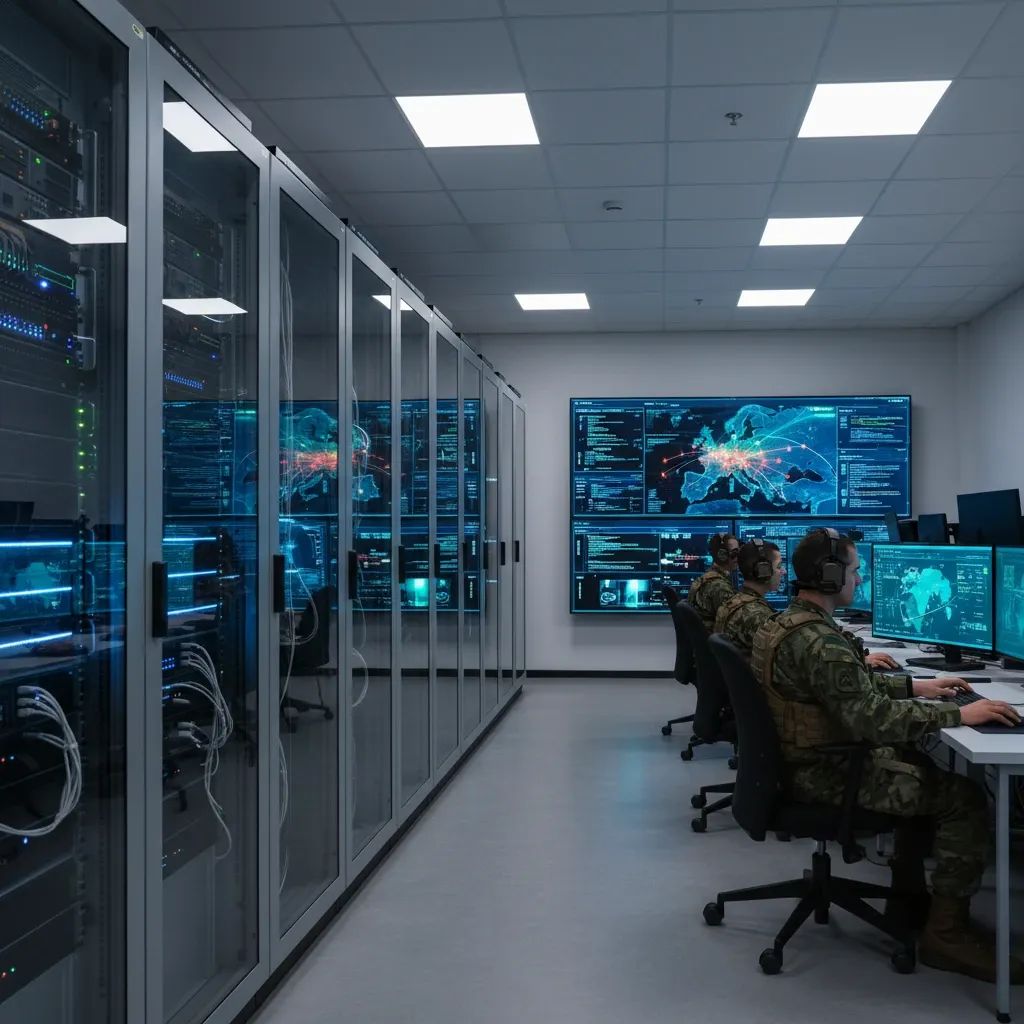
The Portuguese Navy has confirmed that websites belonging to several political parties—including left-wing organizations—are currently inaccessible on its internal network, a revelation that has sparked parliamentary scrutiny and questions about the intersection of military cybersecurity protocols and democratic information access.
Why This Matters
• Political party websites blocked: The Navy's network blocks access to sites including Livre, the Portuguese Communist Party (PCP), and the Left Bloc (BE), while inconsistently allowing access to ideologically similar organizations.
• Automated filtering at work: Four layered cybersecurity platforms automatically classify and block hundreds of URLs daily based on third-party risk assessments—no human review occurs for most blocked sites.
• Parliamentary inquiry launched: The Left Bloc has formally questioned Defense Minister Nuno Melo, seeking assurances that no political bias exists and requesting an independent investigation into whether similar restrictions apply across other branches of Portugal's armed forces.
• Manual override considered: The Navy announced it will explore manually adjusting filtering parameters with its security vendors to eliminate or reduce identified blocks on political party sites.
The Technical Defense
The Portuguese Navy insists the restrictions stem from "purely technical reasons" tied to operational cybersecurity rather than ideological targeting. In a detailed response issued this week, the service explained that its network infrastructure is protected by four overlapping cyber defense platforms that automatically categorize URLs and domains based on risk profiles developed by the manufacturers and specialized external cybersecurity entities.
According to the Navy's statement, sites may be flagged and blocked for several reasons: outdated communication protocols, invalid or suspicious security certificates, known server vulnerabilities, or categorization by third-party vendors as "potentially unsafe." The service emphasized that this filtering process is external to the institution and operates without direct human oversight for the vast majority of daily blocks—numbering in the hundreds.
The Navy cited examples intended to demonstrate the non-political nature of the filtering: while the PCP's website is blocked, the site of the CDU (Democratic Unity Coalition), which includes the PCP and the Green Party, remains accessible. Similarly, the PCTP-MRPP (communist-oriented) site is reachable, but those of the PPM (center-right monarchist party) and ADN (right-wing) are not. Access to the Socialist Party (PS) site generates a generic connection failure message rather than an explicit proxy block notification.
What This Means for Military Personnel
For Navy personnel accessing the internet through official infrastructure—whether on shore installations or aboard vessels—the practical impact is straightforward: accessing information from certain political parties is currently impossible. While personal devices on civilian networks remain unaffected, the restriction applies to anyone relying on the Navy's network for browsing, which could include both professional research and personal use during duty hours.
The Navy justified the filtering regime as essential to "operational security governance" in what it described as a strategic environment characterized by geopolitical competition, cyber operations, and critical dependence on digital infrastructure. The statement framed access restrictions not as mere technical controls but as "institutional risk mitigation decisions aligned with technological sovereignty, information protection, and operational continuity."
By limiting exposure to external domains, the Navy argued, it reduces the "attack surface" and prevents exploitation attempts that could compromise systems, data, and processes. This rationale mirrors standard military cybersecurity doctrine across NATO and allied navies, which prioritize network integrity and mission-critical communications over unrestricted internet access.
Parliamentary Scrutiny and Democratic Concerns
The Left Bloc has elevated the issue to the parliamentary level, formally questioning Defense Minister Nuno Melo about the government's knowledge of and response to the blocking. The party's inquiry seeks three key assurances: whether the government was aware of the blocks before they became public, whether an independent investigation will verify that no political motivations underlie the technical explanations, and whether similar restrictions exist on networks operated by the Army or Air Force.
In its submission, the Left Bloc emphasized that "the right to information" is a cornerstone of democratic society and argued that blocking online information sources from political parties—even within military networks—raises "unavoidable" questions about institutional impartiality and the boundaries of security measures.
This is not the first time internet access restrictions in Portugal have intersected with political sensitivities. While this incident involves internal military networks rather than public services, it echoes broader debates about digital access, censorship, and the balance between security imperatives and democratic norms.
How Automated URL Filtering Actually Works
The Navy's explanation hinges on the mechanics of automated URL classification systems, a technology widely deployed across military, governmental, and corporate networks globally. These platforms rely on machine learning algorithms that analyze URLs based on lexical patterns, network behavior, content analysis, and real-time threat intelligence gathered from millions of global sensors and endpoints.
Industry standards for these systems report accuracy rates above 90%, with leading vendors claiming precision levels between 96% and 99%. However, research indicates that false positives—legitimate sites incorrectly flagged as threats—remain a persistent challenge. The dynamic nature of web content, the volume of new URLs generated daily, and the sophistication of evasion techniques employed by malicious actors all contribute to classification errors.
Critically, these platforms categorize sites not only by security threats but also by content type: social media, e-commerce, entertainment, news, and political content. While manufacturers design these categories to support productivity and security policies, the categorization logic and training data are often proprietary and opaque, raising questions about transparency and accountability when such systems operate within public institutions.
NATO and allied navies, including the U.S. Navy, employ similar layered cybersecurity architectures to protect command-and-control systems, satellite communications, and shipboard networks. However, available research does not indicate that these organizations systematically block access to domestic political party websites as part of their threat mitigation strategies. Instead, the focus remains on defending against state-sponsored attacks, malware, and disinformation campaigns rather than restricting access to legitimate domestic political content.
The Road Ahead
The Portuguese Navy has committed to working with its cybersecurity platform providers to manually adjust filtering parameters where possible, aiming to eliminate or reduce blocks on identified political party sites. This represents a compromise between maintaining automated threat protection and addressing concerns about inappropriate content restrictions.
Whether this technical adjustment will satisfy parliamentary critics remains uncertain. The Left Bloc's inquiry signals that oversight bodies are unlikely to accept purely technical explanations without independent verification, particularly given the apparent pattern of blocks affecting primarily left-wing political organizations—even if right-wing sites are also restricted.
For military personnel, the incident underscores a broader tension in modern armed forces: the imperative to secure digital infrastructure against sophisticated cyber threats must coexist with democratic principles of information access and institutional neutrality. As Portugal's armed forces continue to develop cyber defense capabilities under the National Cybersecurity Strategy, the episode may prompt clearer guidelines on content filtering policies, oversight mechanisms, and transparency standards for automated security systems operating within state institutions.
The Defense Ministry has not yet publicly responded to the Left Bloc's parliamentary questions. The outcome of that inquiry—and any subsequent investigation—will likely shape how Portugal's military branches approach the delicate balance between operational security and democratic accountability in the digital age.