

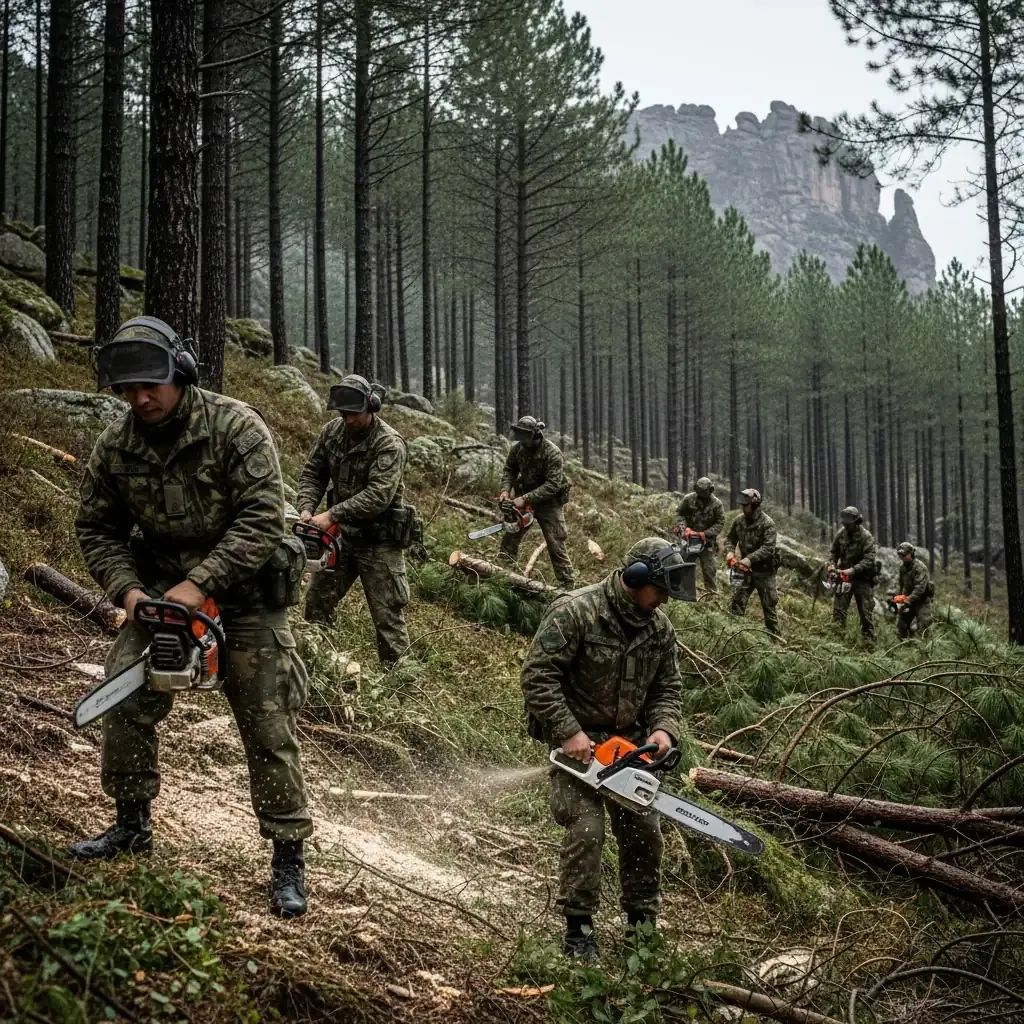
Portugal's Interior Ministry has overseen the clearance of more than 17,000 kilometers of forest roads since the government mobilized a multi-agency command in April to tackle the fire risk left by devastating winter storms. The operation, coordinated by the Comando Integrado de Prevenção e Operações (CIPO), has become the country's most intensive forest access project in recent memory—yet officials warn the job remains far from finished as the country heads into what experts predict will be an exceptionally dangerous fire season.
Why This Matters
• Safety access improved: Emergency crews now have better reach across affected areas, particularly in the Centro and Lisboa e Vale do Tejo regions.
• Heightened fire risk: Winter tempest Kristin left thousands of fallen trees, dramatically increasing fuel loads across forested areas.
• Ongoing deployment: Teams have been working since April to clear debris using heavy machinery across affected municipalities.
• No end date: The Interior Minister, Luís Neves, confirmed CIPO has no fixed termination timeline and may expand roles if fire conditions worsen this summer.
The Scale of the Challenge
When tempest Kristin tore through Portugal in late January, it toppled tens of thousands of trees across forested areas. The accumulation of fallen timber fundamentally altered the fire behavior profile of vast woodland zones, creating what the Portugal National Emergency and Civil Protection Authority (ANEPC) describes as a significant fire risk scenario for affected regions.
The clearance of 17,000 km nationwide represents a substantial tactical achievement, though secondary paths and complex removal zones remain untouched. By May, the Portugal Ministry of Internal Affairs (MAI) reported that work was progressing across multiple regions, with efforts continuing to prioritize areas requiring rapid emergency vehicle access.
What This Means for Residents
If you live in or near forested areas, the improved road network translates to faster response times should a fire ignite. The Portugal Government has extended the mandatory land-clearing deadline to June 30 across all mainland territory, giving property owners an extra window to remove vegetation within legally mandated buffer zones around homes and structures.
Several regions have prohibited all open burning and agricultural fires until the end of September. Violators face fines, and authorities are urging residents to adopt alternative methods—chipping, composting, or municipal collection—for disposing of pruned branches and agricultural waste.
Homeowners in high-risk zones should verify that access lanes to their properties remain clear, as fire crews will prioritize forest roads during active incidents. For those managing woodland plots, the law requires submission of a Manifesto de Corte de Árvores (MCA) before felling or thinning, and any timber that falls onto roads must be removed promptly.
The CIPO Structure and Its Mission
CIPO was established as an interministerial command and coordination hub housed at the Bombeiros Sapadores de Leiria fire station. It brings together the ANEPC, ICNF (Portugal Institute for Nature Conservation and Forests), Agência de Gestão Integrada de Fogos Rurais (AGIF), Guarda Nacional Republicana (GNR), Liga dos Bombeiros Portugueses, and the Portugal Armed Forces General Staff.
The command's mandate is to remove accumulated combustible material, secure critical interface zones between urban settlements and wildlands, and reopen forest access routes. Unlike previous seasonal campaigns, CIPO operates as a permanent structure with no sunset clause, reflecting the government's recognition that wildfire management has become a year-round challenge rather than a summer emergency.
Persistent Vulnerabilities
Despite the massive mobilization, Portugal still confronts significant challenges. Prime Minister Luís Montenegro acknowledged that "there are still many forest roads obstructed and a great deal of combustible material" scattered across woodland zones, underscoring the extended timeline required to fully restore access and reduce fuel loads.
Secondary forest tracks remain largely uncleared, and removal of timber in steep or ecologically sensitive areas poses logistical and legal hurdles. Enforcement capacity is stretched thin across hundreds of thousands of private holdings as authorities work to ensure compliance with clearing requirements and burning bans.
A Cultural Shift in Prevention
Interior Ministry officials stress that lasting fire resilience depends on a shift in mentality—from reactive suppression toward proactive, continuous stewardship. Minister Neves called for "continuity, discipline, and monitoring," emphasizing that prevention must evolve into a culture of shared responsibility among the state, municipalities, private landowners, and the general public.
The coordination challenges exposed by recent tempests have prompted calls for clearer inter-agency protocols and stronger intermunicipal cooperation. CIPO represents one institutional answer to these challenges.
What Comes Next
CIPO operations will continue uninterrupted through the summer, with teams working on ongoing clearance efforts. Residents should monitor local civil protection bulletins for updated burning bans, road closures, and fire-danger ratings. The government continues to remind citizens that human carelessness—cigarette butts, unattended barbecues, and other spark sources—remains a significant fire risk.
The clearance of 17,000 km represents a significant tactical achievement, providing a foundation for improved accessibility and emergency response capabilities. As fire season approaches, sustained effort and public compliance with prevention measures will be essential to protect Portugal's forests and communities.


