
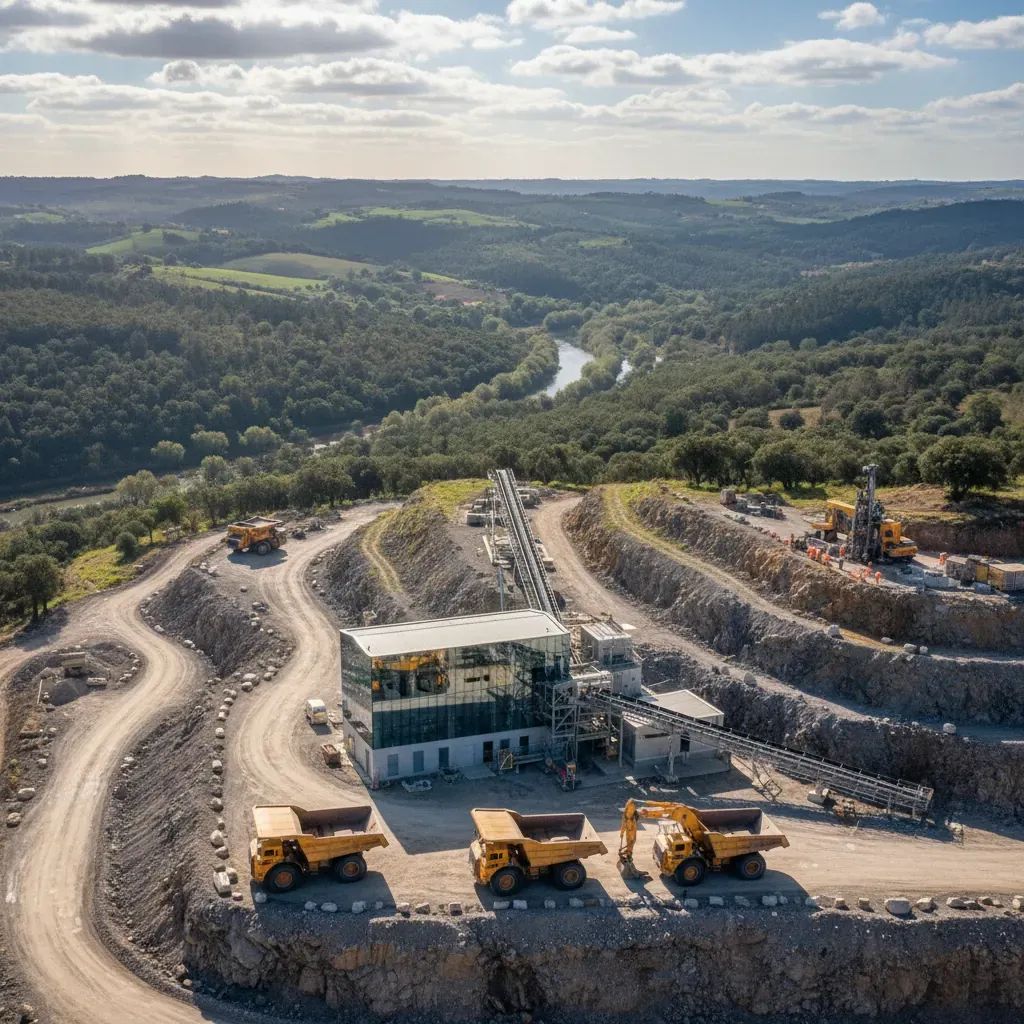
The Portugal Government has formally launched its second attempt at building a comprehensive minerals policy, setting a four-month deadline for a draft national geological resources strategy that could reshape the country's role in Europe's race for energy-transition materials.
Why This Matters
• Timeline: Draft strategy due by early August 2026, followed by a 30-day public consultation.
• Economic Scale: Portugal holds the 8th-largest lithium reserves globally and Europe's largest deposits, plus significant rare earth elements and tungsten.
• Institutional Shift: A new Agência de Geologia e Energia (AGE) consolidates five fragmented agencies into one regulatory body, with full integration targeted for mid-2027.
• Past Failure: The previous 2012 strategy for geological resources was never implemented, leaving Portugal sidelined during a decade of rising global demand for critical minerals.
A Second Chance After a Lost Decade
Portugal's mining sector has spent the better part of a generation in policy limbo. The Estratégia Nacional para os Recursos Geológicos — Recursos Minerais, approved in 2012 with a horizon to 2020, remained on paper while international competitors moved aggressively to secure supply chains for battery metals, rare earths, and other materials essential to decarbonization.
Now, under a dispatch published April 20, 2026, the Portugal Cabinet has mandated the creation of GEO PT 2035, a roadmap designed to unlock the country's mineral wealth in a manner that balances economic opportunity, environmental stewardship, and social acceptance. The working group, led by the state-owned Empresa de Desenvolvimento Mineiro (EDM) and including the Direção-Geral de Energia e Geologia (DGEG) and the Laboratório Nacional de Energia e Geologia (LNEG), has until early August to deliver a proposal.
The urgency is partly geopolitical. Global competition for raw materials has intensified as Europe seeks to reduce dependence on external suppliers, particularly China, which dominates refining and processing of rare earths and lithium. The European Union's Critical Raw Materials Act underscores this shift, and Portugal's geology positions it as a potential anchor supplier within the bloc.
What Portugal Has—and What It Hasn't Done
Portugal is not starting from zero. The country has proven reserves of lithium that rank among the top ten worldwide, with significant concentrations in the north. It also has deposits of rare earth elements, tungsten, copper, zinc, lead, gold, and silver. Active operations at Neves-Corvo and Aljustrel produce roughly 220,000 tonnes of zinc concentrate and 45,000 tonnes of lead concentrate annually.
The ornamental stone sector, meanwhile, generated approximately €35M in export revenue in January 2025 alone, a 2.92% increase year-over-year, and employs more than 8,000 people across extraction, transformation, and trade. Total mineral production in Portugal reached 1.13 million metric tonnes in 2024, up from 1.09 million in 2023. In February 2026, mining output jumped 10.8% compared to the same month in 2025.
Yet for all this potential, Portugal has faced persistent criticism for "abnormal delays" in approving exploration projects, particularly for lithium. These bureaucratic bottlenecks not only frustrate investors but also undermine Europe's strategic goal of securing domestic supplies of critical materials.
What This Means for Residents
For people living in Portugal, the new strategy represents both opportunity and friction. On one hand, expanded mining could bring jobs, infrastructure investment, and revenue to rural regions that have seen decades of depopulation. On the other, mineral extraction is inherently disruptive: it alters landscapes, raises concerns about water quality, and generates noise and dust.
The concept of a "Social License to Operate" (LSO) has emerged as a central pillar of modern mining governance. Unlike formal permits, the LSO is an informal, ongoing approval granted by local communities based on trust, transparency, and perceived fairness. Without it, projects stall or collapse under public opposition, regardless of legal permissions.
Portugal's strategy explicitly acknowledges this reality. The draft framework emphasizes stakeholder engagement from the earliest project phases, continuous environmental and social impact monitoring, and mechanisms for communities to voice concerns and influence decisions. The working group is tasked with integrating the strategy with the Plano Nacional de Energia e Clima (PNEC 2030) and aligning with the EU's critical raw materials regulations.
The challenge is execution. The previous strategy failed not because of flawed ideas, but because of weak follow-through. This time, the Agência de Geologia e Energia is intended to be the institutional backbone.
A New Agency to End Fragmentation
Created by Decreto-Lei n.º 58/2026 on February 20, the AGE consolidates the DGEG, LNEG, EDM, EDMI (a real estate projects company), and the now-defunct Agência para a Energia (ADENE). Part of the functions of the Entidade Nacional para o Setor Energético (ENSE) have also been transferred; ENSE itself has been restructured into the Entidade Gestora de Reservas Estratégicas de Portugal (EGREP).
Headquartered in Porto, the AGE is an autonomous public institute responsible for licensing, inspection, and policy monitoring across energy, geology, and mineral resources. Its mandate includes fast-tracking permits for strategic projects like offshore wind and green hydrogen, intensifying prospecting for lithium and other critical minerals, and monitoring compliance with PNEC 2030 targets.
The agency is in its installation phase. Administration appointments and legal formalization are underway through June 2026. Physical integration of teams from the absorbed entities begins in September 2026, with full operational unification, including IT systems, targeted for June 2027.
Lessons from Abroad
International experience offers instructive models. In Portugal, CIMPOR deployed Vermeer surface mining technology at its Pedreira do Bom Jesus in Alhandra, extracting limestone without drilling or blasting. The result: dramatic reductions in noise and vibration, improving relations with neighboring communities.
Brazil's Vale, one of the world's most sustainable mining companies, has invested heavily in environmental controls and social programs. Its Ferro Carajás S11D project replaced haul trucks with conveyor belts, cutting CO2 emissions by 77%, and processes ore using natural moisture, saving 93% of water. Vale also structures its community relations around transparent information-sharing and incorporating local perspectives into corporate decisions.
Anglo American's Minas-Rio project in Brazil demonstrated the power of leadership engagement: active participation by senior executives in public hearings and community negotiations reduced tensions and accelerated licensing.
Chile has enacted closure regulations for mining operations and is exploring bioleaching, which uses microorganisms to extract metals from waste, reducing tailings and chemical contamination.
The Path Forward
The GEO PT 2035 strategy rests on several pillars: tapping existing mineral resources, strengthening supply chains for critical raw materials, supporting the energy transition, rehabilitating abandoned mines and at-risk quarries, and leveraging geological heritage for nature tourism.
The Portugal Government has also outlined a 19-point national action plan aligned with the EU's Critical Raw Materials Act, focusing on territorial integration and conflict minimization.
Success will depend on three factors. First, institutional coherence—the AGE must prove it can coordinate policy, licensing, and enforcement more effectively than the fragmented system it replaces. Second, social acceptance—communities must see tangible benefits, transparent processes, and genuine mitigation of environmental impacts. Third, speed—Europe's competitors are not waiting, and Portugal's window to establish itself as a reliable supplier is finite.
The country has knowledge, resources, and a favorable international context. What remains is the ability to translate that combination into a functioning, socially embedded mining sector. The draft strategy will be tested in public consultation this summer. The real test, however, will come in the years after: whether Portugal can finally execute a vision it has articulated before but never delivered.
Because in the end, having resources is meaningless if you cannot use them.