

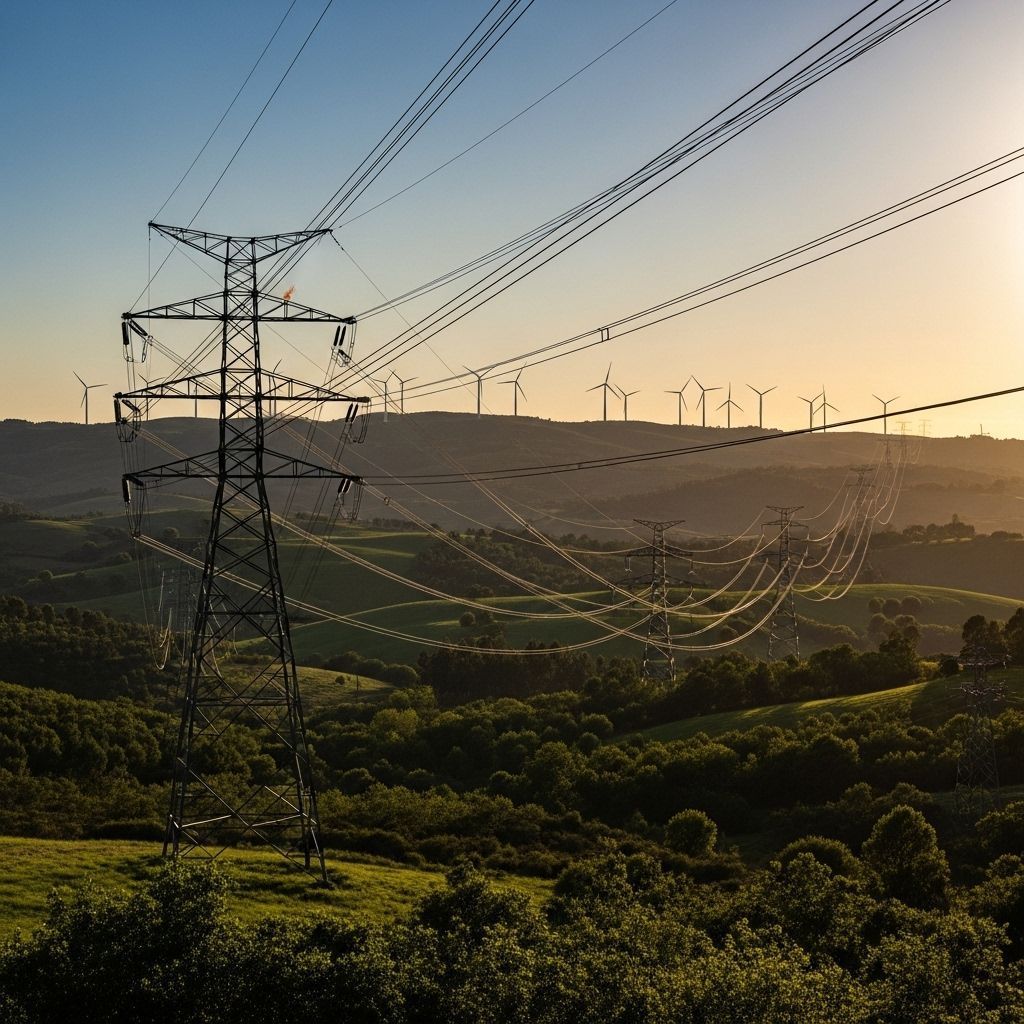
The Portugal-based utility EDP has confirmed that any effort to strengthen the national electric grid against extreme weather will carry a price tag that consumers may ultimately shoulder, with the company's chief executive cautioning that no decision will be made until a government-ordered study concludes by late 2026.
Miguel Stilwell d'Andrade, speaking during the Q1 2026 earnings call, outlined the dilemma facing the country: how to protect infrastructure without triggering a surge in household electricity bills. The debate intensified after Storm Kristin, which swept through the Iberian Peninsula earlier this year, knocking out approximately 6,000 kilometers of grid and damaging close to 5,800 transmission towers. The storm's impact was particularly severe in central and northern regions, with Covilhã, Guarda, and surrounding districts experiencing the longest outages, some lasting over 48 hours. The reconstruction alone cost EDP around €20M in the first quarter, with total estimated losses for the group reaching €80M.
Why This Matters
• Study underway: The Portugal Directorate-General for Energy and Geology is reviewing resilience options, with findings expected by year-end 2026. Once published, the report will be available on the Ministry of Environment and Energy's official website, and public consultations are anticipated.
• Burial costs: Putting medium-voltage lines underground runs roughly €100,000 per kilometer; high-voltage lines can cost 13 to 20 times more than overhead alternatives.
• Current underground share: Only 20% of Portugal's electric grid is buried, compared to a 45% EU average and higher rates in Spain and Italy.
• Your bill: For context, the average Portuguese household currently pays €60–80 per month for electricity. Without EU funding, grid resilience upgrades could add €5–15 per month to household bills, depending on the intervention strategy chosen—a potential 8–25% increase according to industry estimates.
The Kristin Factor: Exceptional or the New Normal?
Stilwell d'Andrade characterized Storm Kristin as an outlier event, noting that the existing overhead infrastructure has withstood decades of severe weather without comparable damage. Yet the sheer scale of destruction—equivalent to roughly twice the distance from Lisbon to Porto in downed cables—has forced regulators and utilities to reassess what "normal" weather looks like in an era of climate volatility.
The EDP CEO emphasized that burying lines is not a blanket solution. In some geographies, underground installation makes economic and operational sense; in others, it doesn't. He pointed to redundancy systems, advanced monitoring technology, and predictive analytics as equally valid pathways to boost grid resilience without the prohibitive cost of trenching thousands of kilometers of farmland and forest.
What Burial Actually Costs—and What It Buys
Independent engineering estimates suggest that fully burying the majority of Portugal's grid could require €20B—a sum equivalent to financing two Lisbon airports. For context, medium-voltage lines (around 20 kilovolts) carry a baseline burial cost of €100,000 per kilometer, while ultra-high-voltage corridors can run 13 to 20 times the expense of traditional overhead towers.
The upside is tangible: underground cables are immune to windfall trees, ice storms, and lightning strikes, the primary culprits behind outages. After Kristin left thousands of households in darkness, the appeal of a more robust, weather-proof network became politically urgent. Yet the flip side is equally stark: repairs to buried cables are slower and costlier, requiring precise fault location and excavation, and heat dissipation challenges can limit capacity or accelerate insulation wear in hot climates or seismic zones.
Portugal's 20% burial rate lags the EU benchmark significantly, leaving the country more exposed than peers. Industry voices argue for a selective approach—prioritizing medium-voltage feeders serving urban centers and critical infrastructure, rather than a wholesale replacement of the entire overhead network.
Alternatives on the Table
Beyond trenching, EDP and grid operators across Europe are exploring a suite of technologies designed to deliver resilience without the sticker shock:
• Smart grids and self-healing networks: Real-time monitoring and automated fault isolation (systems that automatically redirect power when problems occur) allow systems to reroute power instantly, minimizing downtime.
• Microgrids and distributed generation: Local renewable installations paired with battery storage can keep neighborhoods online even when the main grid fails.
• Energy storage systems: Utility-scale batteries stabilize supply, absorb renewable surges, and act as emergency reserves during transmission outages.
• Redundant substations and dual-feed architecture: Connecting customers to multiple grid pathways (so that backup power sources kick in automatically if the primary connection fails) ensures that a single point of failure doesn't cascade into widespread blackouts.
• Predictive maintenance and climate modeling: Advanced analytics forecast storm impacts and identify vulnerable segments before they fail.
According to research on Future Grid strategies, these solutions are gaining traction because they improve flexibility, cut transmission losses, and accelerate decarbonization—all while avoiding the capital and maintenance burdens of buried cable.
The EU Context: Who Pays, and How Much?
Across the European Union, grid resilience is financed primarily through network tariffs, meaning consumers ultimately foot the bill. However, the European Commission has signaled increased support via programs like the Connecting Europe Facility (CEF), which channels funding toward cross-border transmission projects and climate-resilient infrastructure. The Commission estimates that EU grids will require €1.2 trillion in investment through 2040, with €730B earmarked for distribution networks alone.
Countries such as Italy have introduced regulatory incentive programs to test innovative tariff models that reward utilities for maintaining reliable service while protecting consumers. The United Kingdom and Australia employ similar approaches, rewarding utilities for maintaining service levels during extreme weather and penalizing underinvestment. Portugal, meanwhile, spreads certain system costs—such as guaranteed feed-in tariffs for renewable generation—across all ratepayers through a mechanism (known locally as Costs of General Economic Interest, or CIEG) that could be extended to fund resilience upgrades if EU grants prove insufficient.
Impact on Residents and Businesses
For households and small enterprises in Portugal, the immediate question is straightforward: How much more will my electricity bill rise? The answer hinges on three variables: the scope of interventions recommended by the official study, the share of financing secured from Brussels, and the regulatory framework that allocates costs between utilities and end users.
If the study favors a large-scale burial program without substantial EU co-funding, residential tariffs could climb noticeably—potentially adding €5–15 per month to the average household bill, representing a one-time adjustment or phased surcharge over 3–5 years. Conversely, a technology-first strategy emphasizing smart grids and microgrids may spread costs over a longer horizon and yield efficiency gains that partially offset the investment.
Business continuity is another dimension. Industries reliant on uninterrupted power—data centers, cold storage, manufacturing—stand to benefit from a more resilient grid, reducing the frequency and duration of outages that disrupt operations and damage equipment. For these stakeholders, even a modest tariff increase may be preferable to the hidden costs of downtime and lost production.
EDP's Broader Financial Picture
The resilience debate unfolds against a backdrop of mixed financial results for EDP. The company's net profit fell 12% year-on-year in Q1 2026, landing at €378M, driven primarily by lower wholesale electricity prices in the Iberian market. Recurring net income dropped 9% to €399M, while recurring operating income (EBITDA) slipped 3% to €1.38B.
Despite these headwinds, EDP has raised its full-year 2026 guidance, projecting recurring operating income of €5.2B—a 5% increase over the prior forecast—and net profit near €1.3B. The company's net debt stands at €15.7B, up 2% from the end of 2025, reflecting both the reconstruction spend and currency effects from the strengthening Brazilian real relative to the euro.
Total capital expenditure on Iberian networks surged 40% in Q1, reaching €164M, underscoring the pace of investment under new regulatory frameworks. EDP anticipates that figure will climb further if the government study calls for accelerated hardening of the grid, though the final quantum depends on the study's conclusions and the availability of external funding.
What Comes Next and How to Stay Informed
Stakeholders can expect the Portugal Directorate-General for Energy and Geology to publish its findings in the fourth quarter of 2026. The document is expected to include a cost-benefit analysis of various resilience pathways, scenario modeling for different climate futures, and recommendations on priority zones for intervention.
How to monitor developments: Residents and businesses can track updates through:
• The official Ministry of Environment and Energy website (www.mee.gov.pt)
• EDP's investor relations page, which publishes quarterly earnings calls and regulatory updates
• Local municipal administration offices, which typically announce infrastructure projects and public consultation periods
• Portuguese energy regulator (ERSE) publications and public notices
In parallel, EDP and the national regulator will negotiate how any approved investments are recovered—whether through a one-time tariff adjustment, a multi-year surcharge, or a blend of utility equity and EU grants. Public consultation sessions are expected to be announced in Q3 2026, giving residents and businesses an opportunity to voice concerns about bill impacts and intervention priorities.
For now, the message from the EDP CEO is clear: resilience is achievable, but not free. The challenge lies in designing a solution that balances technical robustness, fiscal responsibility, and fairness to consumers—all while acknowledging that extreme weather events, once exceptional, may be becoming the norm.
Residents and businesses should monitor the study's release closely and participate in public consultations when announced. The decisions made in the coming months will shape not only the reliability of Portugal's electric supply but also the structure of household budgets and the competitiveness of the national economy for years to come.


