
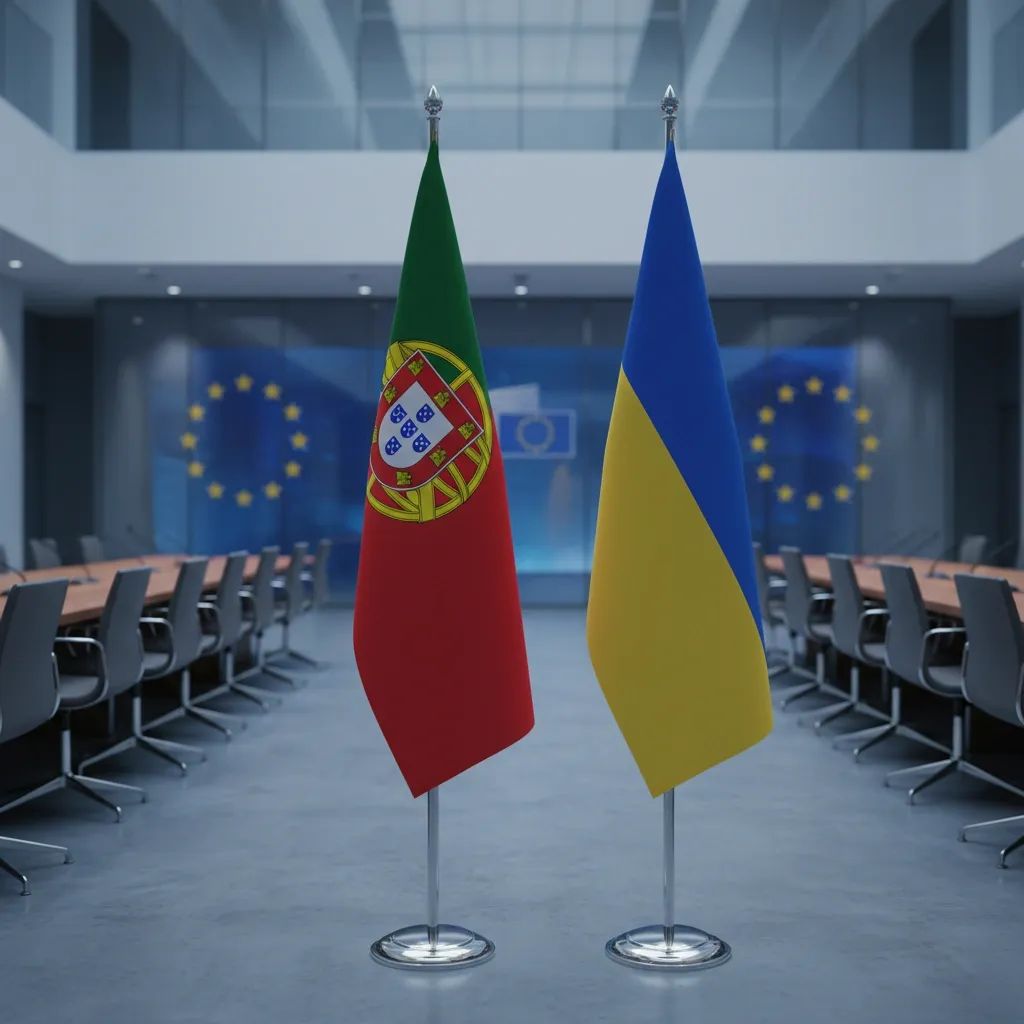
Portuguese Prime Minister Luís Montenegro has reaffirmed Portugal's unwavering commitment to Ukraine's defense during a meeting with Ukrainian Parliament Speaker Ruslan Stefanchuk in Lisbon. The visit underscores ongoing bilateral cooperation and Portugal's continued solidarity with Ukraine across diplomatic, political, and defense channels.
A Diplomatic Affirmation
In a statement confirming the engagement, Montenegro emphasized that Portugal remains firmly committed to Ukraine's "legitimate defense against Russian aggression" and to supporting efforts toward "a just and lasting peace." The Prime Minister noted that this position holds firm across multiple international forums—the European Union, NATO, the Coalition for Good Will, and the United Nations.
The meeting follows a December 2025 visit to Kyiv where Montenegro and Stefanchuk discussed the strategic importance of strengthening political, economic, and defense ties between the two nations. Montenegro highlighted the "excellent integration" of the Ukrainian community in Portugal, framing it as a key element of bilateral cooperation beyond traditional diplomatic channels.
Stefanchuk Addresses Portugal's Parliament
The Ukrainian parliamentary leader delivered a rare plenary session address to Portugal's legislature, thanking lawmakers for more than four years of solidarity with Ukraine. Stefanchuk received a standing ovation from most parties present, though the Portuguese Communist Party (PCP) boycotted the event—a symbolic absence reflecting the party's long-standing reservations about NATO involvement.
In his remarks, Stefanchuk framed Ukraine as the "eastern sentinel of Europe," standing at a civilizational divide between democratic governance and authoritarianism. He invoked the 1974 Carnation Revolution as a parallel to Ukraine's resistance, arguing that "no empire, no dictatorship can stop a people aspiring to freedom." The reference resonated powerfully in a country that defines itself by its peaceful transition from dictatorship to democracy.
Parliamentary Leadership Emphasizes Stakes
Assembly President José Pedro Aguiar-Branco used the occasion to argue that European credibility depends on its response to the war. "Everything we do, or fail to do, as Europeans at this stage in relation to Ukraine will have direct consequences on the future of the European project itself," he said, framing the conflict as a test of whether the continent's post-World War II order—built on territorial integrity, rule of law, and self-determination—can withstand coercive force.
The two parliaments finalized a technical cooperation memorandum, formalizing exchanges on legislative procedure, transparency mechanisms, and anti-corruption measures. While largely administrative, the agreement is intended to accelerate Ukraine's alignment with EU standards ahead of eventual membership discussions.
Stefanchuk's visit included meetings with party representatives and a tour of a war documentation exhibit at the Centro Interpretativo do Parlamento, featuring photographs, testimonies, and territorial maps intended to document the conflict's human and geographic toll.
What This Means for Ukrainian Residents in Portugal
For the 79,000+ Ukrainians officially residing in Portugal—the majority holding temporary protection status—the government's reaffirmed position carries direct implications. Temporary protection permits have been extended through at least March 4, 2027, guaranteeing continued access to employment, healthcare, education, and social services.
Montenegro's specific mention of the "excellent integration" of the Ukrainian community signals continued policy support for this population. The parliamentary memorandum also opens pathways for technical cooperation that may benefit Ukrainian professionals seeking to navigate Portuguese institutions and employment.
The Ukrainian diaspora has grown rapidly since February 2022, now representing one of Portugal's largest foreign communities. Geographic distribution spans from Lisbon and Porto to southern hubs like Faro and northern cities like Viana do Castelo, with community organizations like the Associação dos Ucranianos em Portugal providing cultural and social support.
Continuity of Support
Both leaders emphasized continuity in their commitment. Montenegro reiterated that "Ukraine will always be able to count on Portugal," underscoring that this backing extends across the European Union and NATO frameworks. Stefanchuk's parliamentary address reinforced the message that Ukrainian leadership views Portugal not as a distant supporter but as part of a shared European democratic project.
The visit reflects a broader European alignment: maintaining robust support for Ukraine's defense while pursuing diplomatic channels toward eventual resolution. For Portugal's Ukrainian residents, the reaffirmation provides reassurance that integration policies and temporary protection status will remain stable elements of government policy.


