

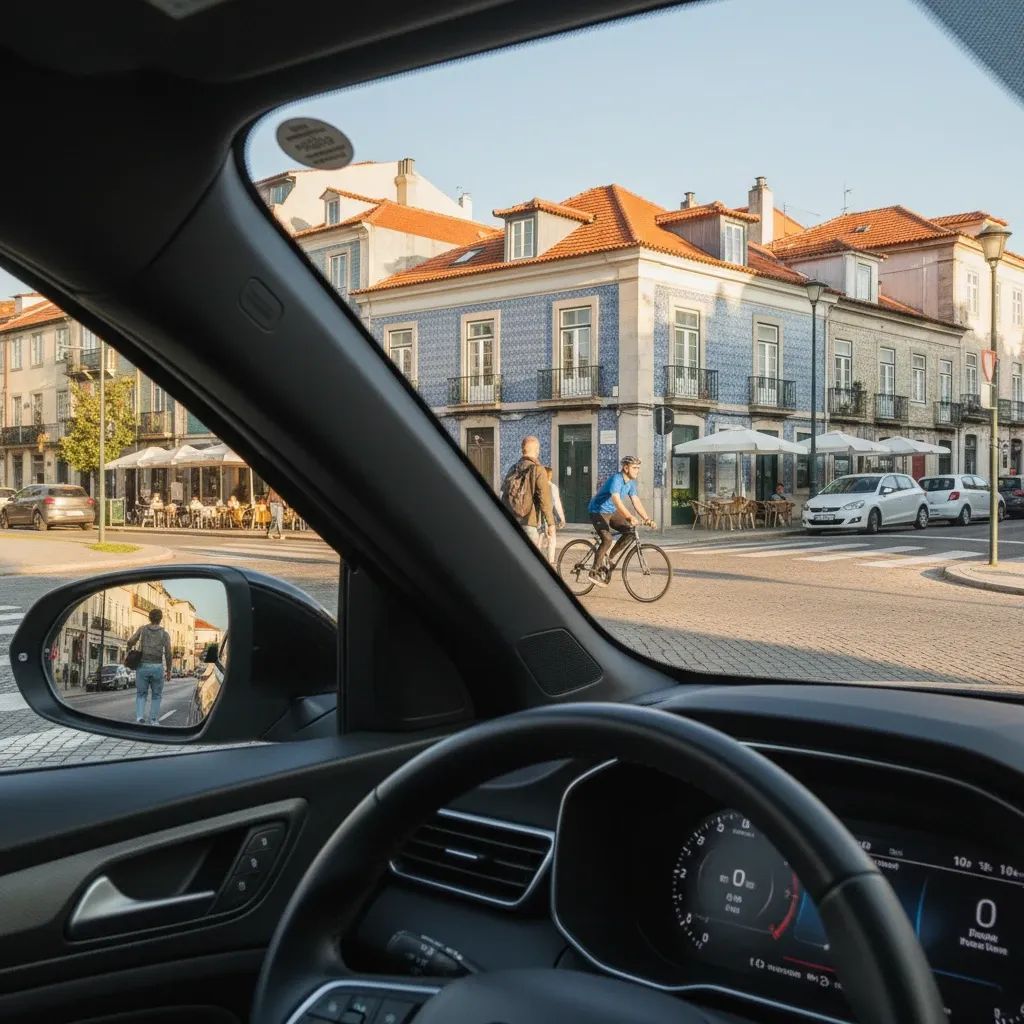
Portugal's newly approved autonomous vehicle testing framework is now live, allowing companies to run trials on public roads starting in July, placing the country alongside a handful of European nations racing to validate self-driving technology under real-world conditions.
Important for residents: While the legal framework is now active, no companies have announced testing plans for Portuguese roads. This article explains what the new rules mean and when autonomous vehicles might actually arrive.
Why This Matters
• Portugal joins the autonomous testing club: The decree-law published on June 8 permits trials of conditional, high, and total automation systems on national roads—with strict insurance, speed, and safety requirements.
• Luxembourg just launched a 12-month robotaxi pilot: Stellantis, Bolt, and Pony.ai are deploying Level 4 autonomous vans in Bissen, aiming for "driverless readiness" by mid-2027.
• Europe is moving toward shared rules: Seventeen transport ministers signed a declaration to enable cross-border autonomous trials, signaling a shift from isolated national projects to a unified EU approach.
• First commercial robotaxis coming to Europe: Uber and partners plan to roll out robotaxis in Madrid, Munich, and London before the end of 2026.
Portugal's Legal Framework: What Companies Must Do
The Portugal Institute for Mobility and Transport (IMT) will issue licenses for autonomous testing in collaboration with the National Road Safety Authority, PSP (Portugal Public Security Police), and Infraestruturas de Portugal. The regulatory structure, effective July 8, imposes a demanding set of operational conditions tailored to minimize risk while encouraging innovation.
Test vehicles must operate 20 km/h below posted speed limits unless a waiver is granted with justification. Drivers and human operators—who remain mandatory for all trials—cannot exceed 0.2 to 0.5 grams of alcohol per liter of blood, and they are barred from working more than three consecutive hours without at least a one-hour break. The decree-law explicitly prohibits the transport of hazardous materials during trials.
Insurance requirements are steep: operators must carry civil liability coverage four times higher than standard auto policies, ensuring adequate compensation for bodily injury or property damage to third parties. Vehicles must log extensive data, including system activation and deactivation, driver interventions, acceleration, braking, steering, position, speed, and connectivity status. This data trove is designed to support both safety analysis and accident investigation.
Within ten days of concluding a trial—or monthly if testing exceeds one month—companies must submit detailed reports to the IMT. Any serious accident triggers an immediate 24-hour reporting obligation, and operations must cease until authorities clear the vehicle for further testing. Penalties range from €150 for minor infractions to €40,000 for serious violations, depending on whether the responsible party is an individual or a corporation.
What This Means for Residents Right Now
For now, Portugal has no publicly announced autonomous vehicle trials. The decree-law creates the legal scaffolding, but no automaker, tech firm, or ride-hailing platform has yet committed to testing on Portuguese roads.
The AUTOCRIS Project: Lisbon Gets Real Testing
The most concrete opportunity for residents to encounter autonomous vehicles in Portugal is the AUTOCRIS project, led by tech company Indra. This initiative will test autonomous systems in three European cities: Lisbon, Madrid, and Paris. In Lisbon, trials are expected to take place along two major routes: the Avenida Marginal and Avenida Brasília, though specific launch dates have not been officially confirmed. These are high-traffic routes familiar to many Lisbon residents and commuters.
While AUTOCRIS represents Portugal's nearest-term autonomous vehicle testing opportunity, the practical impact for residents is limited in the short term. If and when trials begin, expect to see test vehicles moving noticeably slower than surrounding traffic, with human operators seated inside and vehicles clearly marked for easy identification. The real-world benefit—reduced traffic accidents, improved mobility for the elderly and disabled, and potentially lower transport costs—remains years away, pending both regulatory harmonization across the EU and commercial deployment beyond pilot phases.
How Portugal Compares to Its Neighbors
Portugal is not alone in preparing for autonomous vehicles, but the country's approach differs in pace and scale from neighboring countries:
• Spain currently permits only Level 2 autonomy for general use but allows higher-level testing under special authorization. Uber, WeRide, and AVOMO plan to deploy robotaxis in Madrid later this year—making Spain a more advanced market than Portugal in commercial deployment.
• The Netherlands became the first EU country to approve Tesla's Full Self-Driving system and is a testing hub for autonomous technology.
• Germany and France have legislative frameworks that already permit Level 4 autonomous vehicles to operate with remote supervision, positioning them ahead of Portugal's current approval stage.
• Luxembourg is actively running a 12-month robotaxi pilot with Stellantis, Bolt, and Pony.ai.
Portugal's framework is robust and forward-thinking, but the country is entering a competitive field where Luxembourg, Spain, and the Netherlands are already operating real-world trials.
Luxembourg's Robotaxi Pilot: A Template for Europe
Luxembourg has moved faster than Portugal in commercial deployment. On June 9, Stellantis, Bolt, and Pony.ai announced a 12-month pilot program deploying five Level 4 autonomous vans in the town of Bissen, with plans to expand to 30 robotaxis and include Luxembourg City. The vehicles are Stellantis mid-size vans built on the company's L4-Ready Platform, equipped with Pony.ai's seventh-generation autonomous driving software. Bolt, a European ride-hailing leader, provides the operational platform.
The pilot aims to validate safety, performance, and regulatory compliance in European traffic conditions. Safety drivers will remain on board throughout the trial, ready to take control if needed—a requirement that aligns with current EU standards. By mid-2027, the partners hope to achieve "driverless readiness," a milestone that would position Luxembourg as one of the first European jurisdictions to permit fully autonomous commercial services.
What You Need to Know as a Resident
Q: When will I see autonomous vehicles on Portuguese roads?A: The regulatory framework is in place as of July 8, but no trials have been announced. The AUTOCRIS project offers the most concrete possibility, with expected testing on Avenida Marginal and Avenida Brasília in Lisbon, though timelines remain unconfirmed. Residents in other cities may not see autonomous vehicles for several years.
Q: Do I need to do anything different when these cars appear?A: Not initially. Test vehicles will be clearly marked and will operate noticeably slower than normal traffic, with a human operator inside. They will follow all standard traffic laws. Residents should simply treat them like any other vehicle on the road.
Q: Are there safety concerns?A: The regulatory framework includes strict safety requirements: reduced speed limits, mandatory human operators, extensive data logging, and high insurance requirements. Serious accidents must be reported within 24 hours and trigger a halt to testing until authorities clear the vehicle. These safeguards aim to minimize risks during the testing phase.
Q: Who's liable in an accident?A: Current Portuguese law places liability on the operator (the company running the test). The high insurance requirements—four times standard policies—ensure compensation for victims. As the technology matures and moves toward full commercial deployment, EU regulations on liability are still being finalized.
Q: What's the long-term benefit?A: If autonomous vehicle technology proves safe and practical, Portugal could see reduced traffic accidents, improved mobility for elderly and disabled residents, and potentially lower transportation costs. However, these benefits remain years away pending further regulatory harmonization across Europe and wider commercial deployment beyond pilot programs.


