

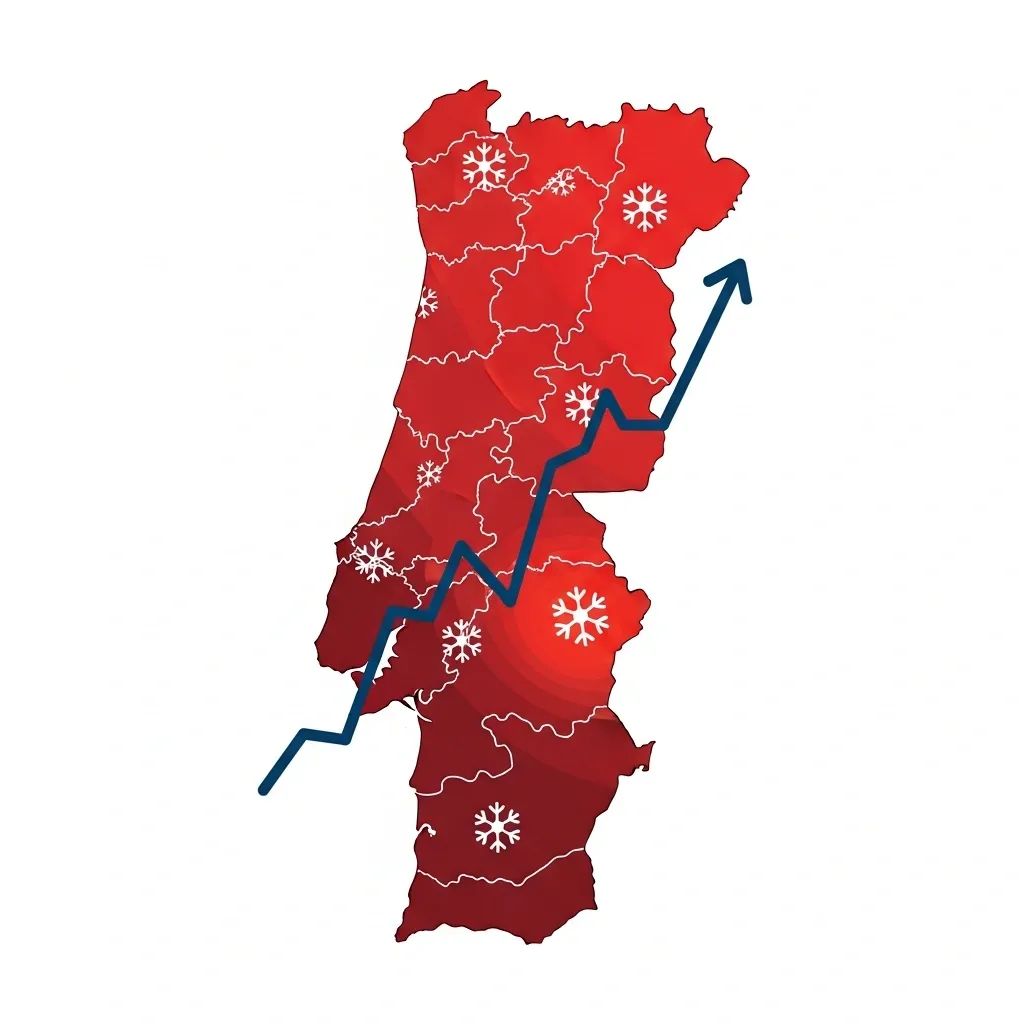
As Portugal enters a critical phase of extreme fire conditions, authorities are sounding an unmistakable alarm: the coming days will test the nation's preparedness infrastructure in ways unseen in recent years. With ambient temperatures potentially exceeding 47°C, air humidity plummeting below 30%, and sustained winds reaching 80 km/h, the entire continental landmass faces what officials frankly describe as "absolutely terrible" circumstances for rapid fire ignition and spread. The National Authority for Emergency and Civil Protection (ANEPC) has activated its maximum deployment capacity—a threshold reserved for the gravest scenarios—mobilizing approximately 15,000 operational personnel, 81 aircraft, and 3,463 vehicles through July.
Key Takeaways
• Level III alert amplifies operational readiness across ground and aerial units, supported by military and police forces standing by for immediate deployment.
• New helicopter resources now operational in Portugal's fire response arsenal, supplementing fixed-wing aircraft and retardant capabilities.
• Human negligence remains the primary culprit, causing approximately two-thirds of rural ignitions; a discarded cigarette or improperly parked vehicle can ignite catastrophic blazes.
• Vulnerable populations face heightened health risks during the heatwave, with authorities anticipating excess mortality, particularly among elderly residents and those with chronic conditions.
The Meteorological Perfect Storm
Interior Minister Luís Neves characterized the confluence of atmospheric conditions as a "powder keg" waiting for ignition. Speaking in Coimbra, he warned that temperatures will remain chronically elevated through mid-July, with nighttime minimums hovering near 20°C—denying forests the cooling relief necessary to reduce flammability. The Portuguese Institute of the Sea and Atmosphere (IPMA) issued red warnings—the highest alert tier—for Lisbon and Setúbal districts commencing Thursday, expanding to Coimbra and Leiria on Friday.
This meteorological pattern extends systematically across Portugal's interior, with heightened risk concentrated in key districts including Bragança, Vila Real, Viseu, Guarda, Coimbra, Castelo Branco, Santarém, Portalegre, and southern Faro, according to ANEPC analysis. The pattern is not random: these zones align precisely with territories where historical fire incidence runs elevated and where multiple ignitions have occurred simultaneously. This geographic reality compounds response challenges—emergency services cannot concentrate assets uniformly when fire risk is dispersed across fragmented landscapes.
Activation of Maximum Fire Response
Portugal's fire response systems have been escalated to maximum deployment, with this reinforcement tier extending through the critical summer period. This escalation represents maximum-capacity deployment: every available ground unit, helicopter, and enforcement resource now operates under heightened readiness protocols.
The activation includes aerial assets, encompassing fixed-wing retardant bombers, reconnaissance helicopters, and additional transport capacity from the Portuguese Air Force deployed operationally. This adds substantial rapid-insertion capability, particularly valuable in mountainous or wildland-urban interface zones where ground access is constrained.
The operatives marshaled originate from volunteer fire brigades, the Força Especial de Proteção Civil (civil protection special force), Guarda Nacional Republicana personnel, and forest firefighting specialists from the Institute for Nature Conservation and Forests. This represents enhanced resource allocation, reflecting recognition that robust deployment levels are essential when fire scenarios escalate in frequency and scale.
Strategic Response and Resource Optimization
To counteract the dispersal challenge of wildfire risk across the territory, the Portuguese government is integrating advanced planning into deployment calculations. Resources are being strategically positioned based on risk mapping and historical fire occurrence patterns to ensure effective response capabilities where they are most needed.
This approach complements Portugal's operational doctrine emphasizing "initial attack success": containing fires within the first 90 minutes of ignition determines whether a blaze remains manageable or escalates into a large-scale disaster. The government has prioritized positioning resources efficiently to ensure they are available at vulnerable points before conditions become overwhelming.
Why Residents Must Act Now
The ANEPC emphasizes that protection originates at the individual dwelling. Homeowners in rural, semi-rural, or wildland-adjacent properties must execute specific hardening measures immediately—not during the alert period, but beforehand.
Establish a defensible perimeter around your residence by clearing vegetation and combustible debris from the surrounding grounds. Move firewood stacks, gas cylinders, lumber, and other flammable materials to a distance ensuring they pose no risk to exterior walls or roofing. Clean gutters, roof tiles, and terraces of accumulated dry leaves and plant residue; these act as kindling when windblown embers make contact. Seal gaps in roof lines, window frames, and eaves where sparks can penetrate the building envelope—this seems elementary but represents a frequent pathway for fire entry.
Develop a family emergency plan specifying a designated safe location where household members will rendezvous if evacuation becomes necessary. Maintain mobile phones fully charged and keep emergency contact numbers (particularly 112) readily accessible. Monitor official ANEPC channels and municipal announcements continuously during the critical period.
If you observe smoke or active flames, contact 112 immediately and relay the precise location when possible. Do not attempt to fight a fire showing intense flames or posing imminent danger to your safety. Evacuate without delay to a secure zone and adhere strictly to instructions from emergency responders. If driving near a fire zone, leave the area at once.
Prohibited Activities and Behavioral Guardrails
During periods of elevated and maximum fire danger, Portuguese law enforces strict prohibitions on activities generating heat or sparks. It is illegal to conduct extensive burns, use open flames for cooking in rural spaces (except at designated facilities), burn vegetation piles, operate brush cutters or mulchers, or fumigate beehives without spark-arresting apparatus.
Residents must avoid any undertaking that produces sparks or heat within proximity to dry vegetation. Defer all non-essential agricultural and forestry equipment operation. Never discard cigarette butts or matches on the ground or through vehicle windows. Refrain from parking vehicles on dry grass—engine exhaust and brake assembly heat routinely ignite fuel-laden ground cover. When feasible, avoid travel to forested and rural areas entirely.
The ANEPC underscores that during high-danger periods, the preponderance of fire ignitions stem from human behavior—either negligence or intentional fire-setting. Two-thirds of rural fires originate from careless actions: improperly controlled burns, discarded smoking materials, unsupervised outdoor cooking, or malfunctioning farm equipment. "A small oversight can trigger a large-scale fire, endangering human lives, homes, infrastructure, and natural heritage," the agency stated in its formal guidance.
Health and Social Solidarity
The extreme temperatures pose direct physiological threats, particularly for individuals with chronic disease, young children, pregnant women, and elderly persons. The Secretary of State for Health, Ana Povo, has advised authorities to expect elevated mortality during the heatwave. Residents should stay hydrated, apply sun protection when outdoors, wear appropriate clothing for hot conditions, and consume light meals rather than heavy fare.
Municipalities are opening air-conditioned public facilities as refuge zones during peak heat hours. Interior Minister Neves emphasized that "the highest value is human life," urging families to proactively contact elderly relatives and isolated neighbors in rural villages. "There must be this social cohesion of anticipated solidarity and proactive engagement," he stated—a call for informal community networks to substitute for formal institutions where coverage is sparse.
Coordination Across Command Structures
The ANEPC has activated its operations coordination for real-time monitoring. Coordination links now bind regional and national emergency command structures, creating unified operational direction rather than fragmented local responses. Liaison mechanisms connect ANEPC with the Armed Forces, the Guarda Nacional Republicana, municipal civil protection services, and cooperating entities including the forest conservation institute.
Ground and aerial combat assets have been strategically positioned in higher-risk zones based on risk mapping, and patrols, surveillance, and enforcement activities have intensified across vulnerable territories. The architecture aims to compress response time and amplify initial-attack capacity—minutes matter when fire behavior accelerates exponentially under extreme wind and heat stress.
Prevention Remains Critical
Portugal's approach to fire management continues to emphasize prevention as the most efficacious instrument for safeguarding people, property, and the territory. Every resident, officials insist, bears responsibility in forestalling the next fire ignition. Collective vigilance and adherence to behavioral guardrails constitute the frontline defense when atmospheric conditions turn hostile to human safety and environmental protection.


