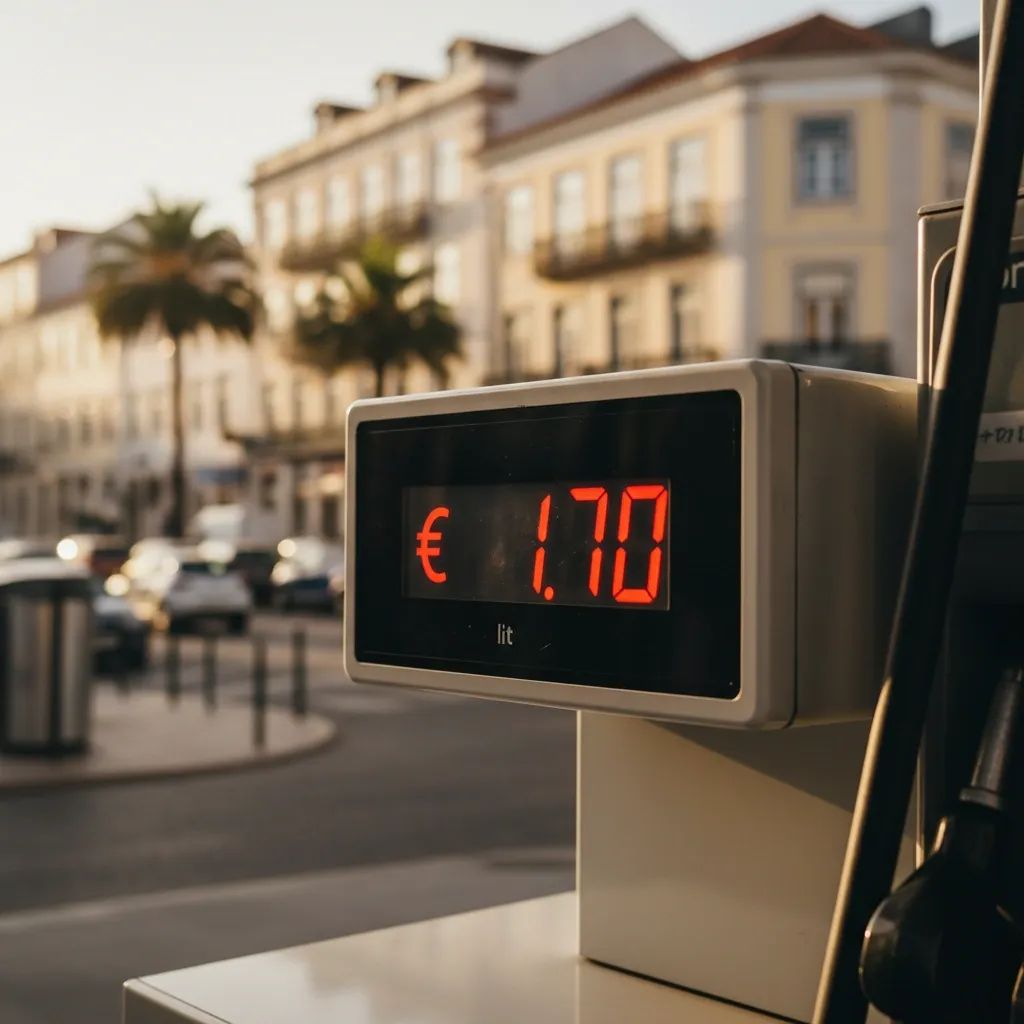
The Portugal Directorate-General for Energy and Geology (DGEG) has confirmed another weekly rise in pump prices, pushing diesel to €2.066 per liter and unleaded gasoline to €1.986 per liter as of the week of August 24–30—a continuation of a five-month climb driven by instability in the Middle East and the intermittent closure of the Strait of Hormuz.
Why This Matters:
• Diesel jumped 2.9 cents and gasoline increased 2.2 cents week-over-week (the most recent weekly change).
• This is the fifth consecutive month of fuel price escalation across the EU, with Portugal recording the 12th-highest increase in July.
• Fuel costs have risen 16.9% year-on-year in the European Union, with Portugal's diesel up 2.1% and gasoline up 1.1% compared to June alone.
What Drove the Surge
The Energy Services Regulatory Entity (ERSE), Portugal's energy regulator, attributes the week-on-week climb to a 4.7% leap in international gasoline quotations and a 2.0% rise in diesel benchmarks. The so-called "efficient price"—a composite measure factoring international commodity prices, freight, logistics, biofuel incorporation, retail margins, and taxes—now stands at €2.021 per liter for unleaded 95 and €2.115 per liter for diesel, representing increases of 1.9% and 1.1%, respectively.
ERSE emphasizes that refined fuel quotations, not crude oil prices, are the primary cost driver for Portuguese consumers. While crude benchmarks capture headlines, it is the cost of gasoline and diesel already processed at refineries—plus maritime freight and the mandatory blending of biofuels—that sets the baseline for pump prices.
The backdrop to this volatility is geopolitical. Fighting in Iran, which began on February 28, led to the closure of the Strait of Hormuz, a chokepoint through which roughly one-fifth of the world's oil and liquefied natural gas transits. A brief ceasefire in June allowed the strait to reopen, easing prices slightly, but tensions reignited in early July, re-blocking the waterway. This has kept upward pressure on international refined product markets ever since.
The Tax Component: ISP Under Scrutiny
Amid rising pump prices, a separate controversy has flared over the Petroleum and Energy Products Tax (ISP), which accounts for roughly half the retail price of fuel in Portugal. On Monday, the Portugal Finance Ministry rebutted allegations that the government is levying an "illegal" road services charge through fuel taxation.
The confusion stems from the 2022 abolition of the Road Service Contribution (CSR), a levy the European Court of Justice ruled incompatible with EU excise duty directives. While the CSR was formally scrapped, its revenue stream—earmarked for Infraestruturas de Portugal (IP), the state road authority responsible for maintaining Portugal's highways—was folded into ISP receipts through a dedicated allocation mechanism. In 2025, this yielded €710M for IP, the highest total since the entity's founding in 2015, equivalent to 8.7 cents per liter on gasoline and 11.1 cents per liter on diesel.
To help residents cope with rising prices, the government has implemented temporary ISP relief measures—rate cuts ranging from 1.4 to 8.34 cents per liter on diesel and 2.7 cents on gasoline—applied from August 17 onward. These discounts offset extra VAT collected when prices spike. Through July 2026, the state collected an extra €141.9M in VAT but returned €139.2M via ISP discounts, netting just €2.8M.
The Finance Ministry insists the current funding model is "fully compliant with European and national law" and that no illegal charge exists. Yet the mechanics remain confusing to many drivers, who simply see ISP rates climb while pump prices soar. Overall, ISP revenues hit a record €3.7B in 2025, up 8% year-on-year. For 2026, the government projects an additional €187M in ISP income (a 4.6% increase).
How Prices Have Moved in August
Tracking the monthly trajectory illustrates the volatility:
• Week of August 3–9: Diesel rose 2 cents to €2.063 per liter; gasoline fell 1 cent to €2.015 per liter.
• Week of August 17–23: Following the application of extraordinary ISP discounts from August 17, gasoline reached €1.954 per liter and diesel €2.026 per liter.
• Week of August 24–30 (current): Diesel advanced another 2.9 cents to €2.066 per liter, and gasoline added 2.2 cents to €1.986 per liter.
When adjusted for loyalty-card discounts—which ERSE calls "a more faithful approximation of actual consumer outlays"—the effective retail price currently sits 2.2 cents below the efficient benchmark for gasoline and 6.8 cents below for diesel, corresponding to deviations of -1.1% and -3.2%, respectively. By contrast, the average "billboard" prices reported by filling stations to the Single Energy Desk run 1.8 cents above the efficient price for gasoline and 1.4 cents below for diesel.
What This Means for Residents
For households and small businesses, these consecutive increases translate to tangible budget pressure. A typical 50-liter fill-up of diesel now costs roughly €103.30, up from around €101.85 a week earlier—an extra €1.45 per tank. Over a month of weekly refueling, that adds up to nearly €6 in additional spending on fuel alone.
The geographic and economic isolation of Portugal's interior regions, where public transport options are limited and car dependency is high, amplifies the impact. Freight companies have likewise signaled that sustained high diesel prices will feed into the cost of goods, particularly perishables transported from distribution hubs in Lisbon and Porto to regional markets.
Practical Ways to Save: Major supermarket chains like Continente, Carrefour, and Pingo Doce offer discounted fuel prices tied to grocery spending—often 5 to 10 cents per liter off for cardholders. The government's Preços dos Combustíveis Online portal (precos.combustiveis.pt) updates daily and allows you to search real-time pump prices by location and fuel type, helping you find the cheapest stations nearby. Prices typically update Monday mornings, so timing your fill-up for weekend rates may capture lower costs. Even a 5-cent difference between neighboring stations can save €10 or more per month for regular commuters.
Outlook and Mitigation Measures
International oil analysts quoted by the US Energy Information Administration (EIA) project Brent crude will average around $85 per barrel in the third quarter of 2026 before declining to $69 in 2027, assuming geopolitical tensions ease and global supply increases. The next OPEC+ meeting on September 6 could provide further clarity on production quotas, though the cartel has already announced a modest 188,000-barrel-per-day increase for September while maintaining broader cuts of roughly 2 million barrels per day through year-end.
For Portugal, any downward movement in refined product quotations will take time to filter through to the pump, given the multi-week lag between purchase contracts and retail delivery. In the meantime, the government's temporary ISP relief measures remain the primary lever for cushioning consumers, though their continuation beyond the current decree period is uncertain.
Historical Context: Why Portugal Pays More
Portugal consistently ranks among the EU's more expensive markets for retail fuel, a function of its peripheral geography—requiring longer tanker voyages and higher freight costs—and a tax structure that places the effective burden of ISP and VAT above 50% of the pump price. While northern European countries such as the Netherlands and Denmark also impose heavy fuel taxes, Portugal's lower average incomes mean the relative weight of each price increase is more pronounced.
The incorporation of biofuels, mandated by EU renewable energy targets, adds a further premium. Current regulations require blending targets that can raise the cost per liter by several cents, though this is offset in theory by reduced carbon emissions. In practice, consumers see only the price effect.
Comparing Discounts and Billboards
ERSE's dual reporting framework—tracking both advertised "billboard" prices and loyalty-adjusted "effective" prices—reveals significant variance. Supermarket-affiliated fuel chains, which dominate Portugal's retail landscape, frequently offer discounts tied to grocery purchases, pulling the real cost below the headline figure. Independent operators, by contrast, tend to hew closer to the efficient benchmark or slightly above, leaving less room for negotiation.
For residents navigating this landscape, apps and portals aggregating real-time pump prices have become essential tools for minimizing outlay. Even small savings compound quickly when refueling weekly.
Political and Fiscal Implications
The Finance Ministry's clarification on the ISP-IP funding mechanism underscores a broader tension: voters perceive rising fuel costs as a direct policy failure, yet the government has limited control over international commodity markets. The reallocation of CSR revenue into ISP was a legal restructuring to comply with EU court rulings, but it has left many drivers wondering whether they're simply paying the same charge under a different name.
Opposition parties have seized on the issue, demanding fuller transparency on how ISP receipts are allocated and whether the extraordinary discounts are sufficient. The €710M channeled to Infraestruturas de Portugal represents a stable funding line for road maintenance and expansion, but critics argue that in a period of acute cost-of-living pressure, diverting such sums away from general relief measures is politically untenable.
Looking ahead, the trajectory of fuel prices in Portugal will hinge on two variables largely beyond Lisbon's control: the resolution—or escalation—of Middle Eastern hostilities, and the supply decisions of global oil producers. For now, residents should brace for continued volatility, monitor weekly DGEG updates closely, and use price-comparison tools to time refueling strategically.