

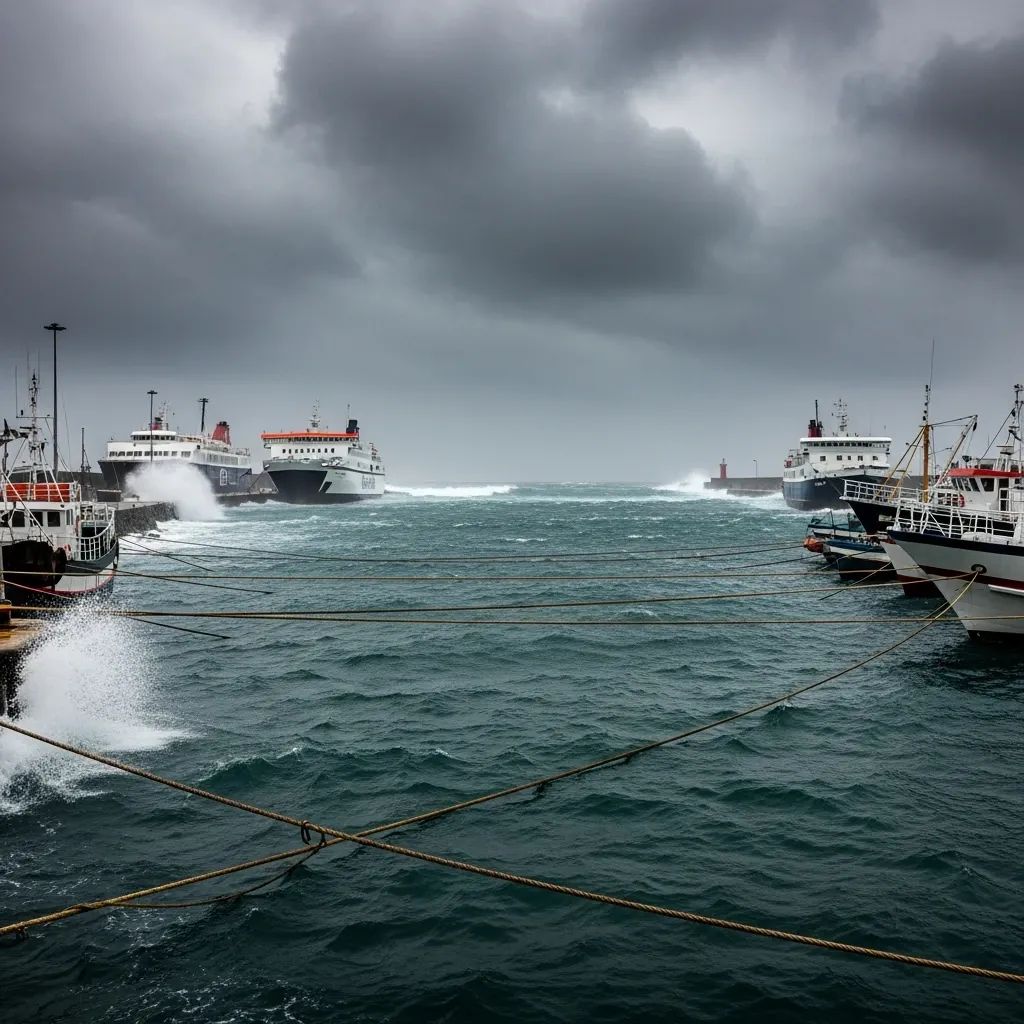
Madeira and Azores face cascading disruptions from weather, strike combine to ground hundreds of flights
Portugal's Atlantic island networks faced their worst operational day in months on June 3 when a transport sector strike collided with severe weather, leaving an estimated 17,000 passengers stranded across both archipelagos. Local aviation authorities reported that 175 flights were cancelled or delayed across the Azores as thick fog persisted, while simultaneously in Madeira, wind gusts reached 72 km/h—forcing the closure of key routes operated by easyJet, Edelweiss Air, Transavia, and Jet2. The double disruption struck during peak tourist season, days before the Corpus Christi long weekend (June 4), turning what should have been a revenue-generating period into a cascading crisis of stranded travellers, emergency accommodations in sports pavilions, and public recrimination of the national carrier.
Why This Matters
• Connectivity collapse: Over 300 TAP Air Portugal flights were affected nationwide; the airline reduced Madeira service to just two daily mainland round-trips under strike minimum service rules, isolating 250,000 residents with no ground transport alternatives.
• Infrastructure exposed: The Horta airport on Faial island—with its cramped 1,700-meter runway—demonstrated why aircraft selection and runway systems directly determine whether weather disrupts a flight or cancels it entirely.
• Passenger support inadequacy: 82 people slept in the Horta municipal sports pavilion; another wave spent nights in airport terminals with cots, raising questions about airlines' duty-of-care obligations during weather events.
• Economic stakes: The timing squarely hit peak tourism; hospitality sectors in both regions report high cancellation rates for holiday bookings, with rebooking windows extending into mid-June creating extended revenue loss.
Madeira's Three-Day Wind Siege
The Cristiano Ronaldo International Airport began experiencing hazardous conditions late on June 2, when the EMAS meteorological station recorded sustained winds of 26.6 km/h from the north quadrant. By early morning June 3, the situation had deteriorated sharply. Peak gusts climbed to 56 km/h within single hours, with a maximum recorded gust of 72 km/h overnight—well beyond the crosswind safety threshold for the narrow Santa Catarina runway.
The runway's tight lateral dimensions and exposure to Atlantic wind patterns meant that even brief wind spikes forced operational suspensions. By mid-morning, the cancellation cascade began systematically across every carrier. easyJet cancelled multiple daily connections to Porto and Lisbon. Edelweiss Air withdrew its twice-weekly Zurich rotation. Transavia abandoned both Paris and Nantes routes. Jet2's Manchester service ground to a halt. Additionally, a SATA Air Açores flight from Ponta Delgada had already been diverted on June 2 as conditions began deteriorating across the region.
What distinguished Madeira's disruption from the Azores fog was its relative brevity but concentrated severity. Wind patterns are episodic; fog is chronic. Yet the timing catastrophically amplified consequences. The strike meant airlines had minimal flexibility to reroute capacity through alternate mainland hubs, and passenger rebooking options evaporated as TAP essentially abandoned its network outside minimum-service corridors.
The Portugal Airport Authority (ANA) issued urgent guidance telling passengers to contact airlines directly before departure rather than present themselves at the terminal. The authority also warned of cascading delays at immigration for non-EU travellers, with border control staffing stretched thin and security queues extending well beyond normal processing times. Passengers on international routes originating outside the European Union were urged to arrive 3+ hours before scheduled departure—an advisory that implicitly acknowledged staffing shortfalls during the strike period.
Fog's Stranglehold on the Azores Reveals Operational Fault Lines
The situation in the Azores archipelago tells a more complex story rooted in infrastructure, fleet decisions, and weather persistence. Fog has dominated disruptions there since late May, not merely on June 3. The Portugal Civil Aviation Authority (ANAC) reported that fog-related cancellations peaked at 175 flights on June 1, affecting roughly 17,000 connected passengers. On June 3 specifically, while conditions remained challenging, the SATA Azores Airlines cancelled 31 inter-island services and Azores Airlines grounded six additional routes, partly because meteorological information systems failed during the strike, preventing real-time weather updates to flight crews.
The accommodation crisis that followed exposed the region's limited backup infrastructure. At the Ponta Delgada airport on São Miguel island, terminal staff improvised cots inside the main concourse when hotels reached capacity—a makeshift solution that travelled widely on social media and embarrassed regional tourism boards. In Horta on Faial island, where the airport sits on a constrained volcanic plateau with limited hotel availability, a municipality-provided sports pavilion housed 82 stranded passengers overnight, while others slept in airport lounges.
The accommodation crunch triggered pointed criticism from local leadership. Carlos Ferreira, the mayor of Horta, stepped before regional media to challenge SATA Azores Airlines directly over aircraft deployment decisions. His core grievance: the airline was relying too heavily on smaller, less-capable aircraft for inter-island routes rather than deploying A320 narrow-body jets that both Azores Airlines and SATA operate. "The planning directorate of SATA Azores Airlines must correct course by prioritising A320 operations at Horta," Ferreira stated to Antena 1 Açores. The A320, he noted, suffers lower performance penalties in challenging weather and theoretically can execute instrument approaches using onboard navigation rather than pilot visual reference—a critical advantage when fog blankets runways.
The mayor's complaint reflects genuine infrastructure constraints that directly affect airline choices. The Horta airport's runway spans only 1,700 meters—roughly half the length of major Iberian hubs—which limits weight, payload, and aircraft type options in adverse conditions. In April 2026, Portugal's National Civil Aviation Authority issued a temporary prohibition preventing A320 operations on wet pavement at Horta due to documented runway surface deterioration at the edges. That two-day ban, though quickly rescinded, signalled that the runway is at or near its maintenance threshold. Instrument Landing Systems (ILS), which allow precision approaches in near-zero visibility, remain absent from Horta, meaning pilots must still visually acquire the runway at decision altitude—a luxury fog denies them.
Despite these constraints, on June 1, SATA initiated what company statements termed an "intense operation," positioning additional aircraft and crew to Faial, prioritising clearance of the stranded passenger backlog. The push worked temporarily. Hotel rooms reopened. Departures accelerated. By Tuesday, June 2, however, new fog systems arrived, and the situation reversed. Cancellations resumed. New queues formed. The municipal sports pavilion filled again. The cyclical pattern frustrated both passengers and local officials alike.
Strike Action: Timing and Scale
The June 3 transport sector strike, called by Portugal's CGTP confederation, targeted proposed labour reforms including streamlined dismissal procedures, expanded subcontracting authorisation, and extended duration of temporary employment contracts. The action had the potential to affect up to 500 flights nationwide, with approximately 300 belonging to TAP Air Portugal. Beyond aviation, the strike paralysed urban metro systems in Lisbon and Porto, regional bus networks, Portugal Railways (CP) commuter services, hospital non-emergency departments, and public administration offices.
In response to mandatory minimum service requirements imposed by Portugal's Labour Ministry, TAP Air Portugal committed to operating 79 flights nationwide under strike conditions. The carrier strategically prioritised routes to the autonomous regions (Azores and Madeira), international gateways including New York, Boston, São Paulo, and Luanda, plus major European hubs in Paris, London, Frankfurt, Rome, and Nice. However, this calculus meant drastic cuts to regional distribution. Between the mainland and Madeira, TAP operated a mere two daily round-trips under the strike schedule—a 90% reduction from normal capacity. For a region with no alternative rail, bus, or ferry network, this translated to near-total isolation for residents and visitors unable to book the limited seats.
The crisis prompted an escalation. The Madeira Regional Government formally notified the Portugal Ministry of Labour that residents faced potential isolation without emergency transport provisions. The alert flagged that mainland passengers had been unable to reach rebooking agents due to strike-driven system outages and that real-time information about available TAP services proved unavailable on public channels. The implicit pressure: if another disruption occurred while strike minimum service remained in force, the region faced a genuine humanitarian constraint.
Passenger Rights, Rebooking, and Compensation Ambiguity
Passengers holding confirmed tickets for June 3 flights discovered that compensation rights proved murky. Under EU Regulation 261/2004, travellers facing cancellations or delays exceeding 3 hours normally qualify for compensation ranging from €250 to €600 depending on flight distance. However, both weather events and strike action typically fall under "extraordinary circumstances" provisions, which allow airlines to claim exemptions from financial liability. The critical legal question—whether a strike initiated by management's own industry negotiators constitutes an extraordinary circumstance—remained untested in June 2026.
TAP implemented an exceptional rebooking policy allowing passengers with tickets for June 3 to change flights free of charge to any date between May 27 and June 11, provided their original booking was made on or before May 20. This window accommodated some flexibility but excluded last-minute bookings. Passengers with earlier reservation dates had no alternative but cancellation refunds or vouchers, a distinction that created fairness friction.
Recovery proved glacially slow. Social media filled with videos and photographs documenting multi-hour airport queues and complaints that SATA rebooked stranded passengers "every two to three days," a pace that left many in multi-day limbo. The reputation damage accelerated in real time across regional Facebook groups and tourism forums, with video clips from terminals and passenger accounts amplifying criticism.
Infrastructure and Planning Crossroads
The crisis has forced both regional and national authorities to confront structural vulnerabilities. Tourism sustains both archipelagos' economies. Madeira draws roughly 1.2M annual visitors; the Azores attract 250,000+. Extended flight disruptions during peak seasons—a category that now includes June—directly threaten hospitality revenue, restaurant employment, and guide income. The Corpus Christi weekend, traditionally a high-occupancy period for domestic and Northern European family travel, became instead a logistics nightmare, with cancellations cascading into July rebookings and reputation damage spreading across travel forums and tourism portals.
Local leaders are now pressing for infrastructure modernisation at secondary airports, particularly ILS installation at Horta and runway resurfacing at Faial to eliminate seasonal restrictions. They are also demanding that SATA and Azores Airlines prioritise fleet deployment decisions based on weather capability rather than short-term cost optimization. The Portugal Ministry of Transport faces implicit pressure to revisit how minimum service agreements protect remote communities during national strikes—an issue that will resurface whenever labour unrest occurs.
Weather forecasts for the remainder of June suggest Madeira will experience manageable conditions with daily highs between 20–24°C and scattered rain, with dangerous wind events unlikely. The Azores face persistent humidity conducive to fog formation, with meteorologists projecting approximately 12 rainy days through June and temperatures averaging 20–23°C. This pattern means fog-related disruptions could recur, particularly in early mornings and late afternoons when visibility typically diminishes.
Lessons for Residents and Travelers
For anyone planning island travel through June or beyond, several practical safeguards have emerged. Confirm flight status within 24 hours of departure and again 2–3 hours before checking in, relying on airline websites or direct phone contact rather than third-party booking platforms. Consider travel insurance specifically covering weather disruptions and airline cancellations, ensuring coverage includes rebooking on alternative carriers if your primary airline cannot accommodate you. Build buffer days into island-hopping itineraries—if your vacation spans only 3–4 days across multiple islands, a single weather event or strike eliminates flexibility entirely.
The convergence of meteorological hazard and labour action revealed an uncomfortable truth: Portugal's Atlantic islands depend on a fragile single-airline ecosystem with minimal redundancy and constrained infrastructure. Until ILS systems are installed at secondary airports, runways are upgraded to support modern aircraft without seasonal restrictions, and competitive carrier capacity is developed or guaranteed, these disruptions will recur. Whether this crisis catalyses genuine infrastructure investment or merely fades as another cautionary footnote in regional travel forums remains an open question.


