

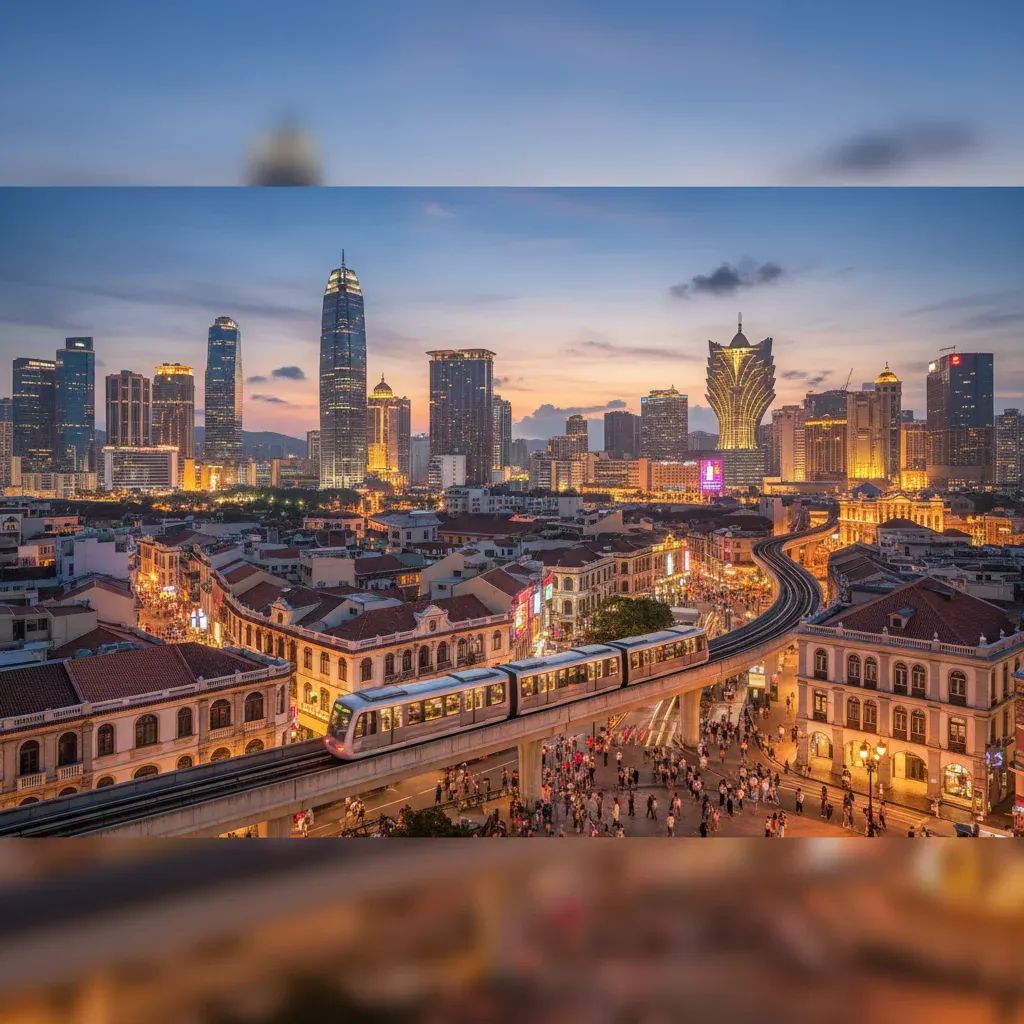
Macau's Statistics and Census Service (DSEC) has confirmed the former Portuguese territory recorded 3.65 million arrivals in January 2026, marking the 5th consecutive monthly high and the busiest January since data collection began in 1998. The milestone arrives as Macau pushes aggressively into European markets—including Portugal—while grappling with infrastructure strain and a stubborn reliance on casino revenue.
Why This Matters
• Record streak continues: Macau has set visitor highs every month from September 2025 through January 2026, surpassing pre-pandemic peaks.
• Diversification drive: International arrivals jumped 15.5% year-on-year, with Malaysia (+52.3%), Thailand (+80.5%), and India (+54.1%) leading growth—offsetting a 1.6% dip in mainland Chinese visitors.
• Portugal connection: The Portugal Tourism Services Bureau named Portugal a "priority market" in February, with Macau returning to Lisbon's BTL travel fair after a one-year absence. For Portuguese visitors, this means expanded tour packages, improved air connectivity via Hong Kong, and stronger promotion at travel agencies in Lisbon and Porto.
• Economic engine: Tourism and gaming accounted for 74.1% of Macau's GDP in 2025 (418 billion patacas / €43.8 billion), underscoring both opportunity and vulnerability.
Why Macau Appeals to Portuguese Travelers
Macau holds particular significance for Portuguese citizens through its rich shared history. The territory boasts UNESCO World Heritage sites featuring distinctly Portuguese architecture and urban design—a living museum of Iberian influence in Asia. The Macanese fusion cuisine, blending Portuguese, Chinese, and African culinary traditions, attracts gastronomy-focused travelers. Additionally, Portuguese-language services and cultural signage remain embedded in the territory's fabric, easing navigation for Portuguese speakers.
Regarding visa requirements: Portuguese passport holders qualify for visa-free entry into Macau for up to 30 days, a significant advantage for spontaneous or extended visits. This aligns with Macau's broader visa-free expansion for 49 nationalities, including access for citizens of Saudi Arabia, Qatar, Kuwait, Bahrain, and Oman (introduced July 2025).
Infrastructure Buckling Under Weight of Success
While Macau welcomed 40.06 million visitors in 2025—eclipsing the 2019 record of 39.4 million—the DSEC data reveals an uncomfortable truth: 62% of January's arrivals were same-day excursionists, mostly from mainland China and Hong Kong, who spent less than 24 hours in the territory. This "turnstile tourism" places acute pressure on public transport, roads, and pedestrian zones without delivering proportional economic benefit.
The Metro Ligeiro (Light Rail) system, a cornerstone of intra-city mobility, faces capacity bottlenecks during peak events. Crowd evacuation after major festivals regularly results in queues stretching for hours, prompting calls for additional carriages and elevated bus corridors. The Macau Bridge, the fourth road link between Taipa and the peninsula, has eased some congestion, yet urban planners warn that road expansion alone cannot solve the fundamental mismatch between visitor volume and carrying capacity.
Residents report daily disruptions—blocked pavements, taxi shortages, and noise—fueling debate over whether the territory's pursuit of record numbers undermines quality of life. The Portuguese-era historic core, a UNESCO World Heritage site, has become a flashpoint: preserving cultural authenticity while accommodating mass tourism is a tightrope walk with no easy answers.
The Lunar New Year Timing Quirk
January 2026's record came with an asterisk. The Lunar New Year "Golden Week"—typically Macau's busiest period—fell in late February this year, rather than late January as it did in 2025. That calendar shift explains the 9.6% year-on-year drop in mainland Chinese visitors traveling under the Individual Visit Scheme (IVS).
Despite the timing disadvantage, overall arrivals still edged past January 2025 by 767 visitors—a razor-thin margin that underscores Macau's ability to attract tourists even outside peak windows.
When the Lunar New Year festivities finally arrived in mid-to-late February (February 15–23, 2026), Macau logged 1.6 million visitors over nine days. The surge peaked on February 19, which set an all-time single-day high of nearly 228,000 arrivals. Casino revenues in February climbed 4.5% year-on-year compared to the previous year, pushing the two-month total to 43.26 billion patacas—a 13.9% gain that underscored February's economic impact.
Pivoting to Long-Haul Markets
Stung by overdependence on mainland China—which still supplies 90% of visitors when Hong Kong is included—Macau is courting Europe, the Middle East, and Southeast Asia with renewed urgency. Maria Helena de Senna Fernandes, director of Macau's Tourism Services Bureau, told reporters in February that Portugal and Spain top the outreach list for 2026.
The territory exhibited at the BTL travel fair in Lisbon (February 25–March 1), where it secured designation as the "Preferred International Destination 2026" by the Portuguese Travel and Tourism Agencies Association (APAVT). This partnership concretely translates into bundled itinerary packages combining Hong Kong (days 1-2), Macau (days 3-5), and mainland China (days 6-8), typically priced 15-25% lower per destination than individual bookings through volume agreements. Tour operators from Lisbon and Porto are increasingly marketing these three-destination circuits through spring and autumn.
Free shuttle transfers from Hong Kong International Airport to Macau are available for long-haul arrivals through December 31, 2026, coordinated with bus and ferry operators. This program targets travelers who might otherwise skip Macau in favor of Hong Kong alone. The shuttle departs from Terminal 1 and Terminal 2 at Hong Kong International Airport; bookings are handled through registered Macau hotels or tour agencies.
Macau also deployed a multilingual Tourism AI Chatbot, expanding language support to reach European, South Asian, and Middle Eastern audiences. At trade shows in Madrid (FITUR), Berlin (ITB), and London (planned March 2026), officials pitch Macau as a "Creative City of Gastronomy" (a UNESCO designation) and the "East Asian City of Culture," emphasizing heritage and cuisine over casino floors.
Yet the strategy faces headwinds. International arrivals in 2025 totaled 2.76 million, short of the 3 million target Senna Fernandes set in August. The 278,453 international visitors in January 2026—the highest January figure since 2019—signal progress, but still represent barely 7.6% of total arrivals. Flights remain a constraint: direct air links from Europe and the Middle East are sparse, and passengers must typically transit through Hong Kong, Shanghai, or Bangkok. Typical flight times from Lisbon to Macau (via Hong Kong) average 18-20 hours including connections.
What This Means for Portuguese Travelers and Investors
For Portuguese nationals, Macau's outreach translates to more package deals, improved air connectivity via Hong Kong, and heightened visibility at travel fairs. The APAVT partnership and BTL presence suggest tour operators in Lisbon and Porto will aggressively bundle Macau into Asian itineraries, potentially lowering per-day costs through volume agreements. Multi-destination packages typically range from €2,500–€4,500 per person for 8-day Lisbon-to-Macau itineraries (flights, mid-range accommodation, basic tours).
Investors and businesses eyeing the Greater Bay Area—a Beijing-backed integration scheme linking Macau, Hong Kong, and nine mainland Chinese cities—should note that Macau's tourism contribution to GDP (111.6 billion patacas in 2025) grew just 0.1%, signaling margin compression even as visitor headcount soared. The government's "1+4" diversification plan (one priority: gaming regulation; four pillars: MICE tourism, cultural industries, conventions, and special economic zones) prioritizes MICE (Meetings, Incentives, Conferences, Exhibitions), halal tourism, and cultural products, opening procurement niches for European hospitality firms, event management companies, and gastronomy consultants.
Concrete opportunities include: (1) Event logistics and conference technology—Macau targets 500+ international conferences annually; (2) Culinary training and Michelin-restaurant consulting—the government funds chef development programs; (3) Cultural product design and heritage tourism planning—UNESCO site management offers licensing pathways.
The Fitch rating agency forecasts Macau's GDP growth will slow to 4% in 2026, down from 4.7% in 2025. This moderation—while still solid—reflects weaker economic conditions in mainland China that could dampen visitor spending. For context, Portugal's comparable growth rate hovers around 2%, making Macau's 4% projection relatively robust but not exceptional. Casino operators, which dominate the skyline and payroll, face regulatory pressure to invest in non-gaming amenities—family attractions, theater productions, Michelin-starred restaurants—creating procurement opportunities for foreign vendors.
Sustainability Versus Growth
Macau's leadership speaks openly about the "harmful impacts of mass tourism"—environmental degradation, cultural dilution, resident displacement—yet the political imperative to hit visitor targets often wins. The General Plan for Tourism Industry Development, still in draft, aims to balance growth with livability, but specifics remain vague.
Urbanists point to the Taipa International Integrated Tourism and Culture Zone, where landfill and airport expansion are scheduled for completion by late 2026, as evidence Macau is building for more tourists rather than managing down numbers. Taxi fleet increases and a revised taxi regulation, expected this year, address symptoms without tackling root causes: too many people in too small a space.
Community groups advocate for resident-only zones, restricted entry to heritage sites during peak hours, and differential pricing to favor overnight guests over excursionists. So far, the government has resisted caps, fearing any perceived hostility to mainland visitors could trigger a political backlash in Beijing.
The Road Ahead
Macau's tourism bureau projects 41 million visitors in 2026, a modest uptick that masks a strategic pivot. Success will hinge less on raw numbers than on composition: fewer bus-tour day-trippers, more long-haul guests who book hotels, eat at restaurants, and buy tickets to shows. January's 15.5% surge in international arrivals offers a glimpse of that future, but the 89.8% mainland-Hong Kong share underscores how far Macau must travel.
For Portuguese observers, the parallels are instructive. Like Lisbon or Porto grappling with overtourism, Macau must decide whether endless growth serves citizens or balance sheets. The difference: Macau's economy has no Plan B. Diversification remains aspirational, gaming licenses expire and renew on Beijing's timetable, and the 418 billion pataca GDP floats on a sea of slot machines and baccarat tables.
The January record—3.65 million visitors in 31 days—is both triumph and warning. Macau proved it can fill hotels and sidewalks year-round. Whether it can build an economy, and a livable city, around that feat is the question for 2026 and beyond.


