

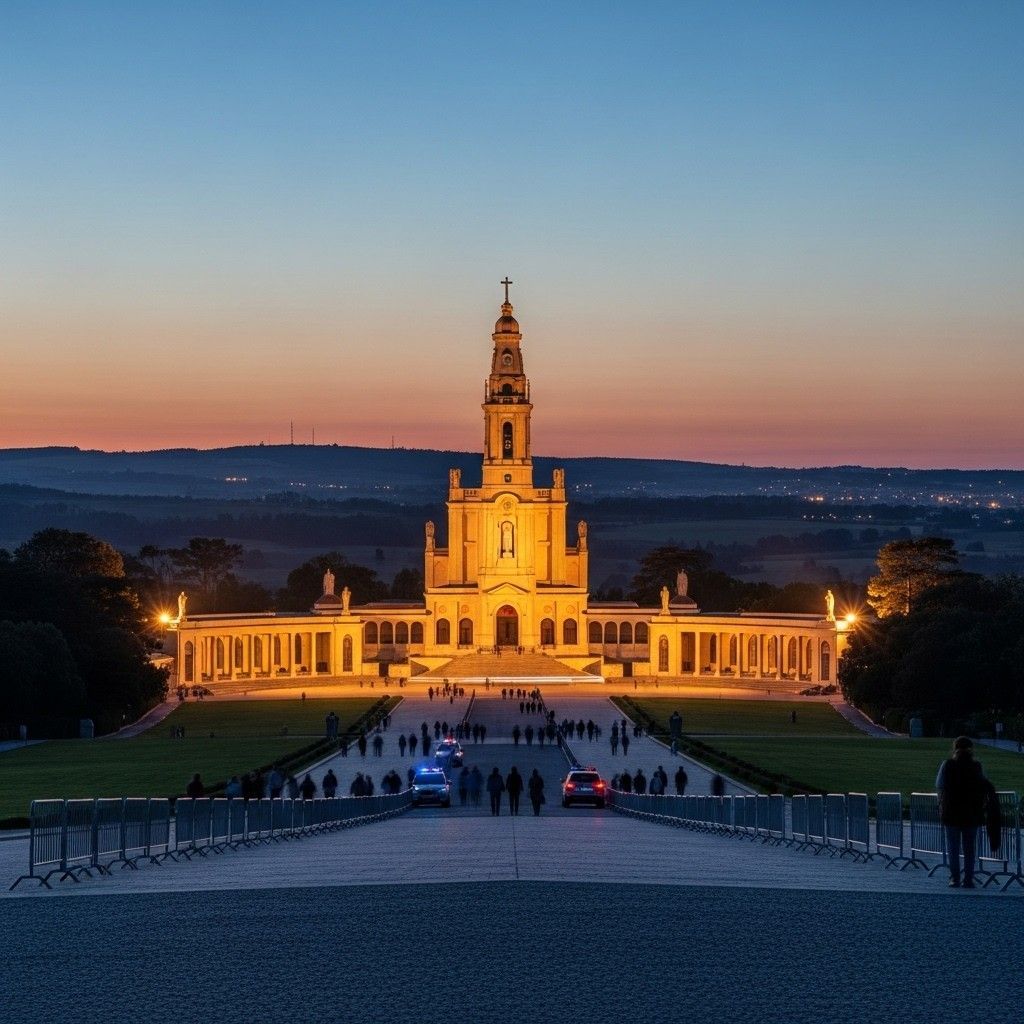
The Portuguese Institute for Sea and Atmosphere (IPMA) has issued a forecast of intermittent showers and potential thunderstorms for the iconic May 13 pilgrimage to the Shrine of Fátima, a move that will test the resolve of the estimated hundreds of thousands of faithful expected to converge on the small central Portugal town tomorrow.
Why This Matters
• Weather warning: Showers and thunderstorms are forecast for May 12–13, particularly in Portugal's North and Central regions, with a 70% chance of precipitation during daylight hours on the 13th.
• Temperature drop: Expect highs of just 16–19°C and lows near 10°C, with northerly winds creating a wind chill below 15°C even in the afternoon.
• Safety protocols activated: The National Republican Guard (GNR) has deployed 200 officers daily, while Civil Protection mobilized 300 emergency responders.
• Mass attendance expected: Although 170 registered groups (7,550 pilgrims from 30 countries) are officially signed up, based on 2024-2025 attendance patterns (450,000–470,000 visitors), similar numbers are anticipated this year.
A Low-Pressure System Over the Iberian Peninsula
According to IPMA's forecast, a depressionary zone centered west of the Iberian Peninsula will continue to dominate weather patterns through Wednesday, May 13. The system is bringing southerly winds that will shift to westerly by the afternoon of Tuesday, May 12, alongside scattered showers that are "most likely to be accompanied by thunderstorms" across Portugal's North and Central districts—precisely where Fátima sits.
For the shrine town itself, forecasters project light rain during the day on May 13, with precipitation probability dropping sharply to 10% overnight between Tuesday and Wednesday. That offers a small window of relief for the traditional candlelit procession scheduled for late evening. Humidity levels are expected to hover around 78%, adding to the damp conditions that will greet pilgrims, many of whom walk for days to reach the site.
The updated forecast notes that while some improvement is anticipated for the 13th itself, fog patches and intensifying northerly winds could make the perceived temperature significantly colder—a critical detail for the thousands who will spend hours outdoors in the open-air Recinto de Oração (Prayer Esplanade).
What This Means for Pilgrims and Residents
For anyone planning to attend or support the pilgrimage, the message from authorities is clear: prepare for wet, cool conditions and exercise heightened caution on the roads. The GNR is in full effect, with drone surveillance monitoring crowds, anti-drone technology to enforce the no-fly zone over the shrine, and real-time traffic updates pushed via the Waze app to manage congestion on critical routes like the IC2 and A1 motorway.
The Infrastructure Authority (IP) has implemented temporary road diversions and alternative routes, with field teams stationed along pilgrim pathways to provide information and emergency assistance. The emphasis is on visibility and communication: all walkers are required to wear reflective vests during daylight hours, travel in single file on the left side of the road, and avoid distractions such as mobile phones or headphones.
The Portuguese Red Cross has deployed approximately 500 operatives and established an Advanced Medical Post adjacent to the shrine on May 12 and 13. The National Institute of Medical Emergency (INEM) and 29 fire brigade units from the Lisbon and Tagus Valley Region are also on standby, adding another 170 responders to the on-ground medical capacity. The Portuguese Podology Association is offering free foot-care stations for walkers, a practical touch given that nearly 10,000 pilgrims registered on the peregrinar.pt platform are making the journey on foot.
Residents of Fátima and surrounding municipalities should expect significant traffic disruptions from the morning of May 12 through the evening of May 13. Local access roads will be subject to rolling closures, and parking in the town center will be severely restricted. Authorities advise locals to stock up on essentials before the influx and to consider remote work arrangements if possible.
Why May 13 Matters: A Century of Devotion
Tomorrow marks the 109th anniversary of the first reported apparition of the Virgin Mary to three shepherd children on May 13, 1917. The event transformed Fátima from an obscure farming hamlet into one of Catholicism's most significant pilgrimage destinations. This year's ceremonies will be presided over by Rui Valério, Patriarch of Lisbon, and will include a rosary procession on the evening of May 12, an overnight candlelight vigil, and a solemn outdoor Mass at 10 a.m. on May 13—all proceeding regardless of weather conditions, following the shrine's longstanding policy.
Practical Guidance for Tomorrow
For those attending, here are the essentials:
• Clothing: Waterproof jacket, thermal underlayer, and reflective vest. Temperatures may feel like 12–14°C due to wind chill.
• Footwear: Waterproof boots with good tread; the esplanade's marble and limestone surfaces become slippery when wet.
• Hydration and nutrition: Portable snacks and a refillable water bottle; food vendors will be present but expect long queues.
• Communication: Fully charged mobile phone with emergency contacts saved, including the GNR hotline (21 321 7000) and Civil Protection (808 215 215).
• Group coordination: Designate a meeting point in case of separation; mobile networks can become congested with hundreds of thousands of users in a concentrated area.
The shrine's official guidance emphasizes avoiding isolated nocturnal travel, particularly for elderly pilgrims and families with children. Heightened security also means stricter enforcement of prohibited items—drones, large banners, and commercial filming equipment require advance authorization.
A Test of Faith and Logistics
The convergence of unpredictable weather, significant pilgrim numbers, and a security apparatus designed for mass-event resilience makes tomorrow's commemoration a high-stakes logistical exercise as much as a religious observance. For the Civil Protection, the GNR, and the Shrine of Fátima's operational team, the priority is ensuring that devotion does not come at the cost of safety—a balance refined through more than a century of managing one of Europe's most enduring expressions of popular faith.
Whether the skies clear or the rain persists, the ritual will unfold as it has since 1917: with thousands kneeling on wet stone, candles flickering in the wind, and the conviction that some journeys are worth taking regardless of the forecast.


