

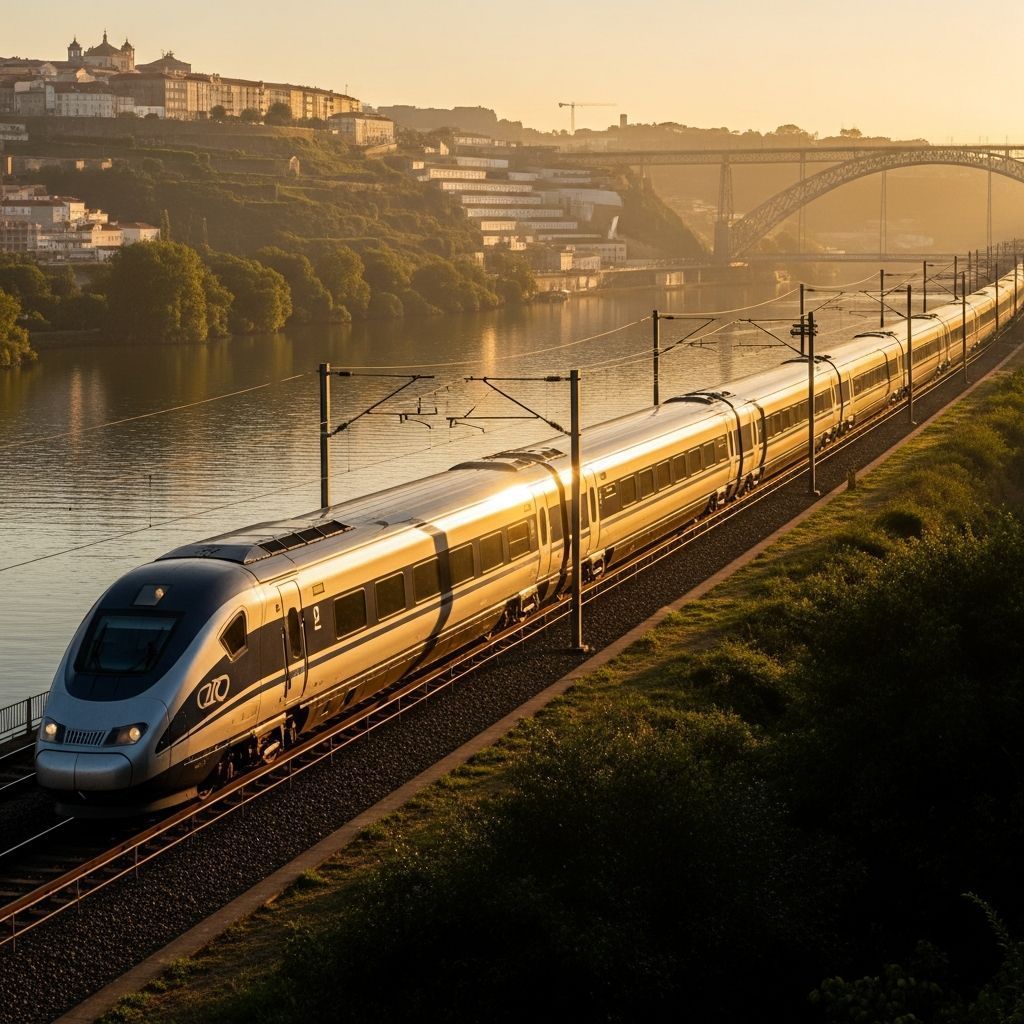
A Regional Hub Left Exposed
Trains arrive and depart on schedule at Vila Franca das Naves station, but passengers board and alight from platforms exposed to the elements. The station building—its waiting room, restrooms, and ticket counter—has remained locked since modernization work on the Beira Alta Line concluded in September 2025, approximately eight months ago. What began as a temporary closure during infrastructure upgrades has hardened into permanent abandonment, prompting an emergency meeting today between local officials and Portugal's state railway property administrator.
Why This Matters
• Working trains, unusable station: Scheduled Intercidades and regional services continue; passengers wait unprotected outdoors, a particular hardship during the region's severe winters.
• Today's negotiation stakes: The Trancoso parish council leadership meets IP Património (Portugal's railway property manager) to demand reopening and propose local governance of station facilities, a model increasingly common in Portugal's interior regions.
• Access exclusion by design: Elimination of physical ticket sales effectively requires older residents and digitally disconnected populations to use online booking systems—a barrier that functionally restricts ridership among vulnerable groups.
• Economic anchoring: The station serves as a connectivity hub for northern Guarda district and northeastern Beira Alta, populations for whom reliable transport access to urban centers substitutes for limited regional employment.
The Durability of Temporary Solutions
IP Património, the entity responsible for railway property management, provided no public justification when it sealed the station building. Local authorities argue the closure contradicts the visible investment: millions of euros directed toward track renovation, signaling modernization, and platform upgrades—yet the facility serving those trains remains inaccessible.
The station occupies strategic geography within the Beira Alta Line corridor, functioning as an interchange where residents from Trancoso and surrounding municipalities board services toward Lisbon, Porto, Covilhã, or Guarda. It is not a peripheral stop but rather a junction point where multiple population flows converge. That trains stop there—Intercidades and regional services on established schedules—confirms operational significance.
Sérgio Pires, newly elected president of the Vila Franca das Naves and Feital parish council (chosen in October 2025 municipal elections), characterized the closure as emblematic of a deeper pattern: the state invests in hardware—infrastructure, rolling stock—while systematically withdrawing from service components. The waiting room, restrooms, and staffed ticket counter are foundational elements that determine whether the transport system functions equitably.
"Millions spent on modernization, yet passengers wait in rain and cold without basic dignity," Pires stated in the parish council's urgent communication. The closure raises questions about equitable access and equal treatment across regions.
Climate Conditions and Vulnerable Populations
Beira Alta winters impose objective hardship. The region sits at higher elevation than coastal Portugal; temperatures regularly hover near freezing from November through March. Rain and occasional snow are routine. For an elderly resident traveling to a specialist appointment in Guarda or Viseu, or a university student returning home between semesters, the absence of a waiting room is not theoretical but immediate discomfort.
An 82-year-old cannot stand exposed on an open platform for 90 minutes while waiting for a connection. A student with an unreliable smartphone cannot reliably book tickets through digital systems when internet connectivity fluctuates. A parent sending a child alone on a train loses reassurance that station staff exist to assist if complications arise.
The parish council's formal submissions emphasize this vulnerability asymmetrically. The closure affects those least equipped to absorb added friction: populations aged 65 and above, individuals with limited formal education, those living outside urban digital connectivity zones. Younger, digitally fluent, and affluent residents navigate online booking with minimal friction. The same closure imposes vastly different costs across populations.
The petition circulating locally explicitly names this asymmetry: the closure affects elderly populations and the digitally excluded disproportionately, raising concerns about equitable access to essential transport services.
A Practical Counterproposal
Rather than simply demanding reversal, the Trancoso parish leadership proposes a governance model: the parish assumes responsibility for managing the waiting room and associated facilities, staffing the ticket counter during operational hours, and developing the space as a regional service hub. This approach reflects the reality that parishes increasingly assume functions across Portugal's interior regions—maintaining public infrastructure as embedded in community life rather than purely commercial operations subject to profit-loss calculation.
The proposal suggests practical outcomes: a staffed ticket counter where older passengers can purchase tickets by speaking to a person; a maintained restroom available to passengers; a waiting room heated during cold months; display space for regional information. The model transforms the station from a purely passive shelter into an active community node integrating passenger services with local development.
The proposal reflects calculation that the parish can operate the facility for less than IP Património finds acceptable operationally. A parish employee overseeing the space during train hours (roughly 6 a.m. to 8 p.m. daily) costs less than a private facility management contract would. The station becomes economically viable at a smaller scale than a corporate operator requires.
Today's meeting in Lisbon tests whether the state entity will engage with this model or remain committed to minimal facility operation. The parish council's public stance signals that escalation awaits if negotiation fails: parliamentary pressure, expansion of the public petition, and potential media amplification of the equity dimension.
Digital Access and Passenger Service Standards
Elimination of physical ticket sales assumes universal digital access. This assumption fails in rural Beira Alta. Broadband coverage across northern Guarda remains inconsistent compared to coastal urban areas. Smartphone ownership approaches universality among younger populations but remains less uniform among those over 65. More fundamentally, access to a technology does not create fluency with its use.
A 74-year-old possessing a smartphone may lack comfort navigating a rail booking website, or may have unreliable internet service at home, or may prefer the human interaction that accompanies purchasing a ticket across a counter from a staff member. These preferences reflect reasonable accommodation to individual circumstance and capacity.
The parish council's proposal to restore the ticket counter directly addresses this. An employee during operational hours, with authority to sell tickets, receive payment, and provide confirmation, restores access to passengers uncomfortable with or unable to access digital systems reliably. This represents restoration of baseline passenger service.
Territorial Equity and Regional Debate
The dispute carries weight within Portuguese political discussion about regional equity and territorial cohesion. Whether interior communities receive equitable treatment in infrastructure policy—whether a functioning train station includes functioning passenger facilities—reflects larger questions about whether the state serves all populations or primarily urban concentrations.
The timing of today's meeting reflects awareness by the parish council that momentum matters. News coverage amplifies local mobilization. The public petition provides visible evidence of broad dissatisfaction. If the state entity signals openness to compromise, negotiation becomes possible. If it declines engagement, escalation becomes likely, with parliamentary intervention and broader municipal involvement.
The parish council's framing aligns with political language increasingly present in Portuguese public debate. Interior regions have become vocal about resource distribution and infrastructure allocation, and whether state investment serves comprehensive national territory or concentrates in densely populated urban areas.
What Remains Unresolved
IP Património has offered no timeline for potential reopening, no explanation for the closure, and no engagement with stakeholder concerns. This silence creates uncertainty for residents and local officials who depend on clarity about the station's future status and operational availability.
Without clear explanation of reasoning, residents interpret the closure as institutional indifference to interior regions—a perception that shapes meetings like today's when questions about infrastructure maintenance and service standards remain unanswered.
For the hundreds of residents who use or depend on this station, the outcome is immediate and concrete: whether they wait for trains indoors during harsh weather or outdoors exposed to elements; whether they can purchase tickets through human interaction or must navigate digital systems alone; whether regional infrastructure incorporates basic service standards or merely functional minimums.
The trains run on modernized track. The passengers wait in the rain.


