
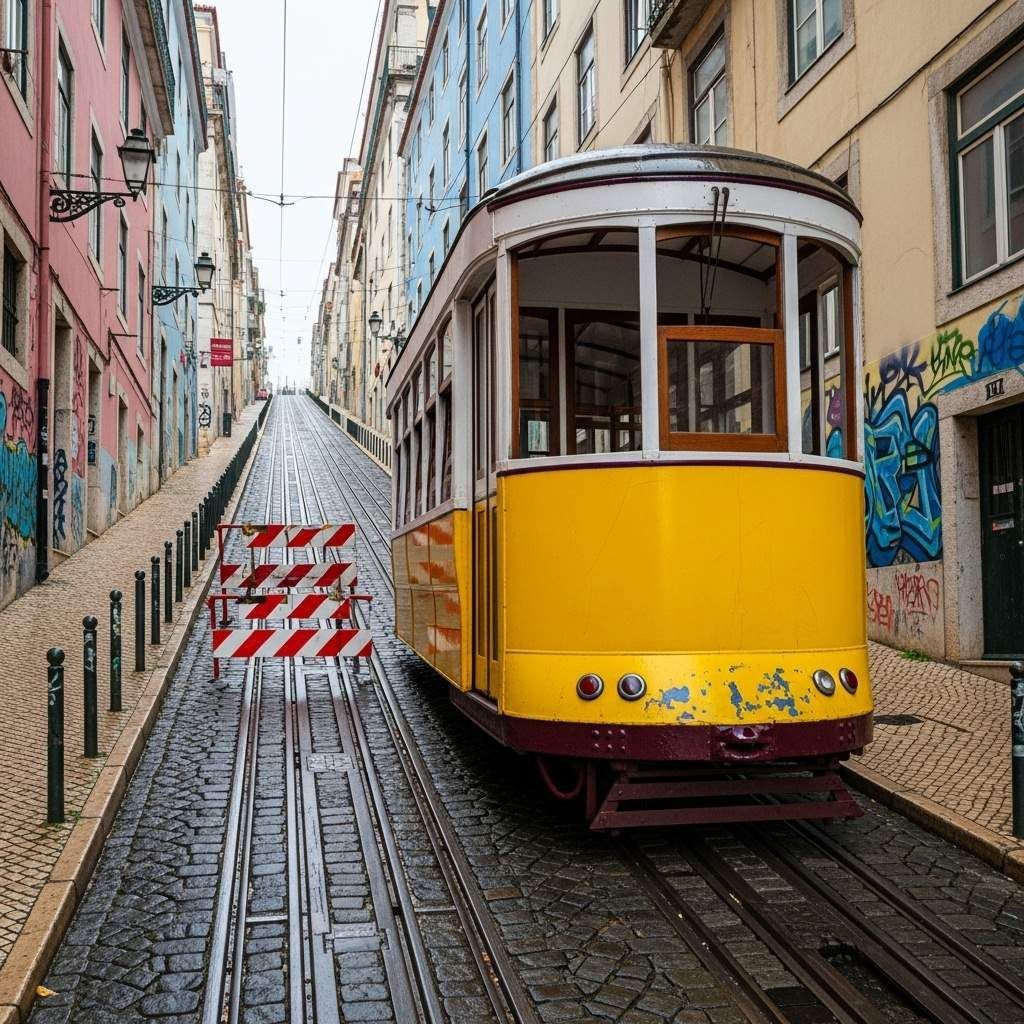
The Carris transport operator has confirmed plans to fully replace the historic funicular systems at both the Glória and Lavra elevators with modern, certified technology—a decision that abandons more than a century of mechanical heritage and could leave central Lisbon without these key transit links for several years.
Why This Matters
• No historic funiculars returning: The cable-and-counterweight systems that defined Glória and Lavra since the 19th century will be scrapped, not restored.
• Multi-year closure ahead: Carris President Rui Lopo stated the city will be "many years" without functioning elevators, with no firm reopening date announced.
• Compensation stalled: Only 2 out of 16 deceased victims' families have received full settlements as of March 2026, nearly six months after the September 2025 derailment that killed 16 and injured 24 (40 total victims with registered insurance claims). Over 20 additional people were also injured.
What Happened at the Meeting
The admission came during a three-and-a-half-hour briefing at Lisbon City Hall organized by the PSD/CDS-PP/IL governing coalition, attended by opposition councilors from PS, Livre, BE, PCP, and Chega. Carris management acknowledged internal procedural failures that directly or indirectly contributed to the Glória derailment on September 3, 2025—a catastrophic event that destroyed carriage No. 1 beyond repair and claimed lives from multiple nationalities.
Rui Lopo, who took the helm in January 2026, outlined the technical impossibility of reviving the original traction systems. The Glória carriage is unsalvageable, and both Glória and Lavra will require entirely new equipment certified under contemporary safety standards. This marks a definitive break from the pneumatic braking and human-intervention mechanisms that characterized the historic installations—systems that failed critically during the accident.
Curiously, Deputy Mayor Gonçalo Reis left the session after one hour as previously announced, meaning no senior political figure remained to field the inevitable policy questions raised by the technical disclosures, according to the Livre party statement.
The Engineering Dilemma
The Glória funicular, inaugurated in 1885 and electrified in 1915, operated using paired carriages linked by a traction cable moving in opposite directions—a design replicated at Lavra. Both relied on pneumatic brakes requiring operator intervention, a vulnerability exposed in the deadly derailment.
The Laboratório Nacional de Engenharia Civil (LNEC), the Ordem dos Engenheiros, and Instituto Superior Técnico (IST) form a technical mission tasked with designing replacement systems. However, no specifications have been disclosed, and the timeline remains open-ended. The challenge: current inspection protocols cannot adequately assess cable anchorages or reinforce carriage structures without radically altering their traditional appearance—a conflict between authenticity and certification that cities from Brussels to Barcelona have navigated with varying success.
In contrast, the Funicular da Bica (which had also been shuttered for precautionary inspections) quietly reopened in April 2026 after structural and operational checks cleared it for service, demonstrating that not all heritage traction systems are beyond salvation.
Compensation Gridlock
The Carris insurance carrier, Fidelidade, continues to process 38 outstanding claims from the 40 registered victims. As of March 2026, most cases remained "in different phases of regularization," with some families still submitting required documentation and injured survivors awaiting medical consolidation—the point at which permanent disability can be assessed and damages calculated.
One family has filed a civil suit demanding €1.05M and a public apology from Carris, Fidelidade, and Main (the private contractor responsible for maintenance). The Livre party criticized the municipality for delegating the entire indemnity process to the insurer, arguing this leaves claimants vulnerable to lowball negotiations. The party urged the Câmara Municipal de Lisboa (Lisbon City Council) to actively shepherd claims and guarantee fair, expedited settlements.
Deputy Mayor Reis defended the pace as "normal" given the legal and medical complexities, but the slow drip of payouts—only two families fully compensated by mid-2026—has fueled frustration among survivors and bereaved relatives.
Criminal Investigation Advances
In May 2026, eight months after the September 2025 accident, the Ministério Público (Portugal's public prosecutor's office) and Polícia Judiciária (PJ, Portugal's criminal investigation police) executed search warrants at the homes of Carris officials and Main employees. Investigators are examining potential charges of negligent homicide and safety-regulation violations, informed by a preliminary report that flagged multiple maintenance lapses, inadequate work supervision, and cable defects. Carris confirmed the raids and pledged full cooperation.
The Preservation Question
The Livre party insists that abandoning classified heritage elevators warrants "broad public debate," not unilateral technical fiat. Lisbon's funiculars are more than transit—they are living monuments woven into the city's topography and tourist identity.
European precedents offer instructive models. Some cities have explored compromises between heritage preservation and modern safety standards, creating pathways for historic systems to receive modernized components within preserved exteriors. Lisbon itself set a benchmark when heritage lift systems received modern upgrades while maintaining their historical character, proving that technological renewal need not erase historical identity. Yet the Carris plan for Glória and Lavra appears to chart a different course—complete replacement rather than adaptive retrofit.
Impact on Residents and Visitors
For residents of Bairro Alto, Graça, Príncipe Real, and adjacent hillside neighborhoods, the prolonged closure translates into steeper climbs and longer bus detours—potentially 15-20 extra minutes added to daily commutes for those currently relying on these elevators. Alternative transport includes the standard bus network (particularly routes 758 and 783 serving Bairro Alto, and routes 37 and 82 for Graça), but these operate on mixed traffic and experience frequent delays.
Tourists lose two of Lisbon's most iconic and most photographed experiences, with potential significant impact on local businesses—cafés, souvenir shops, and restaurants that depend on the steady foot traffic ferried uphill by these historic systems.
The prolonged closure may also pressure rental and property values in the immediately adjacent neighborhoods, though this has not yet been formally studied by municipal authorities. The question of temporary shuttle services or alternative infrastructure remains unanswered by Carris and city officials.
More broadly, the decision tests Lisbon's commitment to adaptive heritage management. Can a city justify scrapping century-old systems when peer capitals have demonstrated it is possible—though expensive and time-consuming—to thread modern safety through historic fabric?
The municipality has pledged to "preserve the historical and cultural heritage" the Glória represents, yet no design concepts have been published, and the "many years" timeline suggests the priority is regulatory compliance over aesthetic fidelity.
What Comes Next
Carris and the city council must eventually publish the technical mission's findings and a concrete implementation schedule. Opposition parties are demanding transparency, and the Livre statement signals that any radical redesign will face political resistance without proper public consultation.
In the meantime, the Bica funicular's successful return to service offers a sliver of optimism—proof that not every heritage lift is doomed. Whether Glória and Lavra can follow that path, or whether Lisbon's hillside transport map will be redrawn with 21st-century machinery, remains an open question hanging over the city's cobbled slopes.


