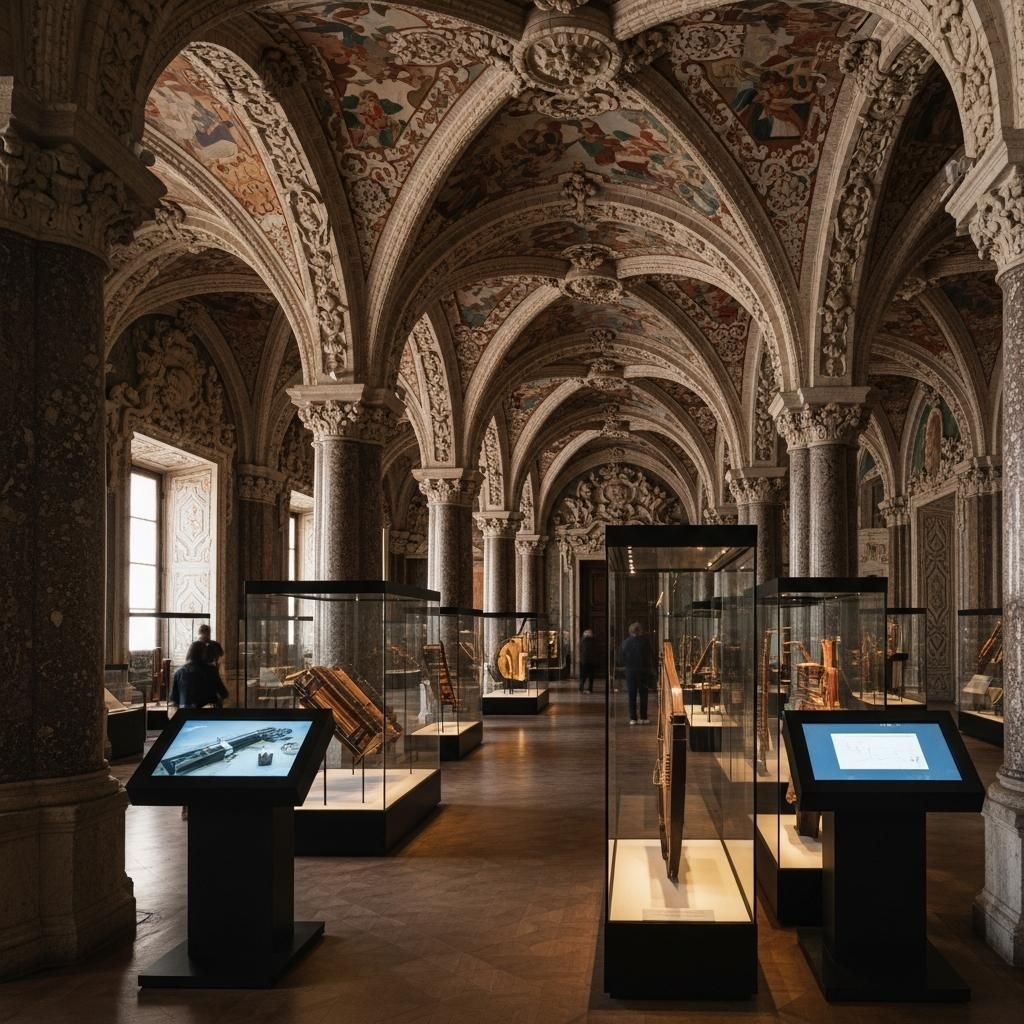

The Calouste Gulbenkian Museum in Lisbon swings open its renovated doors this weekend, concluding a 4-month transformation that revives the architectural vision conceived nearly six decades ago while integrating modern conservation technology. The reopening lands precisely on the 70th anniversary of the Gulbenkian Foundation, offering free admission through July 26 for anyone eager to experience what director Xavier F. Salomon describes as a carefully calibrated journey back to 1969.
Why This Matters
• Free access this weekend: The Portugal-based Gulbenkian Museum offers no-charge entry from Saturday, July 19, through July 26, with extended hours until midnight on Saturday and 8 PM Sunday.
• Architectural heritage restored: Original silk wall coverings, carpeting, and visual connections to the surrounding gardens have been reinstated after decades of alterations.
• Hidden collection revealed: Works stored in reserve for years—including Japanese prints, gold boxes, and a Venetian parasol—return to public view alongside a newly created numismatics gallery.
A Philosophy of Humility, Not Replication
Salomon, who took the helm in January after eight years as deputy director and chief curator at New York's Frick Collection, inherited the renovation midstream. His approach diverged from what he calls "philological restoration"—the museum did not become a time capsule. Instead, the intervention pursued equilibrium: honoring the collaborative genius of Portuguese architects Ruy Jervis d'Athouguia, Alberto Pessoa, and Pedro Cid, who worked alongside international specialists Georges-Henri Rivière and Franco Albini, while deploying anti-reflective glass, upgraded climate controls, and LED lighting calibrated to museum standards.
Architect Teresa Nunes da Ponte led the physical execution, relying on historical blueprints and archival photographs to guide decisions. The project team restored materials that defined the 1960s aesthetic—bronze, silk, wood, concrete, and glass—creating coherence between the building, the art it houses, and the garden designed by landscape architects António Viana Barreto and Gonçalo Ribeiro Telles.
The director champions the philosophy openly. "Returning to the past is an act of humility," Salomon told journalists during a preview tour. "Many solutions the original architects conceived were superior to changes introduced over the decades."
What Residents Will Notice First
Visitors entering the renovated galleries encounter immediate visual drama: the monumental Assyrian bas-relief from Nimrud now commands a central position in the Mesopotamian gallery. The alabaster sculpture, depicting a winged protective deity known as an apkallu and dating to the reign of Assurnasirpal II (884-859 BCE), underwent meticulous conservation to remove decades of accumulated wax layers that obscured the stone's surface detail.
"This piece welcomes visitors," Salomon explains, emphasizing its symbolic function as a cultural threshold.
The new numismatics room, carved from a previously hidden work cabinet, displays an expanded selection of Greek and Roman coins and medals, including the quadriga coin that inspired the foundation's logo. Meanwhile, the mosque lamps gallery—holding 13th- and 14th-century specimens considered among the rarest collections globally—shifted from grouped presentation back to individual vitrines with anti-reflective glass, a format abandoned more than two decades ago. Salomon describes the space as possessing a "magical atmosphere" after the intervention.
The Lalique Exception and the Carpet Controversy
The Lalique Room represents the lone departure from the 1969 blueprint. Rather than reproduce the original layout, curators introduced paintings by Edward Burne-Jones and John Singer Sargent to contextualize the jewelry and glasswork of French artisan René Lalique (1860-1945) within the broader artistic currents of his era. The room houses the largest Lalique collection assembled outside France, built through nearly five decades of friendship between the craftsman and Calouste Sarkis Gulbenkian (1869-1955), the Armenian diplomat and entrepreneur whose passion for art drove him to amass more than 6,000 pieces spanning Egyptian, Greco-Roman, Islamic, and Far Eastern civilizations, plus European paintings and decorative arts.
Gulbenkian settled in Lisbon during World War II and directed in his will that his fortune fund a foundation to benefit humanity. That mandate gave birth to the institution celebrating its 70th year.
The most contentious decision—one Salomon owns entirely—involved reinstalling carpet in the European galleries, removed in the early 2000s. "It's an enormous asset for the museum," he states plainly. "People will disagree with me, but that's fine."
Reconnecting Architecture and Nature
The renovation restored visual dialogue between interior galleries and the surrounding Gulbenkian Garden. Opaque walls gave way to filtered screens and wooden-metal partitions, allowing glimpses of masterworks by Rembrandt and Rubens from transition zones between Asian and European collections. Natural light penetrates more deeply through restored grilles, balanced by conservation requirements that prevent UV damage.
In the museum's largest gallery, where Persian, Indian, and Caucasian ceramics and carpets coexist, Salomon points out a subtle historical echo: an Indian carpet woven with figures of 17th-century Portuguese navigators, a nod to the seafaring legacy that once connected Lisbon to distant trade routes. The Gulbenkian Collection itself contains no Portuguese works, making these embroidered sailors an intriguing artifact of cross-cultural exchange.
The architectural renovation philosophy extended beyond aesthetics. Salomon notes that the building itself qualifies as a 1969 architectural masterpiece, deserving preservation equal to the art it contains.
Impact on Portugal's Cultural Landscape
For Portuguese residents and international visitors alike, the reopened museum offers elevated viewing conditions alongside historical continuity. The intervention positions the Gulbenkian among institutions globally navigating the tension between heritage conservation and technological modernization—a balancing act observable at the California Academy of Sciences with its 10,000-square-meter green roof insulation system, or Rio de Janeiro's Museum of Tomorrow, which reconciles high energy demands with environmental responsibility.
The Portugal-based foundation faced a deadline challenge: completing the work to coincide with the 70th anniversary celebrations, which include a commemorative concert by the Gulbenkian Choir and Orchestra on Saturday, plus the exhibition "Gulbenkian, 70 Years in Posters" in the Art Library Atrium, showcasing 70 posters produced between 1957 and 2026.
Salomon, honored in 2018 as Cavaliere dell'Ordine della Stella d'Italia by Italy's president for contributions to Italian artistic heritage, brings a resume built across London's British Museum and National Gallery, the Dulwich Picture Gallery, the Metropolitan Museum of Art, and the Frick Collection. His academic writing appears in The Burlington Magazine, Apollo, and Metropolitan Museum Journal, and he created the popular online series "Cocktails with a Curator."
When asked about upcoming temporary exhibitions, Salomon remains cryptic: "We're working on them. They'll be announced soon."
Visiting Details
The museum reopens Saturday, July 19, operating until midnight that evening and until 8 PM Sunday. Extended hours continue through July 26, after which standard hours resume: 10 AM to 6 PM, closed Tuesdays. Free admission applies for the first week.
The collection's breadth—from ancient Egyptian artifacts through European decorative arts to early 20th-century paintings—reflects Gulbenkian's eclectic connoisseurship. The renovation ensures those treasures sit within an environment that respects both their historical context and contemporary conservation science, a duality that defines the Lisbon museum's renewed identity as it enters its eighth decade.