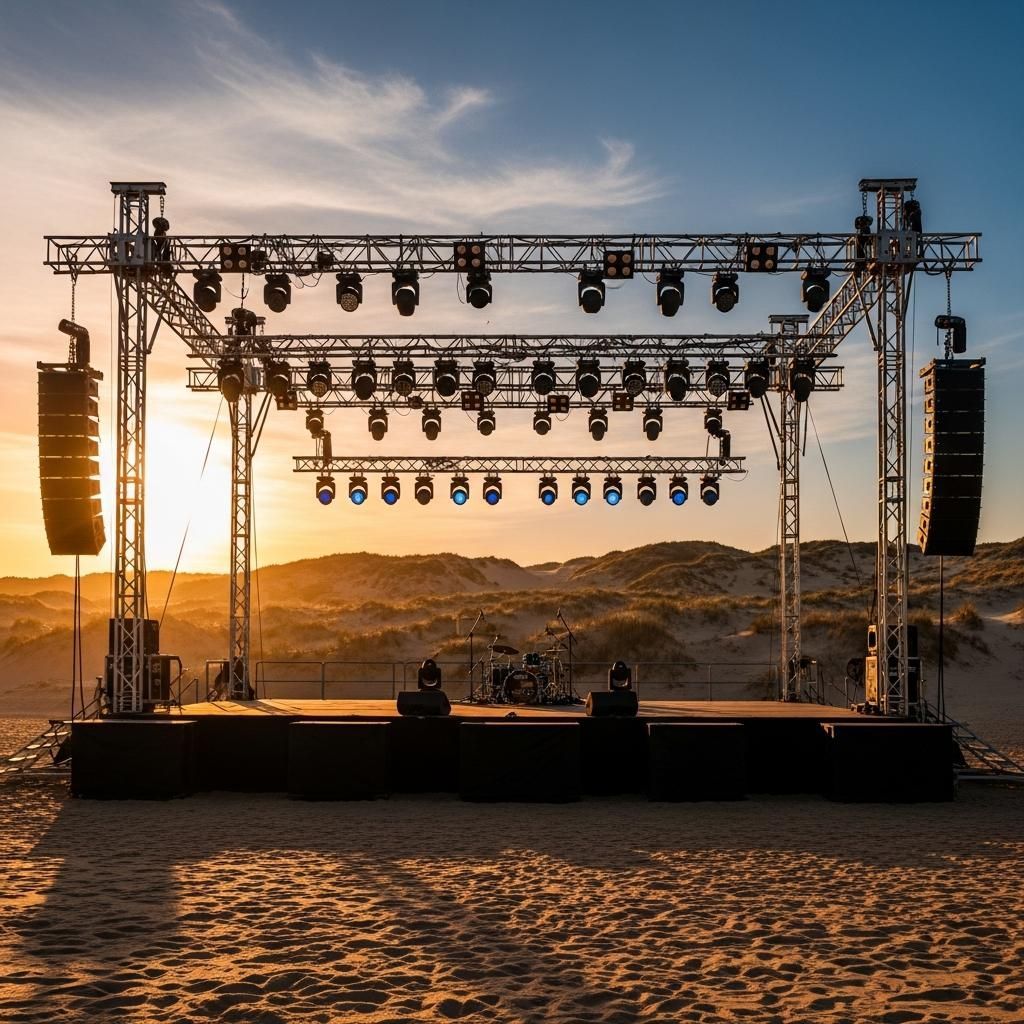
FIGUEIRA DA FOZ, July 17, 2026 — Sting arrived on Portugal's central coast for a rare oceanside performance that had been sold out since March, marking his first beach concert in Europe and his return to Portuguese soil after nearly a decade of absence. The Praia do Relógio in Figueira da Foz hosted roughly 25,000 spectators—predominantly affluent listeners over 45—for a minimalist yet emotionally expansive evening from the 74-year-old musician and his two-piece ensemble.
Practical Information for Attendees
Venue gates opened at 18:00, with the opening act Dea Matrona taking stage at 19:30. The main performance commenced at 21:00.
Parking and Transportation: The Municipal Council designated over 20 parking locations across the city and Buarcos, with provisions for campervan parking and accessible spaces. A pragmatic alternative: leave vehicles at the southern Mondego River bank in Cabedelo and board the electric ferry service that crosses to the city center, effectively bypassing vehicle congestion.
Payment Methods: All purchases required MB WAY payments or prepaid card exchanges at venue entry—cash transactions were not accepted inside. Attendees holding physical currency could exchange it for prepaid cards at designated kiosks.
Prohibited Items: Alcohol, glass containers, oversized bags (exceeding A4 dimensions), drones, bicycles, professional recording equipment, umbrellas, and animals except certified service dogs. Food and water were barred unless accompanied by medical documentation.
Road Closures: The Figueira da Foz Municipal Authority closed major thoroughfares (Avenida de Espanha and Avenida 25 de Abril) and activated more than 20 parking zones across the city and neighboring settlements.
Why This Matters
• A once-in-a-generation venue event: This represented only the third documented beach performance of Sting's entire career, positioning the evening as historically significant for both the artist and Portugal's live entertainment sector.
• Infrastructure pressure test: The logistical coordination demonstrated the city's capacity to manage complex outdoor events; parking, traffic flow, and cashless operations proved essential to the experience.
• Human rights activism embedded: Amnesty International staff collected signatures for the "Protege a Liberdade" campaign during the show, continuing a decades-long partnership between the organization and Sting.
The Minimalist Format: Why Three Musicians Stripped Everything Down
The architecture underlying the evening's performance revealed a deliberate artistic choice. Rather than touring with a full band, orchestral arrangements, or backing vocalists, Sting opted for what he termed the "Sting 3.0" format: himself on bass and lead vocals, Dominic Miller on guitar (their collaboration spanning multiple decades), and Chris Maas, the Luxembourg-based drummer previously active in live contexts with Mumford & Sons.
The 105-minute runtime drew from approximately 20 tracks spanning his 41-year solo career plus his years fronting The Police. This reductive approach emerged during tour residencies in Paris (February-March) and Brisbane (April-May), where critics and audiences alike responded enthusiastically to the stripped-back arrangements. At the BeachLife Festival in California in May, reviews highlighted how Sting's voice remained "as commanding as ever," while his guitar partner's work delivered what observers called "elegant reinvention" of familiar material. Even at the Beach Festival Nieuwpoort in Belgium weeks later, where some felt certain vocal passages "lacked their characteristic soul," the trio format still demonstrated how removing layers could expose compositional bones audiences rarely hear in studio versions.
The performance opened with "Message in a Bottle" and typically concluded with selections emphasizing emotional arc rather than chronological sequencing, with "Fragile" from his 1987 solo album Nothing Like The Sun traditionally closing proceedings.
The opening act, the Irish alternative-rock duo Dea Matrona, performed at 19:30. Orláith Forsythe and Mollie McGinn founded the band in Belfast in 2018; their name translates from Celtic mythology as "Divine Mother Goddess"—a symbolic choice that aligns with Sting's own engagement with mythological and activist themes.
Oceanside Performances: A Rarity in His Catalog
Beach concerts remain exceptional anomalies in Sting's discography. Prior to 2024, only one documented oceanside show existed: a private garden event in Narragansett, Rhode Island, in August 2006 that evolved into an unintended semi-public gathering when hundreds occupied the shoreline and nearby boats.
The 2024 shift saw two distinct beach settings materialize before this July 2026 performance. At Redondo Beach, California, audiences spanning multiple generations—from Gen X through Gen Z, with attendees traveling from Canada—described the atmosphere as "unforgettable." Critics emphasized Sting's vocal resilience and praised the setlist as a "seamless blend of essential hits and deeper album cuts." The North Sea venue in Belgium weeks later generated similar enthusiasm, though some observers noted the absence of signature piano and saxophone arrangements created both interpretive strengths and subtle losses. As one critic noted, Dominic Miller's interpretive guitar work achieved "sophisticated recasting," yet occasional deliveries seemed to be "searching for emotional foundation."
This Figueira da Foz performance entered that continuing conversation about what happens when a global rock figure removes technological scaffolding and confronts an audience across minimal distance.
Visitor Spending and Local Economic Activity
The Figueira da Foz Town Council authorized continuous restaurant and bar operations from 09:00 on July 17 through 06:00 on July 19, waiving standard permitting procedures while maintaining compliance with labor protections and noise regulations. This administrative flexibility acknowledged that hospitality capacity required temporary expansion.
Economic data from comparable large-scale outdoor performances in Portugal provided useful context. Non-resident spectators at similar events—comprising more than half of total attendance—spent approximately €24 on transportation, €22.50 on meals, and €62.60 per night on accommodation, with average stays spanning 2.38 nights. With the sold-out 25,000 capacity and the demographic profile (affluent, over 45, discretionary income available), hotels, guesthouses, restaurants, and transport services across the region anticipated measurable financial activity. Tiago Castelo Branco, executive director of MOT (Memories of Tomorrow), the concert co-promoter alongside Live Nation, emphasized that the Sting audience generates "above-typical per-person revenue" compared to younger festival demographics.
The RFM Somnii festival, also held at Praia do Relógio, previously validated the venue's operational scalability. Castelo Branco noted that such events strengthen the city's competitive positioning among touring promoters, positioning Figueira da Foz as a viable alternative to Lisbon and Porto for international artists seeking mid-sized venues with reliable logistics.
The Activism Component: Decades of Partnership
Amnesty International maintained an on-site presence throughout the "Sting 3.0" tour, gathering signatures for its "Protege a Liberdade" campaign. This collaboration extends deep into historical context. In 1986, Sting headlined the "A Conspiracy of Hope" tour, marking Amnesty International's 25th anniversary. Two years later, he anchored "Human Rights Now!"—commemorating 40 years of the Universal Declaration of Human Rights—alongside Bruce Springsteen, Peter Gabriel, Tracy Chapman, and Youssou N'Dour. Contemporary campaigns have addressed the imprisonment of Russia's punk collective Pussy Riot and forced disappearances across Mexico.
For Sting, activism functions not as supplementary gesture but as fundamental component of artistic identity. His touring infrastructure consistently incorporates human rights platforms, transforming concert spaces into temporary venues for civic mobilization and petition collection.
Portugal's Expanding Role in International Entertainment
The Sting concert intersected with Portugal's expanding footprint in global entertainment markets. The evening demonstrated that mid-sized Atlantic coastal municipalities like Figueira da Foz possess the operational capacity to attract globally recognized headliners, manage complex logistics, and generate meaningful tourism revenue. The sold-out status validated the region's growing competitive positioning for international touring acts seeking alternatives to Lisbon and Porto.