

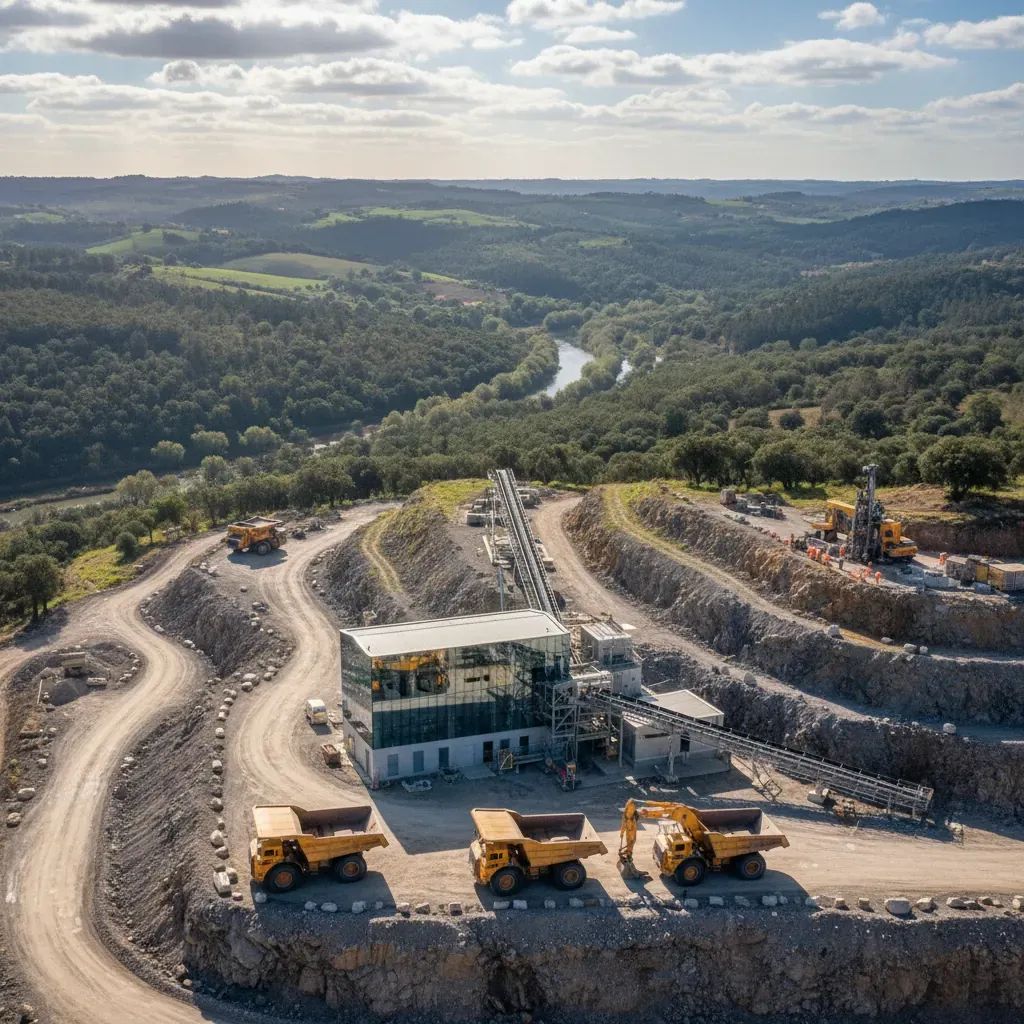
The Portugal Ministry of Environment and Energy has cleared the way for Savannah Resources to resume geotechnical drilling at its lithium site in northern Portugal, ending a 20-day legal standoff that exposed deep fractures between Brussels's energy ambitions and rural communities protecting ancestral lands.
Why This Matters
• Work resumes: Drilling recommences around late June 2026 after a provisional court order from the Administrative and Tax Court of Mirandela halted operations on June 9.
• Timeline intact: The company plans full construction by 2027, targeting first lithium output in 2028.
• €110M in state support: The Portuguese government has locked in substantial development funding approved in January 2026.
• Precedent set: Invoking "strategic national interest" to override local court challenges may reshape how mineral conflicts play out across Portugal and the EU.
The Conflict at Its Core
The Barroso lithium deposit sits beneath one of Europe's most culturally significant landscapes. For centuries, the residents of Covas do Barroso have managed their collectively owned lands—known as baldios—through participatory systems that predate modern democracy. In 2005, the United Nations Food and Agriculture Organization (FAO) recognized this entire region as a Globally Important Agricultural Heritage System (GIAHS), placing it in the same category as Japan's traditional terrace farms and the Moroccan palm groves. That designation was not ceremonial: it reflected millennia of ecological stewardship and a way of life rooted in the landscape itself.
When Savannah Resources, a British mining company, began prospecting for lithium here, it collided head-on with this reality. The deposit—39 million metric tons of spodumene ore, Europe's largest—became a linchpin in Brussels' strategy to reduce dependence on Chinese and Australian lithium supplies. In March 2025, the European Commission designated the Barroso project as "Strategic" under the Critical Raw Materials Regulation, fast-tracking approvals and unlocking EU financial support.
For the Portugal government, the decision was straightforward: economic development, rural employment, and energy security trumped local objections. Yet for the Assembly of Commoners of the Baldios de Covas do Barroso—the legal custodian of communal lands—the project represented an existential threat. When Savannah Resources began accessing private and communal parcels for drilling without formal easement agreements, the Assembly filed an emergency court order on June 9, halting work.
The suspension lasted three weeks. Then the Ministry of Environment issued a "Reasoned Resolution" reaffirming the project's public utility, allowing the company to resume operations by late June. The legal maneuver sidestepped the court challenge by elevating the case from a contractual dispute over land access to a question of "national strategic interest"—a jurisdiction the courts could not easily overturn.
Who Pays the Price
The opposition in Covas do Barroso extends far beyond the Assembly of Commoners. The Boticas Municipal Assembly recently passed a formal motion demanding immediate project suspension. Environmental organizations, including Quercus, have filed complaints with UNESCO alleging threats to the region's heritage designation. Residents cite a cascade of specific harms:
Hydrological risk tops the list. Independent hydrological studies warn that the open-pit mine and its processing facilities could intercept water flows from the Rio Covas, a critical source for drinking water and agricultural irrigation. The region already experiences seasonal water stress; a mining operation consuming millions of cubic meters annually could render existing wells and springs unreliable.
The tailings dam compounds the concern. Savannah Resources plans a 193-meter structure to store waste rock and mineral processing refuse—millions of tons of material. Environmental assessments describe the design as "highly experimental," raising questions about long-term stability in a mountainous terrain prone to heavy rainfall and seismic activity.
Biodiversity loss is equally pressing. The region harbors protected species including the Iberian wolf, the Macromia splendens dragonfly, and the critically endangered Margaritifera margaritifera freshwater pearl mussel. Deforestation incidents already documented outside the permitted season have triggered wildlife protection concerns.
Soil and landscape degradation represents the most irreversible impact. The proposed open-pit mine would transform agricultural terrain into industrial infrastructure. Local advocates argue the Environmental Impact Assessment (EIA), approved by the Portuguese Environment Agency (APA) in May 2023, systematically underestimated these "very significant and irreversible" consequences. The Covas do Barroso Parish Council has demanded the EIA be annulled.
The Legal Machinery and Its Limits
The government's pathway to resumption exploited an administrative tool: temporary easements allowing Savannah Resources to occupy land for geotechnical work. In May 2026, authorities declared 24 parcels subject to these easements, valid for one year. Landowners receive compensation, but the decision was top-down, bypassing community consent.
A subsequent easement expanded the company's footprint to roughly 217 hectares of communal land. Critically, 102.2 hectares fall outside the official concession boundary, designated for drilling platforms and exploratory wells. The Assembly of Commoners views this as disproportionate overreach—using "strategic interest" rhetoric to bypass judicial review.
The precedent troubles advocates across Portugal. If a ministry can simply declare a resource project "strategically important" and sidestep court orders, the practical force of community decision-making erodes. The baldios system, which has survived centuries by requiring collective agreement on land use, becomes ornamental.
Adding to local distrust: Savannah Resources has filed strategic lawsuits against public participation (SLAPPs) targeting civic activists, including the president of a local opposition association. The intimidation tactic deepened resentment and signaled to residents that corporate power, backed by government resolve, outweighed grassroots resistance.
What This Signals for Portugal and Europe
The resumption at Barroso is not merely a local skirmish. It crystallizes a pattern emerging across the EU. Governments, facing pressure to secure critical minerals for the green energy transition, are increasingly willing to override environmental and social safeguards. The European Court of Auditors has already flagged concerns: some projects on the Strategic list received expert opinions advising against approval before being fast-tracked anyway.
In Serbia, mass protests halted a planned lithium mine in the Jadar Valley. In France, proposed lithium operations in Allier have divided communities and triggered environmental alarm. Portugal's approach—using administrative decrees to neutralize court orders—suggests a willingness to move faster than peers, potentially setting a template for other mineral conflicts in the Iberian interior.
For investors, the signal is reassuring: the Portugal government will defend large-scale projects aligned with EU priorities, even against sustained local opposition. The €110M subsidy and Strategic designation provide institutional backing. But reputational risk remains substantial. UNESCO complaints, ongoing legal challenges, and environmental monitoring by civil society groups will intensify scrutiny.
For residents in the region and those living in similar rural areas across Portugal where lithium exploration licenses have proliferated since 2020, the message is starker: traditional community governance and environmental precaution may not survive when Brussels defines what constitutes "strategic national interest."
The geotechnical drills have resumed. The political and legal battle is far from over, but the momentum now favors the mine.


