

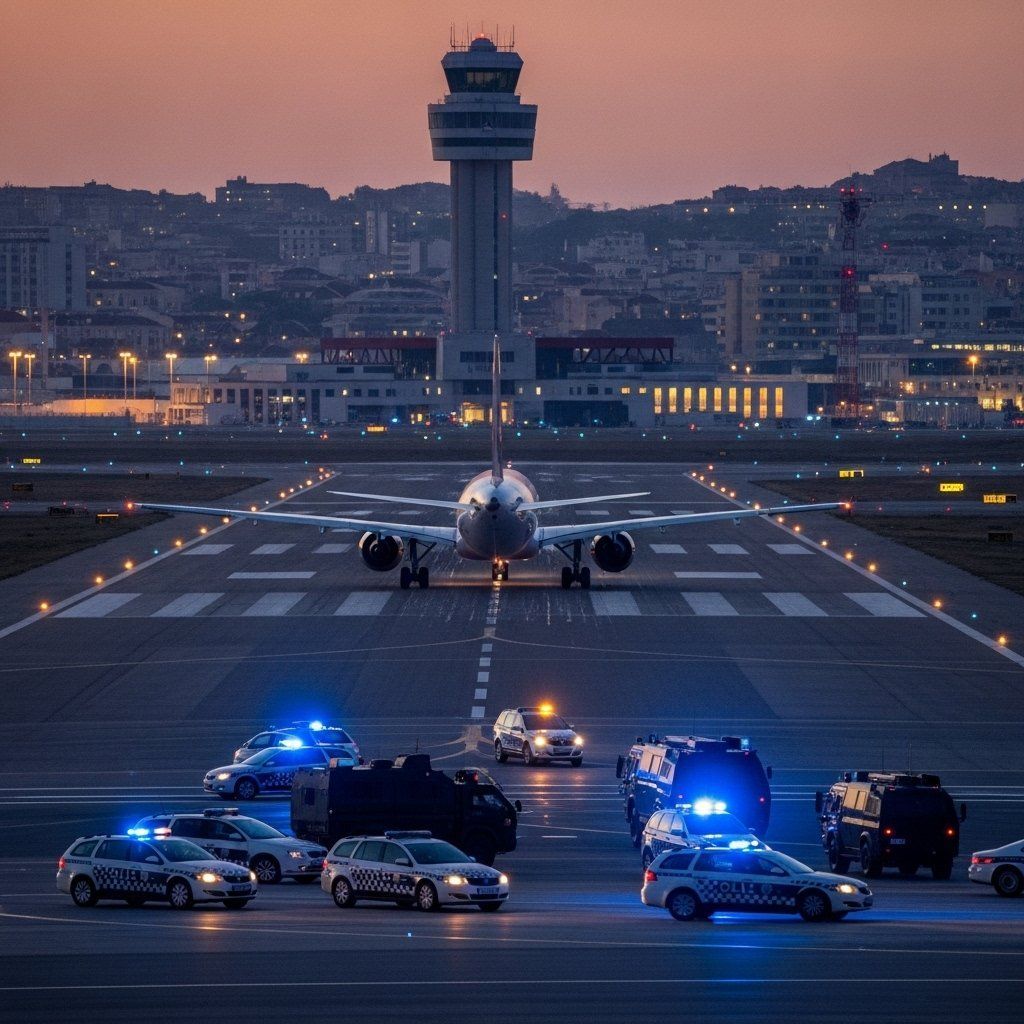
A 16-year-old passenger aboard a transatlantic United Airlines flight triggered a full-scale security emergency on Saturday, May 30, 2026, by naming his Fitbit wearable "BOMB," forcing the aircraft to reverse course over the Atlantic and return to Newark Liberty International Airport. The incident underscores growing aviation security challenges posed by poorly considered device naming conventions—and serves as a reminder for travelers worldwide that even seemingly harmless digital habits can cascade into federal investigations and massive flight disruptions.
Why This Matters
• Travel disruption: 190 passengers and 12 crew aboard flight UA236 faced a 9.5-hour delay after the Boeing 767 was forced to turn around mid-flight.
• FBI investigation: The teenager is under federal scrutiny, though no local charges have been filed as of publication.
• Security precedent: Aviation authorities are treating device naming as a legitimate threat vector, potentially reshaping how passengers configure electronics before boarding.
• Universal relevance: The incident highlights security protocols that apply to all commercial aviation, regardless of departure airport or carrier.
How the Incident Unfolded
The United Airlines Boeing 767 departed Newark at 6:00 PM local time bound for Palma de Mallorca. Roughly midway through the journey, a passenger scanning available Bluetooth devices noticed an alarming label: "BOMB." The individual alerted cabin crew, who immediately began broadcasting repeated requests for all passengers to disable their Bluetooth connections.
Despite multiple announcements, two devices remained active and visible on nearby phones. Unable to confirm the source or intent, and in consultation with the airline's Chicago headquarters, the flight crew made the decision to abort the transatlantic crossing and return to Newark.
The aircraft touched down at 9:34 PM, three hours after departure. What followed was a textbook emergency response: the plane was evacuated, K9 explosive detection units swept the cabin, and all 190 passengers were subjected to secondary screening by both the Transportation Security Administration (TSA) and Customs and Border Protection (CBP)—a process that extended well into the early morning hours.
Investigators eventually traced the offending signal to a Fitbit fitness tracker belonging to a teenage boy traveling on the flight. The device had been casually named "BOMB" at some earlier point, likely without consideration for the context in which it might be discovered.
International Aviation Security Standards
Commercial aviation operates under strict security protocols established by the International Civil Aviation Organization (ICAO) and enforced by regional authorities including the European Union Aviation Safety Agency (EASA) in Europe. These protocols require that any communication or signal that could be interpreted as indicating danger must be treated as a credible threat until definitively ruled out.
The EASA Part-IS regulations, which took effect earlier this year, now require airlines to maintain robust information security management systems that account for digital risks to flight safety. While these rules primarily target cyberattacks and data breaches, the Fitbit incident illustrates how low-level consumer technology can still precipitate major security responses.
For travelers boarding flights from any major airport—including Portuguese hubs like Lisbon Portela, Porto Francisco Sá Carneiro, or Faro—these security standards apply equally. All Bluetooth-enabled devices are visible to nearby passengers and crew when left in discoverable mode, and even a poorly chosen device name can trigger emergency protocols.
The FBI Investigation and Legal Status
As of publication, no charges have been filed against the teenager by local New Jersey authorities, and the Federal Bureau of Investigation inquiry appears to be standard protocol for international flight security incidents. Legal experts note that given the teenager's age and apparent lack of malicious intent, criminal prosecution remains uncertain.
Federal law does permit prosecution for making false bomb threats or interfering with flight crews, both of which carry substantial penalties. However, charges would likely be handled through juvenile channels if pursued at all.
United Airlines has declined to comment on whether the passenger or their family will be banned from future travel, but industry practice typically involves at minimum a temporary suspension pending the outcome of the investigation.
The financial toll is considerable. The aborted flight required a replacement crew and aircraft, accommodation for stranded passengers in Newark, and the deployment of extensive security resources. Similar incidents in the past have cost carriers upwards of €150,000 when factoring in fuel, staffing, and logistical expenses.
Broader Context: A Month of United Airlines Disruptions
This episode was the second major security incident involving United Airlines in a single week. Just one day earlier, on Friday, May 29, a 75-year-old passenger aboard a Chicago-to-Minneapolis flight suffered what authorities described as a "mental health episode" and repeatedly attempted to breach the cockpit door. That aircraft was diverted to Wisconsin, where the man was restrained by crew and taken into custody upon landing.
The clustering of incidents has drawn scrutiny from both regulators and passenger advocacy groups, though there is no indication the events are connected beyond coincidence. Aviation security specialists point out that rising passenger volumes post-pandemic have corresponded with an uptick in disruptive behavior and unintended security triggers.
The Bluetooth Blind Spot
While aviation regulators have long focused on physical threats and cyber intrusions targeting aircraft systems, the role of passenger-owned devices as inadvertent security triggers has received less attention. Bluetooth operates on the 2.4 GHz frequency band, far removed from the 100-130 MHz range used by aeronautical communications, meaning there is minimal risk of technical interference with flight systems.
However, the psychological and procedural impact of a threatening device name is another matter entirely. Any label visible to passengers or crew that suggests danger will be reported and investigated. The regulatory response is not optional—it is mandatory under international aviation security law.
Practical Advice for Device-Carrying Travelers
Whether boarding in Newark, Lisbon, Madrid, or anywhere else in the world, travelers should take a moment to review how their personal electronics are configured before heading to the airport. Here are key steps recommended by aviation security experts:
• Rename devices neutrally: Avoid humor, slang, or provocative labels. Stick to generic identifiers like "João's iPhone" or "Smartwatch."
• Disable Bluetooth discoverability: Most devices allow you to turn off the broadcast that makes them visible to strangers while still maintaining active connections to paired accessories like headphones.
• Use airplane mode early: Activating airplane mode before boarding not only complies with airline policy but also prevents inadvertent discovery of your device name during boarding and taxiing.
• Educate younger travelers: Teenagers and children may not fully appreciate the security implications of device naming. A brief conversation before departure can prevent serious consequences.
The Cost of a Joke
The incident serves as a cautionary tale about the collision between digital informality and analog security. What might seem like a harmless prank or an edgy username in everyday life takes on entirely different meaning at 35,000 feet, where crew and passengers are primed to detect and report anything anomalous.
For the 190 passengers who spent an unplanned night in Newark and arrived in Mallorca nearly 10 hours late, the cost was measured in missed hotel reservations, disrupted vacation plans, and hours of stress. For the teenage passenger at the center of the investigation, the consequences may include a federal record, a temporary or permanent airline ban, and the financial burden of potential civil suits.
As aviation continues to evolve with increasing passenger volumes and heightened security awareness, incidents like this serve as reminders that device names are not private, and they are not a joke. The rules apply uniformly across all commercial aviation: whether you're boarding in Newark, Lisbon, or Porto, the same security protocols govern your safety and the safety of everyone aboard.
The FBI investigation remains ongoing, with further announcements regarding the case expected in the coming weeks.


