

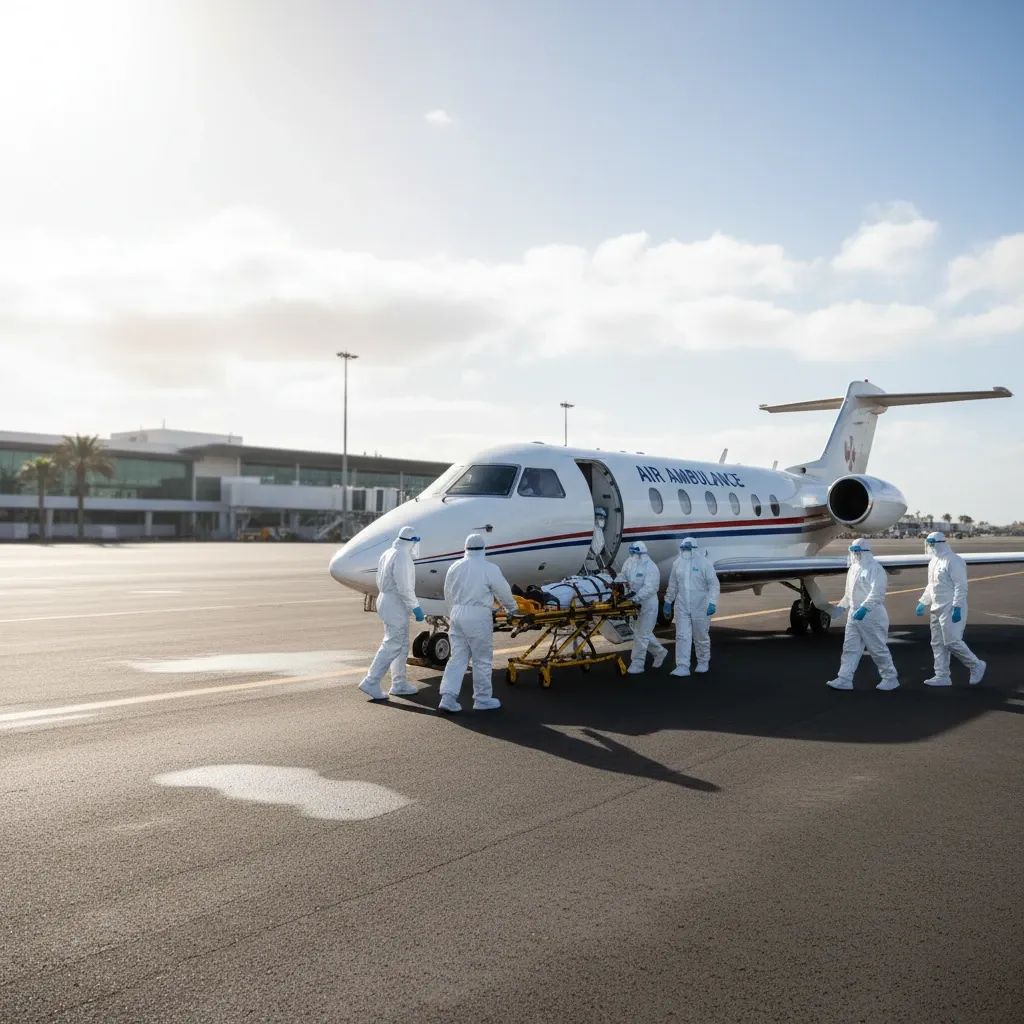
Health authorities in Spain are managing a complex medical evacuation unfolding in the Canary Islands, where an air ambulance transporting hantavirus patients experienced a critical equipment failure during transport logistics. The incident underscores the challenges of cross-border medical transport amid a rare viral outbreak aboard a cruise ship that departed Argentina in April.
Why This Matters for Portugal Residents
The MV Hondius case has direct relevance to people living in Portugal and travelers heading to the Canary Islands or South American cruise destinations. Spain's proximity, shared European health coordination systems, and common travel routes mean Portuguese residents and expatriates should understand the situation, quarantine protocols, and travel implications. Portuguese authorities are coordinating with Spanish counterparts through EU health channels, ensuring consistent information and response strategies.
The Core Situation
• Equipment complications: An air ambulance transferring infected patients experienced an electrical failure in life-support systems at Gran Canaria airport, requiring a backup aircraft deployment.
• Quarantine protocols: Over 140 passengers from 23 nations are awaiting repatriation from the MV Hondius cruise liner, expected to dock in Tenerife on 10 May.
• Transmission risk: The strain detected is Andes hantavirus, the only human-to-human transmissible variant, raising concern for close contacts and evacuation crews.
Technical Complications During Transfer
When the air ambulance touched down at Gran Canaria International Airport on 9 May, the onboard physician identified a malfunction in the electrical support system sustaining one of two patients being transferred from Cape Verde to the Netherlands. Spain's Ministry of Health confirmed the individual remained inside the aircraft, connected to airport ground power, while a replacement medical plane was dispatched from Amsterdam.
Canary Islands officials permitted the unscheduled technical stop under strict conditions: no one could enter or exit the aircraft. The restriction reflects heightened protocols around the Andes hantavirus, which killed three people aboard the MV Hondius and has generated five suspected cases and two laboratory-confirmed infections so far, according to the World Health Organization (WHO).
The stranded patient was eventually transferred to a substitute air ambulance that completed the journey to Amsterdam. The original aircraft continued to the Netherlands via a refueling stop in Valencia, illustrating the complex logistical coordination required for emergency medical transport involving infectious patients.
The Cruise Ship Situation: From Argentina to Quarantine
The MV Hondius departed Argentina in early April with 147 people aboard, on a scientific expedition that became a public health concern. The vessel spent days in quarantine off Cape Verde after crew members exhibited symptoms consistent with acute respiratory syndrome. Three passengers died before the ship could secure permission to dock in Praia on 7 May.
Two air ambulances lifted off from Nelson Mandela International Airport in Cape Verde around 11:00 local time (13:00 Lisbon time) on 9 May, carrying two symptomatic crew members and one asymptomatic individual who shared a cabin with the third fatality. All three are now en route to Dutch medical facilities for further evaluation.
The cruise liner itself left Cape Verde, heading for Tenerife in the Canary Islands, where it is scheduled to arrive in the early hours of 10 May. Spanish authorities have activated the EU Civil Protection Mechanism to coordinate a mass disembarkation and repatriation operation involving the WHO, the European Centre for Disease Prevention and Control (ECDC), and national governments representing the 23 nationalities on board.
What This Means for Residents and Travelers
No local contact: Spain's Interior Minister Fernando Grande-Marlaska emphasized that all transfers will occur without interaction with the general population of the Canary Islands. Passengers will be moved directly from the port to dedicated aircraft via segregated routes.
Medical screening: Everyone aboard will undergo fresh health assessments upon arrival. Those displaying no symptoms will be repatriated immediately; anyone requiring care will be hospitalized under isolation protocols.
Portuguese nationals and residents: Citizens of Portugal on the vessel face the same protocols as other European nationals. Portugal's Ministry of Health is coordinating with Spanish authorities through established EU channels to ensure Portuguese residents receive appropriate repatriation support and quarantine placement, potentially at designated facilities in Portugal if necessary. Portuguese health authorities recommend that residents planning travel to the Canary Islands or cruises from South American ports monitor official health guidance and ensure comprehensive travel insurance covering medical evacuation.
Spanish nationals: The 14 Spanish citizens on the MV Hondius will be flown by military aircraft to the Hospital Central de la Defensa Gómez Ulla in Madrid, where they face a quarantine period of up to 45 days—the maximum incubation window for hantavirus. During isolation, individuals occupy single rooms, submit to PCR tests on arrival and again after seven days, and record their temperature twice daily. The hospital's 22nd-floor High-Level Isolation Unit (Uatan) stands ready with seven beds if symptoms develop.
Treatment options: Confirmed cases receive the antiviral ribavirin for five consecutive days if detected early, though its efficacy against the cardiopulmonary syndrome variant of Andes hantavirus is less robust than against hemorrhagic fever strains. Spain's Ministry of Defense has ordered an immediate ramp-up in ribavirin production at the Military Pharmacy Centre to ensure adequate stockpiles.
Risk Assessment and Transmission Pathways
Health Minister Mónica García stated that all individuals currently aboard the cruise liner are asymptomatic, a reassuring sign given the 45-day incubation period. The WHO rates the risk to the broader European population as low, noting that Andes hantavirus requires close, prolonged contact for person-to-person spread—typically through respiratory droplets in confined settings.
The virus was first identified in a passenger transferred to a hospital in South Africa, where laboratory testing confirmed the Andes strain, endemic to parts of Argentina and Chile. Unlike most hantaviruses, which spread via rodent excreta, Andes hantavirus can pass between humans, making cabin-mates and close contacts particularly vulnerable.
Passengers who disembark in Tenerife will receive detailed instructions on self-monitoring and isolation for the following weeks. The United States is arranging a repatriation flight for 17 American passengers, while the United Kingdom will collect 22 British nationals. The Netherlands will serve as the fallback coordinator for individuals not covered by national or European flights.
International Coordination and Response
The WHO Director-General is expected to travel to the Canary Islands to oversee the evacuation, marking a rare field deployment for a viral outbreak aboard a commercial vessel. The ECDC has activated its EU Health Task Force and dispatched a specialist to the ship to investigate transmission dynamics and advise on infection control.
This is the first recorded hantavirus outbreak on a cruise ship, presenting novel challenges for containment. Lessons from terrestrial outbreaks in Argentina—where the Andes strain has caused sporadic clusters—are informing quarantine protocols, including the minimum 42-day observation period and the emphasis on early PCR testing.
Spain's civil protection apparatus has drawn on experience managing previous large-scale health repatriations, including the use of military aircraft, dedicated ground transport, and sealed transfer corridors. Health officials stress that no shortcuts will be taken in screening or isolation, even as diplomatic pressure mounts to expedite the return of stranded passengers.
Travel and Health Implications
For travelers and expatriates in Portugal and Spain, the episode serves as a reminder that remote expedition cruises—especially those departing from South America—carry health considerations in regions where zoonotic diseases remain endemic. The MV Hondius case highlights the importance of travel insurance that covers medical evacuation, given the potential for quarantine delays and multi-country coordination.
Portugal's Instituto Nacional de Saúde (INSA) is monitoring the situation and has issued guidance for residents with concerns. Anyone who has traveled on the MV Hondius or had contact with passengers should contact their healthcare provider and monitor for symptoms including fever, muscle aches, and respiratory symptoms appearing within 45 days of potential exposure.
Operational Lessons and Next Steps
The technical incident at Gran Canaria airport exposed challenges in long-haul medical evacuations that rely on intricate logistics and international cooperation. The reliance on airport ground power during the equipment failure prevented a potentially serious delay, but the episode underscores the complexity of air ambulance operations in cross-border health emergencies.
As the MV Hondius approaches Tenerife, Spanish authorities are finalizing a disembarkation plan that balances public health security with the logistical complexity of repatriating over 140 individuals to nearly two dozen countries. The outcome will set a precedent for future cruise ship outbreaks, particularly those involving pathogens with human-to-human transmission potential.


