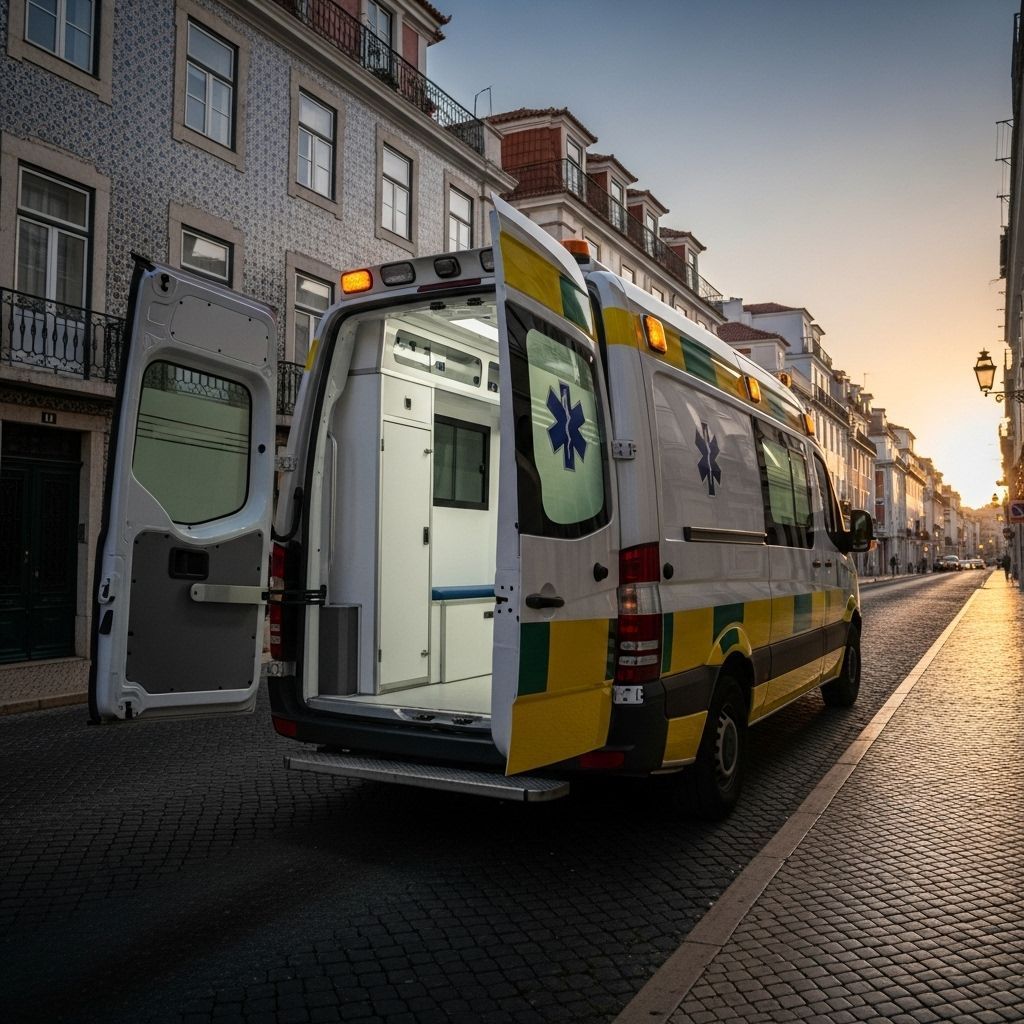
A 48-year-old epilepsy patient died in his home in Moita do Lobo, Ourém district, after emergency responders were sent to the wrong address, dispatched without critical equipment, and arrived nearly an hour after his father's distress call—a failure that exposes Portugal's ongoing crisis in pre-hospital care.
Why This Matters
• Systemic breakdown: A dispatch error, missing defibrillator, and inoperational backup unit all compounded in a single case.
• Nationwide fragility: Portugal recorded 1.66 M emergency calls in 2025, with chronic understaffing and equipment gaps persisting into 2026.
• Local vulnerability: Only 1 VMER (Viatura Médica de Emergência e Reanimação) serves the entire Santarém district—and on the day José Luís collapsed, it was offline.
A Cascade of Errors From the First Minute
Germano da Silva placed the emergency call at 17:54 on Sunday, May 10, after his son José Luís, who suffered from epilepsy, began complaining of dizziness. "Oh dad, it's nothing, just a little dizziness," José Luís reassured him. Within minutes, the man's condition deteriorated sharply.
Eleven minutes passed before the Centro de Orientação de Doentes Urgentes (CODU) dispatched the Bombeiros Voluntários de Santarém at 18:05—but the coordinates were wrong. Crews were sent to a hamlet 9 km from Almoster, accessible only by a narrow, difficult road, according to Commander Rui Carvalho. There is only one place called Moita do Lobo in the entire municipality, yet the system failed to identify it correctly.
By 18:13, the correct address arrived. At the same moment, the priority level jumped to maximum—code for cardiac arrest—requiring arrival within 8 minutes. Three minutes later, at 18:16, CODU confirmed José Luís was in cardiorespiratory arrest. Bombeiros immediately requested a VMER (Viatura Médica de Emergência e Reanimação), the specialized unit equipped with a doctor, advanced life support, and defibrillation capability.
None was available. Santarém's VMER was inoperational. The nearest alternative, based in Caldas da Rainha, was engaged on another call.
At 18:33, nearly 40 minutes after the original call, the ambulance crew radioed a final complication: they had no automatic external defibrillator onboard, because the priority had been upgraded mid-route and the vehicle had not been equipped for cardiac emergencies.
What This Means for Residents
The death of José Luís is not an isolated incident—it is a symptom of a pre-hospital infrastructure under sustained stress.
Portugal operates 44 VMERS across the mainland, with just 10 units covering the entire Centro region. Santarém's single VMER logged more than 2,100 missions in 2022 and maintains a 100% operability rate on paper. Yet when it is offline or occupied, backup options are scarce. The next-nearest unit is more than 40 km away in Caldas da Rainha.
According to Liga de Bombeiros Portugueses, CODU dispatch protocols now prioritize distance over local knowledge, a shift introduced in January 2026 alongside a new five-tier triage model. While designed to accelerate response times, critics argue the system is rigid and fails to account for terrain, road quality, or familiarity with rural addresses—exactly the factors that delayed help in Ourém.
Moreover, 379 shifts in the first half of 2024 were classified as "high-risk" due to understaffing at CODU call centers, particularly overnight and early morning. Though staffing improved after strikes in late 2024, the system remains fragile. In 2025 alone, more than 109,500 non-urgent calls were misrouted to the 112 emergency line—roughly 300 per day—clogging dispatch capacity.
A National Reckoning After Storm Kristin
The vulnerability of Portugal's emergency network became impossible to ignore after Tempestade Kristin in January 2026. The storm knocked out 40% of mobile towers in the Leiria region, crippling the Sistema Integrado de Redes de Emergência e Segurança de Portugal (SIRESP), the national emergency communications backbone.
The government responded with a €6 M emergency injection and a €26 M annual compensation package to keep SIRESP operational while a replacement is developed. But in May 2026, the Ministro da Administração Interna admitted the system's "debilities and fragilities" and conceded that a full overhaul is not feasible in the near term. The SIRESP S.A. public company, responsible for managing the network, has operated without executive leadership since March 2024.
One year after a nationwide blackout in April 2025, hospitals across Greater Lisbon still lack standardized backup generators, and some rural health centers have none at all. There is no national strategy for hardening critical infrastructure against power failures.
The Human Cost of Dispatch Failures
Germano da Silva told CNN Portugal that if responders had arrived on time, his son would likely have survived. "If they had shown up, they would have saved him," he said.
Emergency medicine specialists stress that survival from cardiac arrest drops by 7–10% for every minute without defibrillation. In José Luís's case, nearly 50 minutes elapsed between the call and the arrival of an ambulance without the equipment needed to restart his heart.
Portugal's Instituto Nacional de Emergência Médica (INEM) has pledged to embed hospital physicians in CODU centers to improve triage and dispatch accuracy, positioning the centers as the "brain" of emergency response. However, recruitment has been slow, and the structural challenges—aging equipment, geographic dispersion, volunteer shortages—remain unresolved.
What Comes Next
The Bombeiros Voluntários de Santarém are conducting an internal review of the May 10 incident. INEM has not yet announced whether a formal audit will follow, though a similar case in Seixal in January 2026—where a patient died after prolonged ambulance delays—triggered an investigation.
Advocacy groups, including the Liga de Bombeiros, are calling for a national review of dispatch protocols, increased investment in VMER units for underserved districts, and mandatory equipment standards for all emergency vehicles regardless of initial triage priority.
For families like Germano da Silva's, those reforms come too late. But for the thousands of residents across Portugal's rural interior—where response times routinely exceed urban benchmarks and backup options are thin—the question is no longer whether the system will fail again. It is when.