The Portugal National Statistics Institute (INE) has confirmed that household grocery spending climbed by €486 annually between 2019 and 2025, pushing the average family's supermarket bill from €1,707 to €2,193 per year. When adjusted for accumulated inflation, that figure could reach €2,625, a €918 jump that far outpaces wage growth over the same period—which rose by just €418 gross during those six years.
Why This Matters
• Spending grows faster than earnings: Grocery costs have increased more than twice as fast as salaries, squeezing household budgets across Portugal.
• Food inflation hits harder here: Portugal dedicates a proportionally larger share of household income to food compared to the eurozone average.
• Behavior shift underway: Families are making smaller, more frequent shopping trips and prioritizing trusted brands over bulk stockpiling.
The data, drawn from Worldpanel by Numerator tracking 4,000 representative households across mainland Portugal through March 22, 2026, paints a stark picture of enduring financial pressure despite slowing inflation and improving macroeconomic indicators. The perception of economic hardship remains entrenched, and caution continues to define consumer behavior in the country.
The Structural Squeeze on Household Budgets
Housing, energy, transport, and food absorb the lion's share of Portuguese family income. Food and non-alcoholic beverages carry particular weight when benchmarked against other eurozone nations. Recent estimates place average monthly grocery spending per person at around €275, while a four-person household can expect to pay between €500 and €800 monthly—and in some cases, up to €1,200. For single-person households, the monthly outlay hovers near €300.
This elevated proportion of income earmarked for groceries means that any price shock in staple categories reverberates immediately through the wallet. When meat, bread, cereals, and seafood—collectively the top spending categories—get more expensive, there is little cushion to absorb the blow. The result is a rapid recalibration of shopping habits as families attempt to maintain nutritional standards without blowing through discretionary funds.
Inflation's Legacy and the 2026 Outlook
Portugal's inflation trajectory since 2019 has been volatile. After registering minimal price growth in 2019 (0.3%) and 2020 (0.0%), the Consumer Price Index (CPI) accelerated sharply in 2021 (1.3%), peaked at 7.8% in 2022—the highest since 1992—and moderated to 4.3% in 2023, 2.4% in 2024, and an estimated 2.3% in 2025. For 2026, official forecasts range from 1.9% (Public Finance Council) to 2.8% (Banco de Portugal), with the government estimating 2.1%. In March 2026, year-on-year CPI inflation stood at 2.7%.
Food prices, however, have consistently outpaced general inflation. Between 2020 and 2024, food costs surged 34%, versus a 20% increase in the broader economy. Fresh food products led the charge: in March 2026, they were up 6.4% year-on-year. Industry sources warn of further pain ahead, forecasting 7% increases for meat and fish in 2026. Bread, pastries, coffee, cocoa, fruits, and vegetables are also expected to climb.
These persistent food price spikes have a regressive distributional effect, hitting lower-income households hardest because they dedicate a larger fraction of their budget to essentials. The Public Finance Council (CFP) has highlighted this dynamic as a core equity concern heading into the second half of the decade.
How Shopping Behavior Is Changing
Faced with rising costs, Portuguese consumers are not simply cutting back—they are fundamentally reorganizing how they shop. According to Centromarca, the Portuguese Branded Goods Association, 76% of consumers altered their shopping habits in 2025 due to inflation, a figure that climbs to 86% among 18- to 24-year-olds.
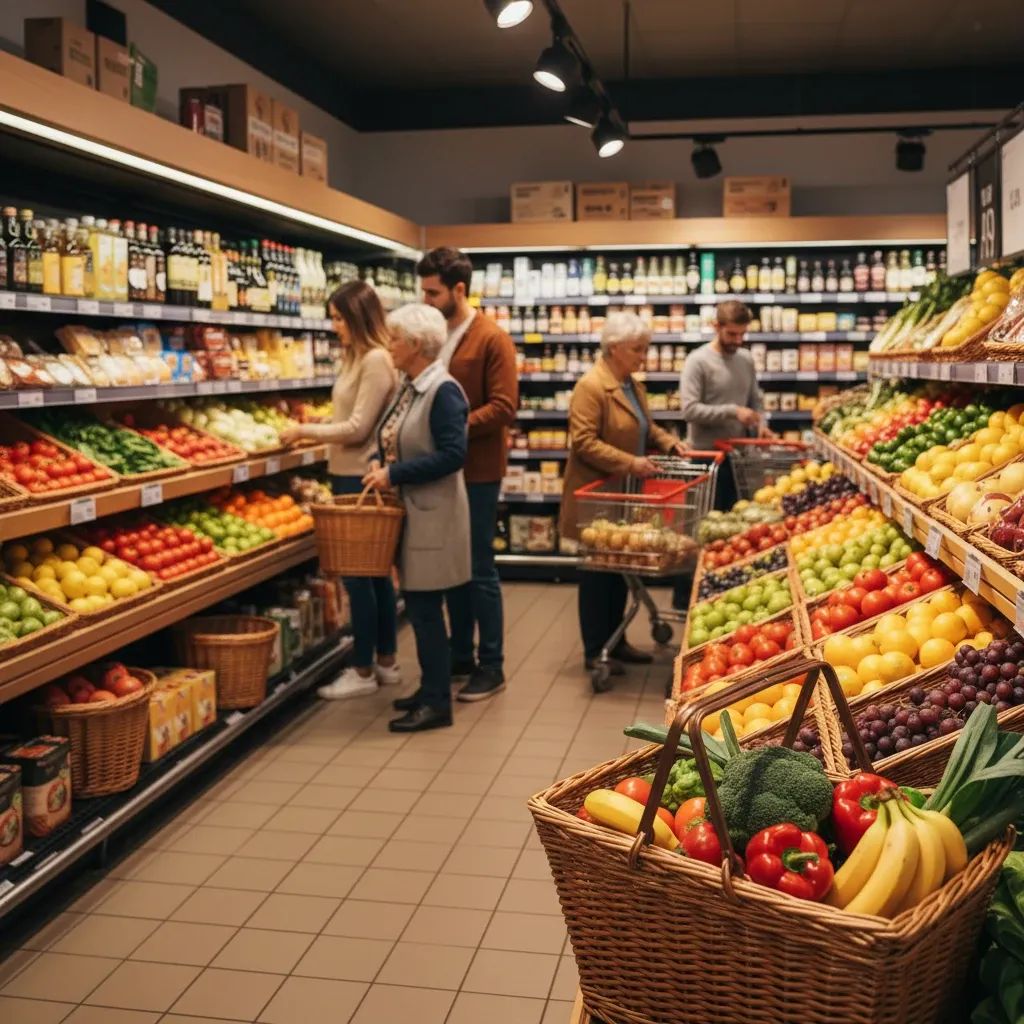
Rather than making large, infrequent stock-up trips, families are now opting for more frequent but smaller baskets. Trip frequency fell 2.1%, but the average basket size grew 1.5%, signaling a rationalization of shopping logistics. Purchases have become more immediate and need-driven, discouraging pantry stockpiling.
This shift has several implications. First, it favors trusted brands over experimentation: when the shopping trip is quick and unplanned, consumers lean on familiar names as anchors of reliability. Second, it drives traffic toward hypermarkets (favored by 80% of shoppers) and increasingly toward online platforms. In 2026, 38% of Portuguese consumers buy groceries online at least once a week, nearly double the 24% recorded in 2025.
Third, it accelerates the adoption of cost-saving tactics: 86% of shoppers are buying more private-label products, 80% are hunting promotions or family-size packs, 64% make smaller, more frequent purchases, and 54% buy in bulk when possible to reduce per-unit cost.
What This Means for Residents and Expats
For anyone living in Portugal—whether long-term resident, recent transplant, or digital nomad—the grocery inflation story translates into concrete lifestyle adjustments. Budget planning must account for food costs that are not only high but structurally volatile. Meal planning and strategic shopping are no longer optional; they are financial necessities.
Expats accustomed to lower food costs relative to income in other European markets may find the proportion of take-home pay dedicated to groceries surprising. While Portugal's overall cost of living remains attractive in areas like rent (outside Lisbon and Porto), the food basket punches above its weight class, especially compared to Spain or the Netherlands, where purchasing power stretches further.
Practical steps to mitigate impact include leveraging private-label brands, timing trips around weekly promotions, and considering online platforms that enable price comparisons across multiple chains. The rise of discount formats and bulk-buying options also merits attention for households managing tight margins.
Policy Responses and the European Context
The Portugal Cabinet has deployed several fiscal and regulatory tools to ease the burden. These include a reduction in VAT on essential food items, agreements with production and distribution sectors to stabilize prices, and targeted income supports—such as enhanced meal allowances for public-sector workers and monthly subsidies of €30 per vulnerable household plus €15 per child. Extraordinary aid has also been extended to housing (rent and mortgage relief) and transport sectors, with Social Security contribution deferrals for transport companies.
Portugal's approach mirrors strategies seen elsewhere in Europe. Spain cut VAT on food, France brokered basket-price deals with supermarket chains, Greece capped retailer margins, and Bulgaria and Croatia imposed outright price controls on staples—though the latter measures risk supply disruptions. Portugal has so far avoided hard price caps, opting instead for negotiated agreements and targeted tax relief.
Notably, Portugal leads Europe in the implementation of healthy eating policies, including product reformulation, advertising restrictions targeting children, and pricing rules in public spaces. Yet these long-term public-health measures do not address the immediate affordability crisis.
Scanning Ahead
The convergence of wage stagnation and structural food inflation has reset the terms of household consumption in Portugal. Even as headline inflation moderates, the cumulative effect of years of price gains continues to compress disposable income. The shift toward smaller, more deliberate shopping trips reflects a population adapting to a new normal—one where every euro counts and brand loyalty becomes a function of trust under pressure.
For policymakers, the challenge is twofold: maintaining fiscal support without distorting markets, and addressing the root causes of Portugal's above-average food cost burden within the eurozone. For households, the path forward involves a mix of savvy shopping, digital tools, and a clear-eyed acceptance that the grocery bill is no longer a background expense—it is a central pillar of financial planning.